Warda's Son: I Don't Like Baligh Hamdi But He Was the Most Influential in Her Career
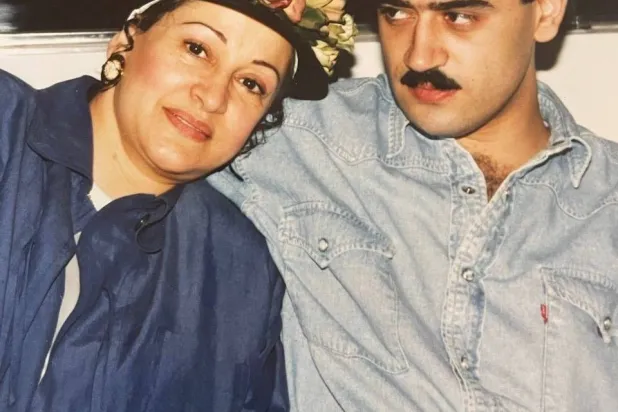
في ذكرى ميلادها، كشف نجل الفنانة الراحلة وردة عن تفاصيل كتابه الجديد الذي يروي ذكرياته معها وتحدياتها الصحية، متحدثاً عن كواليس حياتها الفنية وأبرز الشخصيات التي عاصرتها.
Riad Kacimi, son of the late singer Warda (July 22, 1939 – May 17, 2012), spoke on the occasion of the 87th anniversary of her birth about the behind-the-scenes of his book "The Voice, Blood, and Life," which included several personal details he experienced with his mother, explaining that the book is his first literary publication, and he tried to express in detail his closeness to his mother. He also discussed in his interview with Asharq Al-Awsat via a phone interview his relationship with the late Egyptian composer Baligh Hamdi, who married his mother when he was six years old.
Riad Kacimi, who resides in Algeria, pointed out that his book "The Voice, Blood, and Life" deals with his life with his mother from different perspectives and her challenges with illness, stressing that he had thought about writing it for 10 years, but his respect for literature and his doubt about his writing abilities made him take his time. He added that he was looking for a pen to write the book, but narrating highly private details about a person he does not know is not good, so his wife and friends encouraged him, and he began writing sentences and ideas, and the matter developed into paragraphs and chapters until he reached the end of the book.
Cover of the new book by Warda's son (Asharq Al-Awsat)
Regarding the reason for writing the book in French, he said that his weakness in Arabic led him to write it in French, explaining that it will be translated into Arabic by a publishing house in Lebanon and distributed throughout the Arab world.
Riad Kacimi stressed that the content of the book is not a biography of Warda's life, but rather memories of a son, things he saw and witnessed, characters he met, places they went together, stories from family members in childhood, and things about roots.
Riad Kacimi revealed that Warda's life was clear, so he had no taboos in narrating details while writing, but he kept some private matters and family secrets, as not everything that happened is told, and his criterion was always: "Would my mother be satisfied with what I narrate or not?" Therefore, he sat for a long time to be sure of what he would write and make public.
Regarding the most prominent figures he talked about in his book, Riad Kacimi said that being with his mother made him meet many political and artistic figures, and due to her work, he met many composers, including Mohamed Abdel Wahab, and Baligh Hamdi and his marital relationship with my mother. He also touched on her relationship with artist Nabila Ebeid and her honesty and loyalty to my mother, "It is a rare relationship in the artistic field."
Warda's son says he is proud of her career (Asharq Al-Awsat)
He denied the existence of a current series or film project about her life: "Egyptian producer Mohsen Gaber, who owns the rights to all of my mother's songs, would certainly be aware, as it is impossible to present any work without referring to him for approval to use Warda's songs."
Riad Kacimi added: "I am not against any artistic work about Warda's biography, but it must be presented with international standards in terms of production, direction, and script, and I lean towards presenting her in a film, as series are usually unnecessarily stretched and prolonged."
Kacimi stressed that he is satisfied with everything his mother did in her life: "I am proud of all her decisions, she took responsibility and was right, so I have no objection to narrating everything that happened in her life," noting that "adapting her biography from his book is up to filmmakers."
Warda with her son and grandson (Asharq Al-Awsat)
Riad Kacimi mentioned that he is happy with the celebration of his mother at several artistic events such as the Cairo Opera House and the Algerian Opera, and honoring her in Saudi Arabia and other Arab countries, but he considers that the audience's interaction with her songs is the most important honor. He added: "My mother left a tremendous artistic legacy and many masterpieces that are still repeated, extending to the new generation of audiences and singers."
When asked about the most important and most influential musician in Warda's life, Kacimi chose Baligh Hamdi, considering him "the most in terms of quantity, quality, period, and achievements," adding: "Baligh was creative and provided many timeless melodies and was an exclusive source of creativity for her, but at the same time, the imprint of Mohamed Abdel Wahab in her career cannot be denied."
The son of the late artist affirmed that he was the source of the talk that used to circulate about the tense relationship between him and Baligh Hamdi during his marriage to his mother, reaching the point of not accepting him, and perhaps hating him. He added: "I said that publicly and will keep repeating it clearly, away from Baligh the composer. I was a 6-year-old child and saw my mother separate from my father and marry another man, so I did not like him no matter what."
Baligh and Warda: a love story that lasted 7 years (from the book "The Story of Warda")
Riad Kacimi continues: "I will use what my mother said about Baligh in a media appearance where she described him as a husband being 'bohemian' and not serious about marriage and stability, which contributed to my not liking him, but I do not deny his genius as a composer, and the only one comparable to Abdel Wahab in my view. I even noted in my book that they both created over a very long period without fading, unlike some composers, but his genius has not and will not prevent my personal feeling towards him," stressing that "their separation occurred when he was 13 years old, and he had no role in the divorce."
During her long artistic career, Warda the Algerian, who passed away 14 years ago, collaborated with a prominent number of composers and presented many romantic and patriotic songs, including "Hikayati Ma' al-Zaman," "Al-Oyoun al-Soud," "Betounes Beek," "Haramt Ahebbek," "Lawla al-Malama," "Ana ala al-Rababa Baghani." She also starred in films such as "Alamaz wa Abdo al-Hamouli" with Adel Mamoun, "Amira al-Arab," "Hikayati Ma' al-Zaman," "Ah ya Leil ya Zaman" with Rushdi Abaza, and "Sout al-Hob" with Hassan Youssef. She also participated in television drama with the series "Awraq al-Ward" and "Ann al-Awan."
Original source: Asharq Al-Awsat


Comments (0)
Be the first to comment.