Al-Suwayyan: Yemen is not the origin of Arabs as commonly rumored
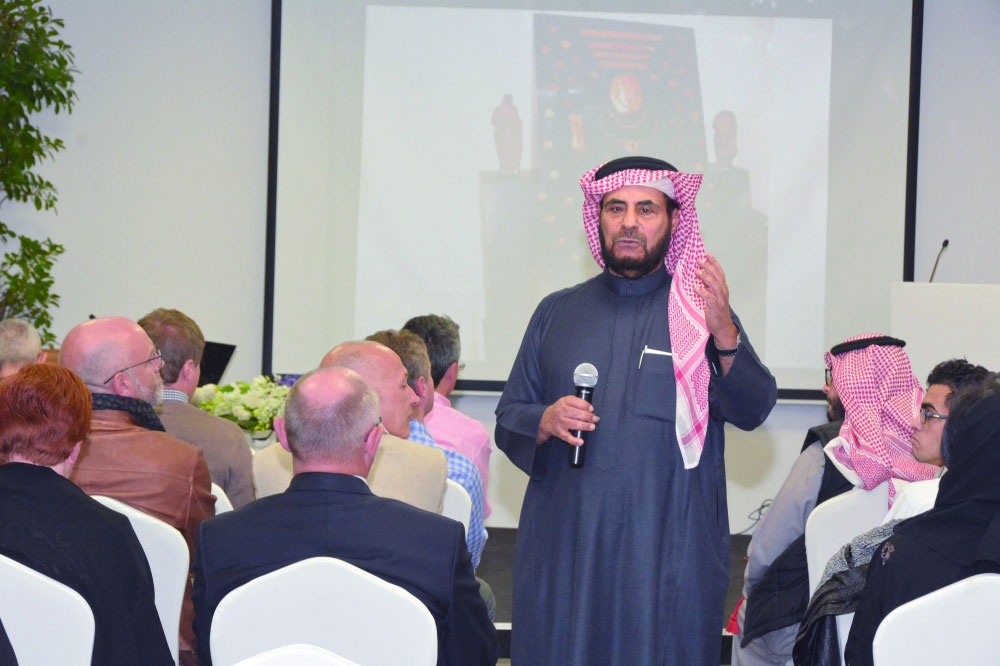
Professor of Sociology at King Saud University Dr. Saad Al-Suwayyan explained that Arabic writing became active after the emergence of Islam, and there were simple inscriptions and writings in Arabic, but writing only became active with Islam. He stressed that Yemen is not the origin of the Arabs as commonly rumored, but the entire Arabian Peninsula from north to south is the homeland of the Semitic race from which the Arabs branched.
Al-Suwayyan added during the cultural evening organized by the Faisal Institute for Human Resources Development and Training, affiliated with the King Faisal Center for Research and Islamic Studies, titled 'Human Activities in the Arabian Peninsula through History and Local Saudi Culture,' that the Arabian Peninsula represented a crossroads between ancient civilizations such as Egypt and Mesopotamia, and that two million years ago it was lush green and inhabited. He called for the necessity of documenting the history and civilization of the Kingdom and the Arabian Peninsula, stressing that the Kingdom urgently needs to support this direction by incorporating it into educational curricula. He urged the Ministry of Culture and Information, the Saudi Commission for Tourism and National Heritage, and relevant authorities to play a major role in raising the level of citizen culture and paying attention to documenting the Kingdom's heritage and antiquities.
Al-Suwayyan added: The peninsula is the original homeland of the Semites, who are the basis of the Arabic language, and the desert culture is an important key to understanding ancient Hebrew culture and the cultural milieu in which the Old Testament emerged.
On the other hand, Professor of Archeology at King Saud University Dr. Sulaiman Al-Dheeb affirmed that the inhabitants and tribes of the Arabian Peninsula have a long history during which they achieved many accomplishments, and that the Arabian Peninsula was not like it is now in ancient times. He cited the recent discovery by a British scientific team, in cooperation with Saudi scientists, of a lake in the Empty Quarter, indicating that the Arabian Peninsula was different from the present.
Al-Dheeb added during the evening: Survey studies began in the Kingdom 35 years ago and revealed dense human presence in the peninsula, but climate change and water scarcity drove the population to migrate. The first migration was to Iraq, where they established the first kingdoms, while the second migration was to the Assyrians and Nabataeans, and the Akkadians migrated to the east and center of the peninsula. Then the advent of Islam restored the status and weight of the Arabian Peninsula. He pointed to the existence of thousands of sites in the Kingdom from the Stone Age, which was followed by the beginning of the era of history and writing. He confirmed that the existence of Sabaean, Nabataean, Thamudic, and Aramaic languages is one of the achievements of the Arabian Peninsula, and that many kingdoms were established in the center and north of the Kingdom, including Sheba, Ma'in, Hadramawt, and Midian, and that the Kingdom of Dedan is one of the oldest kingdoms in the Arabian Peninsula, as well as Tayma, which became famous in 600 BC.
Al-Dheeb continued: Archaeology in Saudi Arabia began during the reign of King Faisal, as Orientalists started studying Arab history in the peninsula at the beginning of the 20th century through two French scholars who came to the region and wrote five volumes about their journey from Palestine to the city of Al-Hijr in Mada'in Saleh at present. Then missions followed: a Dutch mission came to the Eastern Province, a British team studied the north and northwest of the Kingdom, and an American team wrote about some areas during the reign of King Faisal.
From Al-Suwayyan's paper: • There are no major differences between the Arabs of the peninsula and, for example, Egypt, Iraq, or the Levant. • The peninsula was full of arts and music. • Arab life in ancient times abounded with many celebrations, artistic aspects, and singing. • The peninsula is the original homeland of the Semites, who are the basis of the Arabic language. • Writing in Arabic began after the emergence of Islam. • The Arabic language in general changes over time and place, becoming dialects and daily languages different from the mother tongue. • Oral culture changes over time, but the written language is the basis and is stable.
Original source: Makkah





Comments (0)
Be the first to comment.