Al-Warari Probes Manifestations of Autobiography in Arabic Poetry
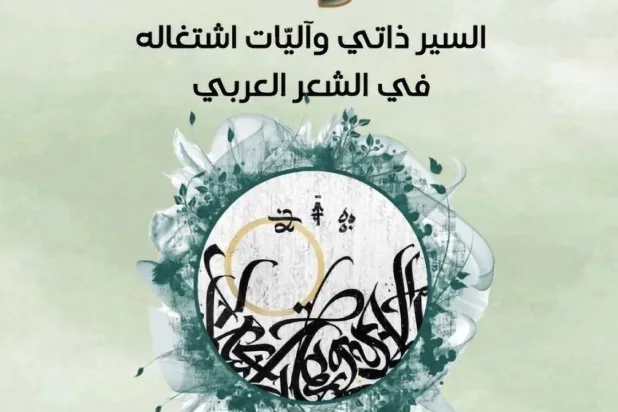
Published recently by 'World of Modern Books' in Jordan, a new critical book by Moroccan critic Abdel Latif Al-Warari.
The novel 'My Secret Funeral Songs' by Egyptian novelist Nisma Ouda is built from start to finish on the technique of letters, but letters from one side—from the mother 'Amina' to her daughter 'Aisha', whom her father took with him on his travels many years ago, and whom the mother has not seen since her childhood. Letters more like diaries, in which the mother tells her daughter the story of her life, the cruelty she suffered from childhood, and the reason she gave her up to the father, denying the charge of 'madness' that everyone leveled at her. Throughout the novel, we do not hear the daughter's voice, who is uninterested in her mother's electronic messages, and through this biography we see the deeper sites of societal madness.
The body of the novel, published in Cairo by 'Al-Moharer Publishing House', is the mother's memories and pains. Through WhatsApp messages, she tells her absent daughter the story of her life and that of an entire society. She tells her about her symbolic deaths since her childhood in the 1970s and 1980s, through her adolescence, and her forced marriage to a man decades older, who married her only because she resembled the mistress of his youth and adolescence, with whom he had a physical relationship long before Amina's birth. That mistress was none other than Amina's own mother, but they could not marry at the time, so he traveled for many years. When he returned, his old lover was married and had a child, so he used his wealth and influence to marry the daughter. Thus Amina was merely a double for her mother, upon whom he projected his anger and revenge.
With great delicacy and a painful, sharp language, the novel presents many intertwined dramatic paths and lines, narrated by the protagonist narrator 'Amina', deconstructing much of the unspoken social reality. The social, political, ethical, and religious are intertwined, and with artistic boldness it exposes the social structure, the psychology of poverty, and the cycles of oppression that swallow everyone, as well as the collective collusion that allows a girl to marry her mother's old lover, with everyone's complicity despite their knowledge of the past and the husband's intentions, under the rule that 'what is forbidden does not make the permissible forbidden'.
Contrary to common belief, masculinity and domination over women do not come solely from men. Although such domination is present, the novel reveals a more brutal domination exercised by women over the protagonist, especially the grandmothers, who control the destinies of their children and grandchildren. The grandmother represses her six daughters and her son, the protagonist's father, who appears as a faint, weak shadow before his mother, who controls everything—a clear representation and revival of matriarchy. This same control was also exercised by the grandmother of 'Deheiba', Amina's only and close friend, who is more daring and rebellious. The physical and psychological abuse this other grandmother inflicted on her granddaughter was more severe and physically harmful than the physical assault by her uncle 'Aziz', the addict. Meanwhile, the father also appeared absent, with no real presence.
The narrator sometimes interrupts the flow of the narrative, providing insightful analytical glimpses into the behaviors of the characters in her world, in line with the logic of writing memoirs or letters. Explaining why women are cruel and dominating toward one another, she says: 'No one sympathizes with women, not even women, as if they do not want the circle of pain to stop, so they do not feel the wretchedness of their fates. In collective suffering there is solace; in individual salvation there is betrayal.'
The novel reveals the absence of the father in impoverished communities and the transfer of power inside homes to the eldest women. In her childhood, Amina imagined that her father could grow wings and fly—it is the imagined superman image every girl has of her father. But gradually his weakness and subjugation before his mother, his boss at work, his wife, his daughter, and the entire world become apparent. He ends up being seen in an exceptional, cleverly grotesque scene where he shrinks and diminishes, stunningly depicted aesthetically. She says: 'At that moment, my already shrunken father melted, melted until he became the size of a small blue marble. He rolled to the door of the apartment, then jumped down the stairs. He flew upward a little.'
Alongside the lives of the two heroines, Amina and her friend Deheiba, and each's suffering with her family, the novel presents a representation of the political, social, and economic life in Egypt. These conditions seem ever-present in the background, clearly and tangibly affecting the lives of the characters. It also paints a narrative picture of the nature of life in working-class and semi-slum areas on the outskirts of Cairo, where people displaced from distant provinces reside, such as Deheiba's family, which originates from Nubia. The displaced bring their rural value systems and implant them in the heart of the city, with the dominance of rural customs and traditions over the place that is supposed to be a space for openness and liberation.
The protagonist narrator, who was fond of drawing and the arts in general in her youth, blends her biography with famous songs from different eras, beginning each chapter with an excerpt from a song. These songs she later recalls during her psychological treatment, telling her doctor that each song accompanied one of her previous deaths—her symbolic deaths. In addition to songs, there is a strong presence of films, with three films standing out: 'Ice Cream in Gleem'—the first film she watched in a cinema with her friend Deheiba after they skipped school that day, challenging the grandmothers' notion of a girl going to the cinema. The second is 'The Dreams of Hind and Camellia', which was like a dream for her; she wanted to embody it and run away with Deheiba and live together, along with her daughter Aisha later. The third is 'Dinner Date', in which she wished to take revenge on her husband, just as the protagonist Suad Hosni did with her husband.
Art, singing, and companionship were Amina's world. But her forced marriage to a man belonging to political Islam, and her giving up her daughter to him—where she only sees her on screen hosting a program on a religious channel owned by her father and his group, during the rise of the Muslim Brotherhood after January 2011—she sees her daughter attacking the creed and religion of all who disagree with her. The mother grieves twice: first for the loss of her own life and the way those around her treat her as 'mad', and second for what has become of her daughter. Both have become distorted, like all the characters in this fictional world, transformed into monsters: 'Violence, Aisha, is what creates deformed, submissive, and trembling characters who never have the right to refuse.'
Original source: Asharq Al-Awsat

Comments (0)
Be the first to comment.