‘Why Are You Sitting at the Back?’... The Question That Changed Women’s Status - Huthami Mahjoub

Some phrases are no more than a few words, but they encapsulate an entire vision and project.
Phrases that over time become the headline of a new history.
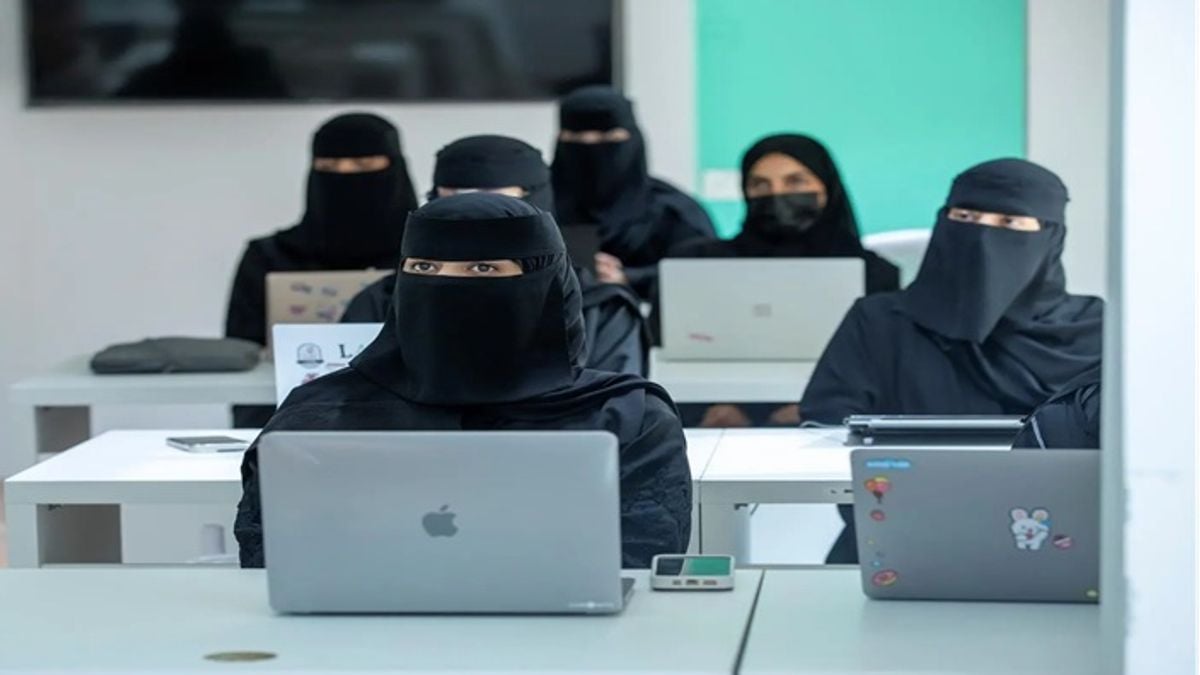
Among these phrases stands out a question raised by His Royal Highness the Saudi Crown Prince Mohammed bin Salman, as recounted by Princess Reema bint Bandar bin Sultan, the Kingdom’s ambassador to the United States, in her interview on the program ‘Wa’ad’ on MBC, when he noticed that women were always sitting in the back rows during one of the meetings, and turned to them asking in astonishment: ‘Why are you sitting at the back?’
The question was not about seating arrangements or sitting protocol, but rather a question about women’s status in an entire national project.
A leader’s question that shook a mental image entrenched for decades, declaring that the era of women being relegated to the back has ended, and that their natural place is where decisions are made and the future is shaped.
Perhaps this explains the widespread circulation of that clip on social media platforms; people did not dwell on the words so much as they reflected on their symbolism.
The scene embodied a moment of transition from a culture accustomed to seeing women in the back rows to a new vision that considers competence alone as the criterion for progress, and sees women as genuine partners in development and decision-making.
Princess Reema’s account gains deeper dimension when she clarified that no one had asked the women to sit at the back; rather, it stemmed from an internal conviction formed over many years.
And here lies the most important message: major challenges are not always in the constraints imposed by society, but sometimes in the boundaries that one draws for oneself without realizing.
How many doors were open, but hesitation prevented their owner from crossing through.
Although that interview aired some time ago, the clip in which Princess Reema recounted the Crown Prince’s question ‘Why are you sitting at the back?’ remains strongly present on social media, with users constantly sharing and reposting it, indicating that some words do not end with the occasion in which they were spoken, but become an enduring message that encapsulates the spirit of an entire era.
And this is the essence of the transformation carried by the Kingdom’s Vision 2030.
Empowerment is not limited to issuing regulations or expanding opportunities; it begins with reshaping societal culture and entrenching the conviction that women are not a supplementary element in the development march, but one of its fundamental pillars.
Decisions may open doors, but changing mindsets is what makes everyone walk through them confidently.
In just a few years, the presence of Saudi women is no longer an exception or a notable event; it has become a natural part of the national landscape. Today, she leads institutions, manages companies, represents her country in international forums, and participates in the economy, environment, diplomacy, culture, technology, space, sports, construction... and other sectors that bear witness to the scale of the transformation the Kingdom is experiencing today.
This is not merely a social gain, but a strategic choice.
Countries aspiring to a competitive economy and a prosperous future cannot afford to disable half of their human potential.
Hence, women’s empowerment came within a broader vision that invests in human beings, liberates their capabilities, and considers that true development is only complete with everyone’s participation.
But the greatest achievement is not measured by the number of positions women hold, but by the change in society’s view of them.
There is a big difference between giving women an opportunity and seeing them as having a natural right to leadership and decision-making.
True empowerment begins when her presence in the front row becomes a matter of course, requiring no explanation or justification.
That is why the Crown Prince’s question transcended the occasion in which it was asked, becoming a clear and sincere call to reconsider many inherited ideas. Societies do not change by laws alone; they change when the mental images that define individuals’ roles and positions are transformed.
The greatest transformations are those that begin in minds before they appear in reality.
The experience of Saudi women in recent years provides a clear pioneering model showing that social reform requires bold political vision and a societal will that believes in change. The journey was not merely women’s transition to new positions, but the transition of society itself to a new understanding of her role, as a full partner in building the nation and shaping its future.
Saudi News
Perhaps the most beautiful thing about this story is that it began with a fleeting question inside a closed room, and ended with a message that transcends the boundaries of place and time.
The front row is not just a chair or an advanced seat; it is a symbol of status, confidence, responsibility, and recognition of capability.
When His Royal Highness Prince Mohammed bin Salman asked, ‘Why are you sitting at the back!?’, he was not merely inviting women to change their seats, but calling on the entire society to redefine women’s status in the Saudi national consciousness.
With this question, His Highness encapsulated a complete journey: the journey of Saudi women from demanding the right to be present to exercising their full role in action, influence, and leadership. The future, as Vision 2030 believes, is not built with half of society, nor does it rise with partial participation; it flourishes when the efforts of all its sons and daughters are integrated.
That is why that clip and those words will remain more than just a fleeting civilizational moment; they summarize the philosophy of an entire era: that Saudi women no longer stand behind the scene, but have become its heart... where achievements are made and future chapters are written.
Original source: Al-Jazirah



Comments (0)
Be the first to comment.