From Sculpture to Landmark: Jeddah's Story Between Planning, Art, Memory and History
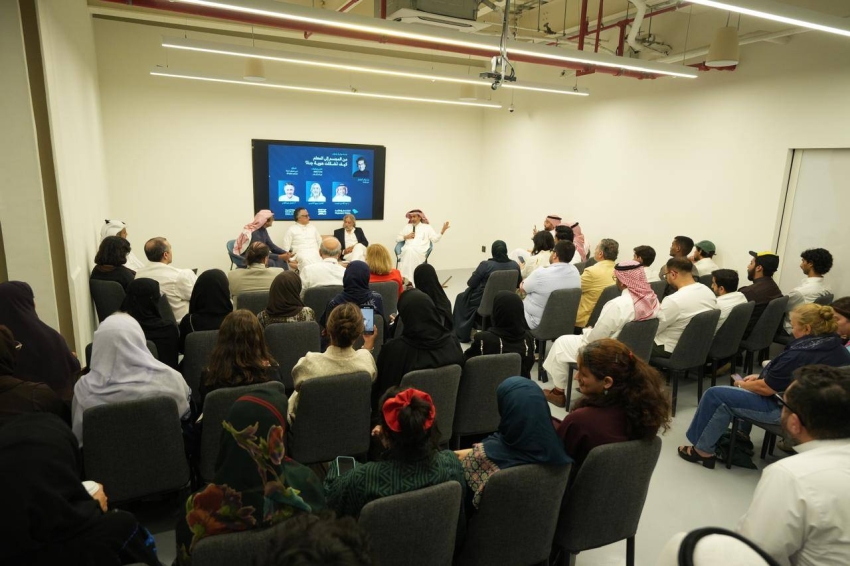
A dialogue session titled: "From Sculpture to Landmark: Jeddah's Story" was held in Hayy Jameel, organized by the Botaq Center for Urban Research and Studies in collaboration with the Majsamin Watan initiative, with participation from Dr. Abdullah bin J...
In Hayy Jameel, the Botaq Center for Urban Research and Studies, in collaboration with the Majsamin Watan initiative, organized a dialogue session titled 'From Sculpture to Landmark: Jeddah's Story,' with participation from Dr. Abdullah bin Junaidab, artist and sculptor Rabee Al-Akhras, and writer and media consultant Kamal Abdelqader, moderated by architect and engineer Nawaf Al-Nassar, in a journey that combined planning, art, memory, and history.
This session comes within the framework of increasing efforts to document the urban and artistic memory of the city of Jeddah, which has witnessed major transformations over recent decades.
Dr. Abdullah bin Junaidab presented a calm and profound vision of the city from the perspective of an architect and urban planner, speaking about the spontaneous growth and development of cities, and the importance of planning in shaping the identity of a place and sustaining its character. He drew on examples from major urban projects, emphasizing that the success of cities is measured not only by the scale of their projects but also by their ability to preserve their distinctive spirit.
As for artist Rabee Al-Akhras, he chose a different language: the language of image, memory, and emotion. The man whose works contributed to shaping Jeddah's visual landscape did not consider sculptures mere works of art, but rather saw them as part of people's daily memory. He revisited stories of the squares and sculptures that accompanied the city's transformations, summarizing his relationship with Jeddah in a simple and sincere phrase that resonated widely: 'Jeddah is lovable.' That short sentence was more eloquent than many analyses, because it expressed the emotional bond between a person and a city when it becomes part of their life and memories.
On the other hand, Kamal Abdelqader took the audience through pages of Jeddah's modern history, recalling his long experience with His Excellency Engineer Dr. Muhammad Saeed Farsi, former Mayor of Jeddah and the man behind the urban project that changed the face of the city. He recounted stories about an era that viewed art and beauty as an essential part of development, not a luxury to be added. He spoke about how Jeddah turned into an open museum hosting works by artists from around the world, becoming one of the cities most associated with public art in the region. But what made the session most distinctive was not the variety of topics, but the variety of angles from which the guests looked at the city. The architect read the place, the sculptor evoked visual memory, and the media figure told the story. Between these three angles, a more complete picture of Jeddah emerged. Despite differing viewpoints, everyone ended up with the same conclusion: 'Jeddah cannot be summed up in a single narrative.' Rather, it is a city formed by the overlap of cultures, the movement of the sea, the stories of those who came to it, the arts that inhabited its streets, and the diversity that has remained an integral part of its character over the decades. Perhaps this very diversity is the secret that gave Jeddah its uniqueness and made it a city capable of renewing itself without losing its identity.
The session reflects the diversity of visions regarding Jeddah's identity, where urban planning intersects with art and popular memory. It highlights the importance of dialogue among specialists to bring out the city's historical depth. It can be said that the continuation of such discussions contributes to raising awareness about the importance of preserving Jeddah's unique character amid rapid urban developments.
Original source: Al-Madina
Comments (0)
Be the first to comment.