Saudi Diplomacy: From Founding Wisdom to Leading Influence

The Middle East has not seen this degree of entanglement between crises and regional tensions for decades. History has proven that international crises are not exceptions in relations between states, but rather part of the nature of the international system, which is based on overlapping interests, competition of powers, and differing visions. Hence the importance of diplomacy as the most effective tool in containing conflicts, de-escalating tensions, building trust, and transforming conflict from the battlefield to the negotiating table arises. The more complex the crises, the greater the need for a diplomacy that possesses wisdom and the ability to combine steadfastness in principles with flexibility in managing differences.
Abdulrahman Al-Judai
Saudi Diplomacy: From Founding Wisdom to Leading Influence
This report was published on July 24, 2026, and last updated on the same date.
This perspective comes at a time when the regional landscape is marked by unprecedented complexities, forcing states to reassess their diplomatic tools.
Follow Okaz channel on WhatsApp
The Middle East is now witnessing an unprecedented entanglement of crises and regional tensions not seen in decades.
History has proven that international crises are not exceptions in relations between states, but rather part of the nature of the international system, which is based on overlapping interests, competition of powers, and differing visions. Hence the importance of diplomacy as the most effective tool in containing conflicts, de-escalating tensions, building trust, and transforming conflict from the battlefield to the negotiating table arises. The more complex the crises, the greater the need for a diplomacy that possesses wisdom and the ability to combine steadfastness in principles with flexibility in managing differences. Therefore, diplomacy in the 21st century has become one of the most important elements of comprehensive national power, no less impactful than military or economic strength in shaping the balance of influence.
The Middle East is the clearest model of this reality, as it is one of the world's most conflict-ridden regions subject to external interventions, making it an arena for competition between regional and international wills, casting shadows on the security, stability, and development paths of its peoples.
Amid this complex environment, Saudi Arabia has managed to establish its own diplomatic school, based on moderation, independence of decision-making, political realism, respect for state sovereignty, and a belief that dialogue is the least costly and most sustainable path to resolving crises, thus enhancing its position as a regional power capable of balancing conflicting interests without slipping into polarization.
This approach is not a recent product, but an extension of a firmly established policy since the era of founding King Abdulaziz bin Abdulrahman Al Saud, who succeeded in building a modern state amid major international transformations, while ensuring it avoided entanglement in great power conflicts, preserving the independence of its political decision in a period that witnessed two world wars and the collapse of empires that redrew the world map.
The Kingdom's stance during the October 1973 war was a pivotal moment in the history of international relations, when it used oil as a means of political pressure in support of Arab rights, a step that proved that influence in the balance of power is not limited to military strength but extends to the effective utilization of national power elements in service of political objectives, affirming that diplomacy is inseparable from economic power tools. This represented an early model of employing comprehensive national power tools in service of foreign policy, a concept that later became a main pillar in modern strategic studies.
The Kingdom also demonstrated its commitment to the principles of international legitimacy during the 1990 Kuwait occupation crisis, when it stood with right against aggression, dedicating its political and military capabilities within an international framework to restore Kuwait's sovereignty. Conversely, it declared its rejection of the 2003 Iraq occupation, based on its conviction that respect for state sovereignty and territorial integrity is the foundation for regional stability.
Saudi diplomacy was not limited to managing crises as they occurred, but sought to address their causes through political initiatives. The Arab Peace Initiative launched by the Kingdom in 2002 remains one of the most comprehensive and realistic initiatives to address the Palestinian issue, presenting an integrated vision for a just peace based on ending the occupation and establishing an independent Palestinian state in exchange for comprehensive peace in the region. Despite its stalled implementation, this initiative remains the most clear Arab reference for a political settlement.
With the accelerating changes in the international environment, the ability of states to build partnerships and manage balances has become a key criterion for measuring their influence in the regional and international systems. Today, Saudi diplomacy appears more present and influential than ever. The Kingdom has adopted a policy based on de-escalation, expanding spaces for dialogue, and openness to various parties, driven by the conviction that regional stability is not achieved through polarization but through building understandings and managing differences.
This approach has been reflected in Saudi efforts to enhance dialogue with regional powers, support political solution tracks in several Arab crises, participate in international efforts to stop escalation in the region, along with its role in protecting energy security and stabilizing global markets, and contributing to the security of international navigation—issues that are no longer merely regional but directly impact the global economy. This reflects the broadening of the concept of national security to include energy security, supply chain integrity, and global economic stability as interconnected components of the contemporary international security system.
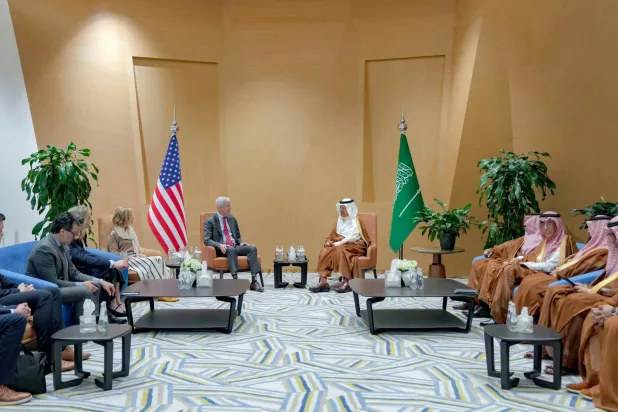
The Kingdom has also strengthened its position as a platform for international dialogue, hosting meetings and consultations between divergent parties, and working to bridge viewpoints on several international issues, benefiting from a large reservoir of international trust and a foreign policy characterized by balance, clarity, and the ability to communicate with various powers without engaging in a policy of axes. Thus, the Kingdom is no longer just a party managing regional crises, but has become a trusted mediator in several issues with international dimensions.
What distinguishes Saudi diplomacy today is not only the extent of its influence, but the nature of this influence. It is a diplomacy based not on escalation but on creating balance, seeking not just to manage differences but to transform them into opportunities for understanding. In a world moving towards multipolarity, with rising security and economic challenges, the need for regional powers capable of building bridges rather than barriers, and producing solutions rather than deepening crises, has grown.
Therefore, the Saudi role in the current phase transcends the limits of protecting national interests to become an active contribution to enhancing regional and international security. The Kingdom, with its political and economic weight, its Arab and Islamic stature, and its young leadership, has succeeded in consolidating its presence on the international stage, becoming a trusted partner in shaping regional and international understandings, and one of the most prominent balancers in the Middle East, reflecting its growing ability to influence strategic issues with global dimensions. In a world where power balances are changing rapidly, wise diplomacy remains the most sustainable investment. The Saudi experience offers a model affirming that true influence is measured not by possessing power tools alone, but by their effective utilization, the ability to build trust, create balances, and transform dialogue into policy, policy into stability, and stability into a more secure and peaceful future. It has managed to combine credibility and effectiveness in crisis management, a formula that has cemented the Kingdom's presence as an influential partner in regional and international stability.
Original source: Okaz




Comments (0)
Be the first to comment.