In the Face of the Houthi Threat... Yemen Shifts from Containment to Confrontation
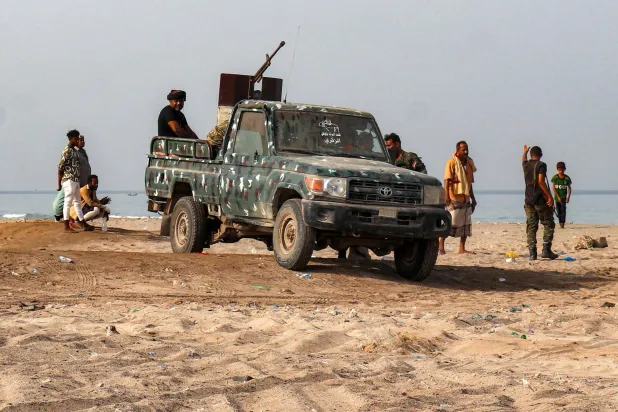
In recent days, the Yemeni legitimate authority has moved from containing the Houthi escalation to confronting and regaining the initiative, through a simultaneous move encompassing the presidency, government, constitutional, military, and security institutions, in response to the group's threats to impose a ban on shipping linked to Saudi Arabia, and the accompanying escalation viewed as an extension of Iran's project in the region.
While the Houthis focused their rhetoric on threatening terrorist attacks and piracy in the Red Sea, the Yemeni leadership sought to shift the battle to a different arena, centered on restoring state institutions, reviving the economy, and mobilizing regional and international support; as ending the coup is the only gateway to ending the threats facing both Yemen and international navigation.
The sequence of official positions, starting from the speech of Presidential Leadership Council Chairman Rashad al-Alimi, through meetings of the National Defense Council and the government, and reaching the positions of the Shura Council and relevant ministries, reflects an attempt to build an integrated political narrative linking the Houthi escalation to the necessity of enabling the state to recover its resources and institutions, rather than merely responding to the group's military threats.
Al-Alimi during his reception of the Indian Ambassador to Yemen (Saba)
Al-Alimi's latest meetings with foreign officials and diplomats included meeting with the Indian Ambassador to Yemen, during which he linked Houthi movements to the security of the Red Sea and the Asian countries connected to this vital maritime corridor, stressing that the group's attempts to drag Yemen into a broader conflict threaten not only Yemen's interior but also extend to global trade security and food and energy supplies.
The Presidential Leadership Council Chairman also stressed the need for the international community to view the Houthis as part of a cross-border network of regional threats, given what he described as increasing coordination with armed groups and terrorist organizations, necessitating enhanced international cooperation to confront these risks.
These Yemeni presidential messages reveal an attempt to expand the framework for dealing with the crisis, so that it is not confined to internal conflict but is directly linked to the security of international navigation, a file that is receiving increasing attention from regional and international powers, especially with the continued tension in the Red Sea.
Domestically, the Yemeni political leadership worked to expand the circle of national alignment; the Shura Council announced its full support for the contents of the Presidential Leadership Council Chairman's speech, considering that restoring state institutions and ending the coup represent the real gateway to achieving peace, and affirming that the Houthis have brought nothing but destruction and division, and that their continued rejection of political initiatives confirms their adherence to the option of war.
The Council also condemned the Houthi group's threats to Saudi Arabia and international navigation, calling on the international community to take a firmer stance towards what it described as Houthi threats to regional and international security, and demanding intensified support for Yemeni state institutions.
Economy at the Heart of the Confrontation
Despite the security nature of the escalation, the Yemeni government pushed the economic file to the forefront of the response, in a step reflecting its realization that the war in recent years is no longer only military but has become a battle over resources and economic sovereignty.
In this context, Prime Minister Shaya' al-Zindani held a meeting of the Supreme Committee for Oil Marketing to follow up on the implementation of the Presidential Leadership Council Chairman's directives to resume oil exports, and to discuss the technical and administrative procedures necessary to restart this sector, which has been halted since the Houthis targeted export ports in October 2022.
Yemeni Prime Minister during his meeting with the Oil Marketing Committee (Saba)
The government affirmed that resuming exports is a sovereign entitlement and a right for Yemenis to benefit from their wealth, stressing that oil revenues will be directed to paying salaries, improving services, and supporting economic stability, in a message aimed at showing the difference between the state project that links resources to serving citizens, and what it describes as the Houthis' use of the economy as a tool for political blackmail.
The committee also discussed the extent of losses incurred by the state as a result of the halt in oil exports, and the consequent decline in the government's ability to meet its obligations, considering that restarting this sector is a national priority to enhance economic recovery and restore public resources.
The transition from political announcement to the start of executive actions gives the impression that the government is trying to turn its rhetoric into practical steps, thereby enhancing its credibility domestically and with regional and international partners.
Raising Comprehensive Readiness
On the security and military level, official messages aligned with the political discourse; Interior Minister Ibrahim Haidan announced that various security units are at the highest level of readiness to carry out their tasks, enhance security in liberated governorates, and confront Houthi-affiliated cells and anything that threatens stability.
The minister affirmed that security agencies will continue implementing their plans to protect society, praising the Presidential Leadership Council Chairman's call to rally around state institutions and the armed forces, and stressing that security is a shared national responsibility.
This stance is an extension of what the National Defense Council and the Ministry of Defense had previously announced regarding raising the level of military readiness, reflecting a trend towards showing that state institutions are moving in a coordinated manner to confront any potential scenarios, whether on military fronts or in cities and liberated areas.
Yemeni Transport Minister Mohsen al-Omari during his inspection tour of institutions in Aden (Saba)
At the same time, the government was keen to send a message of reassurance regarding the continued operation of transport and port institutions; Transport Minister Mohsen al-Omari conducted field tours that included Yemen Airways, Aden Airport, the General Authority of Civil Aviation, and the container terminal at Aden Port.
The visits focused on ensuring the continuity of services, improving operational performance, and enhancing the readiness of ports and the airport, while emphasizing that commercial navigation and supply chains are proceeding stably, despite the repeated Houthi threats to maritime navigation.
Read also
Original source: Asharq Al-Awsat



Comments (0)
Be the first to comment.