Salam Plants Lebanese Flag in Zouqar, Marks State’s Return to the South

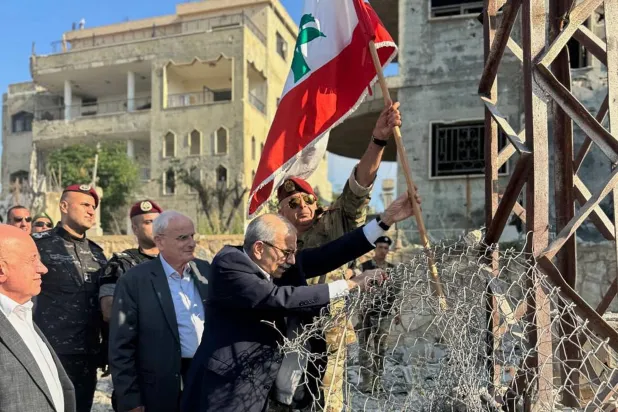
The scene of Prime Minister Nawaf Salam planting the Lebanese flag in the western town of Zouqar was not merely a symbolic gesture; it carried political and national messages reflecting the state’s direction in the current phase toward reasserting its presence in the south, and that it is committed to accompanying their return and rebuilding their areas away from any Iranian control or Israeli occupation.
The south, which in recent years had grown accustomed to the sight of party and Iranian flags, this time witnessed the raising of the Lebanese flag alone, in a message affirming that the state has returned to be present in this region, standing by its people—a stance Salam reiterated more than once, as did President Joseph Aoun, who repeatedly stressed that the Lebanese army and state institutions are the only entities capable of protecting all Lebanese and preserving sovereignty.
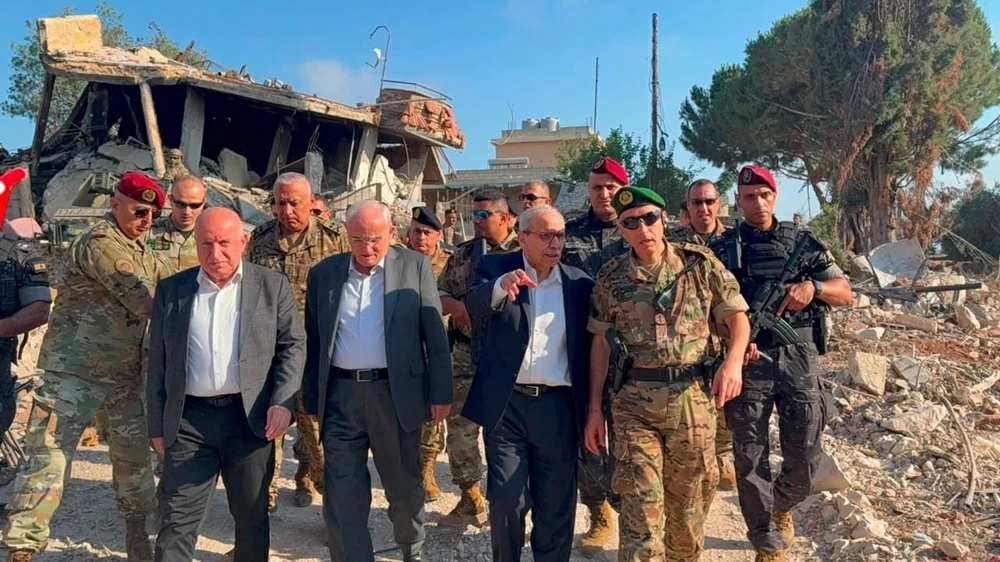
Salam’s visit to the south on Wednesday coincided with the deployment of the Lebanese army in several southern villages, a step seen by many residents as a notable shift after years of limited military presence due to security conditions.
Two Messages to the Lebanese and Southerners
From Zouqar al-Gharbiyeh, Salam delivered two clear messages: the first to all Lebanese, affirming that the Israeli withdrawal that began from some areas is only a start, and that the state’s goal remains achieving a full Israeli withdrawal from all Lebanese territory, stressing that the government will continue to mobilize all political and diplomatic efforts until this objective is completed.
The second message was to the people of the south, where he affirmed that the state has begun marshaling all its resources to accompany their return to their villages, noting that the Lebanese army and security forces are present to protect returning civilians, and that work continues in parallel with the army’s deployment to open roads, clear rubble, and provide basic services, allowing residents to return safely and with dignity.
With the start of the Israeli withdrawal, my words from Zouqar al-Gharbiyeh this morning: I would like to address all Lebanese, especially our people in the south, from the town of Zouqar al-Gharbiyeh. This is a national moment with great political and moral dimensions, because it represents the beginning of the Israeli withdrawal from our land. We have stressed from the beginning... pic.twitter.com/c6OgiDHZ8R
— Nawaf Salam (@nawafsalam) July 22, 2026
Salam also announced that the government has begun preparing for the restoration of basic services—water, electricity, and communications—and is working to secure ready housing and everything needed for the transitional phase, stressing that the return of life to the south is not just a slogan but a national goal the state is committed to achieving, and that the return of residents to their land represents the truest expression of Lebanon’s unity and sovereignty.
This approach aligns with positions previously announced by President Joseph Aoun, who affirmed that the Lebanese army and state institutions are the only entities authorized to protect all Lebanese, and that he will not compromise on the south or Lebanon’s sovereign rights, calling on the people of the south to join the military institution as the guarantor of the country’s unity and security.
A citizen speaks to the Lebanese army in Zouqar al-Gharbiyeh (Reuters)
Al-Sadiq: A True Victory
Salam’s step was welcomed in Lebanon. MP Waddah al-Sadiq said: “The true victory is for the state to plant Lebanon’s flag on land it liberated, after it became free of weapons that brought it to occupation and destruction.” He told Asharq Al-Awsat: “This is proof that there is no solution in Lebanon except through the state. All previous experiences, including the imposition of arms under the slogan of resistance, only led to ruin, destruction, and the occupation of Lebanese territory.” He noted that “the claim that weapons serve as a deterrent has been proven false, after the Israeli army entered Lebanon without any deterrent,” stressing that “the only entity capable of protecting Lebanon is a strong state.”
Al-Sadiq saw the prime minister’s visit to Zouqar and the planting of the Lebanese flag there as “symbolizing the restoration of the state’s strength and executive authority, and that the state is the one that liberates the land.” He added that President Joseph Aoun’s meeting with U.S. President Donald Trump, along with the state’s presence in the south and the emphasis on continuing efforts to liberate all Lebanese territory, confirms that “this is the only path, and everyone must rally behind the state.”
He noted that Lebanon “is now laying the foundation for rebuilding institutions and moving in the right direction despite obstacles and difficulties,” pointing out that the president and prime minister “now have nearly full decision-making authority.”
He concluded: “We are against anyone who harms Lebanon. Israel is an enemy of Lebanon, and Iran is a hostile state after everything it has done in Lebanon.”
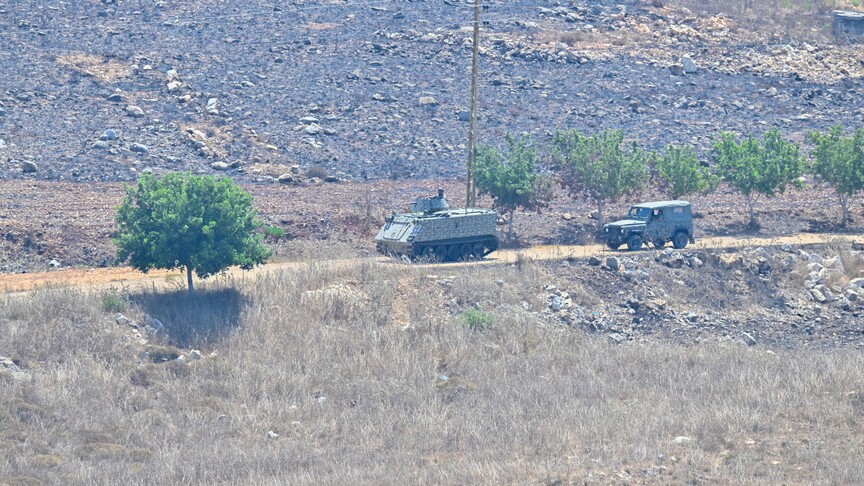
Citizens walk alongside a military vehicle as residents try to enter the village of Zouqar al-Gharbiyeh (Reuters)
Ministerial Activity Toward the South
South Lebanon is witnessing field movements by ministers across various sectors to confirm the return of state institutions to the region. In May, Minister of Social Affairs Haneen al-Sayed toured frontline villages, stressing that the state stands with the people of the south, and that supporting the resilience of residents is no less important than supporting the displaced, because people staying on their land constitutes the first line of defense against displacement projects, and their resilience strengthens the chances of return for those forced to flee, considering that the resilience of the southerners is a national responsibility incumbent on the entire state.
Citizens try to enter the village of Zouqar al-Gharbiyeh as Lebanese army forces deploy in the area following the withdrawal of Israeli forces (Reuters)
In the same context, Minister of Communications Charles al-Hajj visited the south two weeks ago, stressing that the goal of the tour was to consolidate the state’s presence and fulfill its duty to provide basic services, in line with the reconstruction phase and restoring the recovery path for all Lebanon after Israeli aggression. During his presence in the southern capital Sidon, he announced the signing of the Fiber Optic system.
Al-Hajj also explained that the ministry is working to restore the services of the two telecom companies, Alfa and Touch, to their previous levels in the coming days, with further improvements expected in the coming months, stressing that the fiber optic project will not be limited to Sidon but will also extend to the cities of Nabatieh and Tyre, and that continuous work over the past months has allowed the restoration of a large part of the telecommunications services damaged by the Israeli aggression.
Original source: Asharq Al-Awsat


Comments (0)
Be the first to comment.