Armed Mobilizations Revive Fear in Libyan Capital

Security tensions returned to the Libyan capital Tripoli from Tuesday evening until the early hours of Wednesday, with movements and mobilizations of armed factions affiliated with the authorities in the west of the country, in a scene that reminded residents of the armed clashes the city witnessed in recent months.
Thick smoke following recent clashes in Tripoli (AFP)
This militia mobilization came amid the absence of any official comment from the Presidential Council or the interim Government of National Unity clarifying the nature of these movements or their objectives.
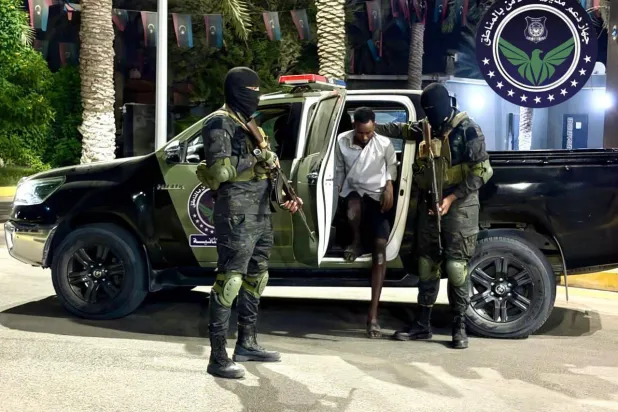
According to local sources and eyewitnesses, as well as video recordings circulated by activists on social media, the military movements were concentrated in the vicinity of the Mansoura area, near the radio building, where vehicles and personnel of the 'Counter-Terrorism Force,' led by Major General Mukhtar al-Jahawi, were deployed. This force is affiliated with the General Staff of the Government of National Unity, alongside patrols from the 222nd Brigade, led by Hussein al-Shawath.
The circulated footage showed a heavy deployment of military vehicles on several main streets, with gunfire heard in some areas, prompting residents to stay home for fear of the situation escalating into armed clashes, especially in the absence of any official clarification regarding the reasons for these movements.
Remnants of Tripoli clashes (AFP)
The National Institution for Human Rights in Libya monitored some of these developments, expressing concern over what it described as 'manifestations of security tension and military mobilizations' and the accompanying random firing of live bullets and gunfire, which it said terrorized civilian residents and turned residential neighborhoods into something resembling battlefields.
The rights organization warned of the risks of the situation sliding into acts of violence that could endanger civilian lives, considering that such practices constitute a violation of the rules of international humanitarian law and may result in legal responsibilities for the parties involved. It also held the parties to the tension fully responsible for any potential escalation, calling on all parties to exercise restraint, refrain from using force, and urgently instruct the competent authorities to contain the situation and prevent any armed clash.
According to observers, this movement reflects the continued fragility of the security situation in western Libya, where the capital still hosts a number of armed formations with divergent loyalties, despite the authorities repeatedly announcing efforts to reorganize the military and security institutions.
Residents of Tripoli fear a return of clashes and the absence of security in the capital (Tripoli Security Directorate)
Meanwhile, mystery surrounds reports of a stalled meeting that was being prepared in the city of Sirte, involving the Deputy General Commander of the 'National Army,' Lieutenant General Saddam Hifter, and the Deputy Minister of Defense of the 'Government of National Unity,' Lieutenant General Abdul Salam al-Zubi, as part of a US-led track to bridge views between the military institutions in the east and west of the country.
Libyan and American authorities have not announced a new date to resume these consultations, and the 'Government of National Unity' and the 'National Army' have remained silent regarding what has been reported about them.
In contrast, the 'National Army' General Staff merely published an activity of the Chief of Staff, Lieutenant General Khaled Haftar, during an inspection tour that included a number of military facilities belonging to the Infantry and Armored Corps, where he stressed the importance of developing training programs and raising officer efficiency in line with modern technical and military requirements, in a step that seemed far from commenting on the news of the postponed meeting or the security developments in Tripoli.
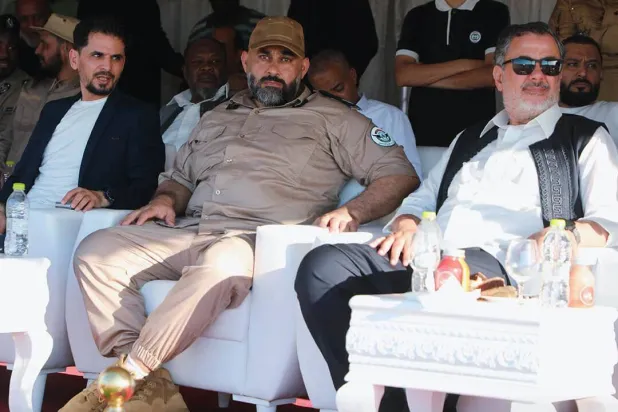
Chief of Staff of the National Army in eastern Libya during his attendance at the conclusion of a training course for military commanders on Wednesday (General Staff)
These developments once again highlight the continued fragility of the security and political scene in Libya, at a time when international efforts continue to push Libyan parties towards a comprehensive political and military settlement, amid fears that any new field escalation could undermine those efforts and return the country to a spiral of armed clashes.
Original source: Asharq Al-Awsat
Comments (0)
Be the first to comment.