"Currents' Conflict" Dominates Libyan State Supreme Council Elections
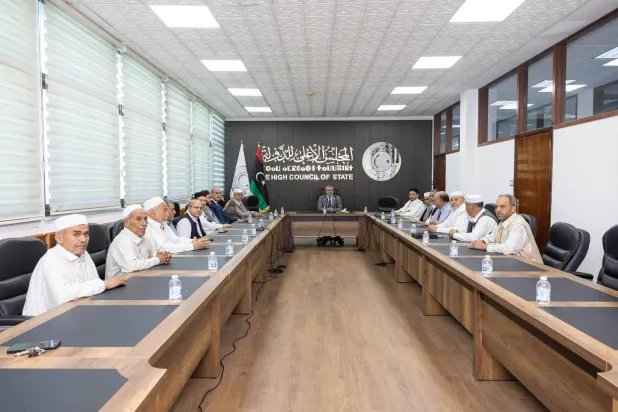
Amid internal divisions, the Libyan State Supreme Council in the capital Tripoli plans to hold elections for its presidency at the end of this month, amid competition and conflict between different currents.
Speculation is mounting over the names that will run in the elections for the presidency of the Libyan State Supreme Council, scheduled for the end of this month, amid widespread anticipation of the nature of the political blocs supporting them.
Observers go beyond traditional competition for a leadership seat in their reading of this annual event, seeing it as a 'pivotal event' that helps calibrate the political compass in a divided country. This event derives its weight from the 'council's broad powers' as an obligatory partner of the House of Representatives in deciding several important issues, including agreement on the electoral laws that Libyans are awaiting; which gives the President of the State Supreme Council and his office influence in steering solution paths and building alliances among conflicting forces.
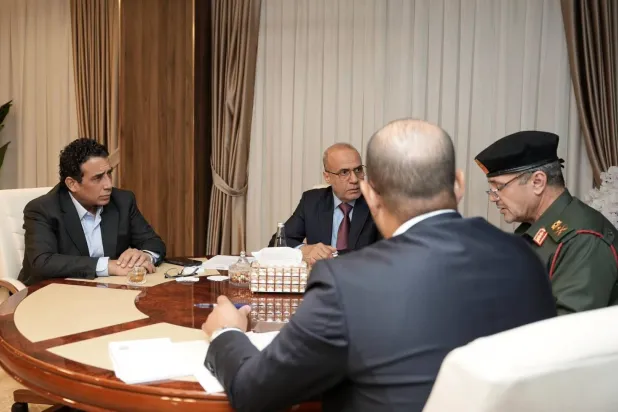
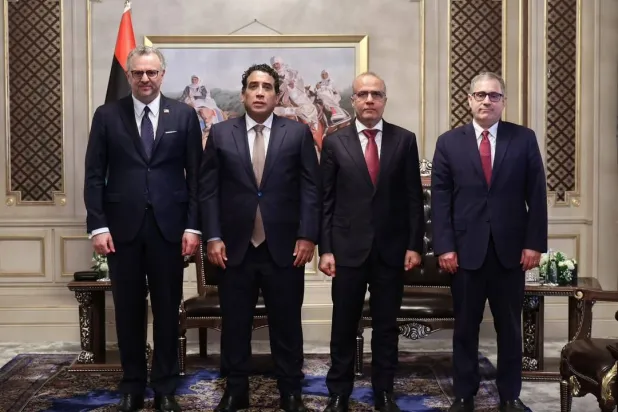
Takala flanked by Al-Manfi (right) and Al-Dabaiba (Libyan Presidential Council)
Libya has been divided for years between two governments: the first is the interim 'Government of National Unity' headed by Abdul Hamid Al-Dabaiba in Tripoli, and the second is appointed by parliament headed by Osama Hammad, which runs the east and parts of the south, with support from the General Commander of the 'National Army' Khalifa Haftar.
The current session is witnessing competition among four names frequently mentioned as candidates: the current council president Mohamed Takala, former council president Abdul Rahman Al-Suwehli, along with prominent members Belqasim Qazit and Salah Mitu, which makes this ballot - as some see it - an accurate indicator to measure the weight of new alliances on the Libyan scene.
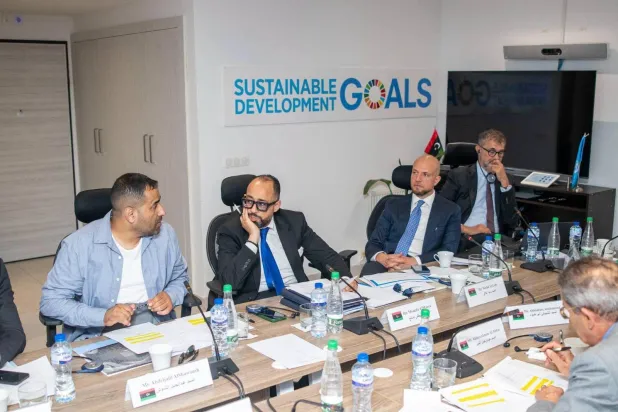
From a previous meeting of members of the State Supreme Council (the Council)
According to observers, the initiative proposed by US presidential advisor Massad Boulos months ago changed previously existing alliances; Al-Dabaiba has not announced an official position on it yet, but Takala and his council quickly rejected it, leading to circulating news of tension in their relationship, despite previous rapprochement.
This reading deepened about a month ago with Takala's announcement - in coordination with House Speaker Aguila Saleh and Presidential Council President Mohamed Al-Manfi - of a 'roadmap' to end the preparatory phase, a step some described as an attempt to ensure that council heads are not marginalized in any future political settlement, while others saw it as a rapprochement between Takala and Al-Dabaiba's opponents.
The head of the council's political committee, Mohamed Maazeb, believes that 'the competition this year is limited to two currents that reflect the intellectual and political divide within it.' Maazeb told Asharq Al-Awsat that 'there is the civil state current, which forms the majority inside the State Supreme Council, and enjoys the support of about 60 percent of its 142 members. It is led by Takala, and insists on holding fair elections, peaceful transfer of power, and keeping Tripoli as the capital of the state, while its supporters are wary of any rapprochement with Haftar.'
Aguila Saleh, Speaker of the Libyan House of Representatives (Reuters)
As for the second current, which Maazeb describes as 'close to the eastern camp' with its political and military arms, 'it may receive support from about 30 percent of members' votes,' noting that supporters of this current 'may not oppose the Boulos initiative, despite its formulas for power-sharing.'
The 'American initiative' focuses on unifying institutions and paving the way for elections, amid leaks about granting Saddam Haftar, deputy of the General Commander of the 'National Army', the presidency of a new presidential council instead of Al-Manfi, in exchange for Al-Dabaiba remaining head of a unified government, which some described as a 'power-sharing deal.'
Maazeb did not rule out 'continued political polarization until the moment of voting for the council presidency, especially targeting a swinging bloc representing between 10 to 15 percent of the votes, which deploys its positions according to regional or personal interests,' and he believes that Al-Dabaiba 'is indifferent to the council elections as he is preoccupied with the fate of his government, and that some names have known orientations from distant periods.'
In contrast, council member Ali Al-Sweh considered that 'the current conflict is limited to two currents: the first wants to move forward and hold elections due to the untenability of the current situation, with deteriorating economic and security conditions and rampant corruption, and the other wants to keep the current scene unchanged.'
Al-Sweh explained to Asharq Al-Awsat that 'the political agreement signed in Skhirat, Morocco, at the end of 2015 - which is the governing framework for the current transitional period in the country - called for consensus between the House of Representatives and the (Supreme) Council on electoral laws and holding the election, forming a unified government, and then the exit of both councils from the scene, and this is what the first current, to which we belong, wants.'
Al-Sweh called on his council members to 'adhere to the texts of the political agreement to achieve institutional unity, protect the country's resources and restore its sovereignty, stay away from any alliances that serve the interest of staying in power rather than the citizen's interest, and alleviate his suffering.'
For his part, council member Saad bin Sharada rejected 'some people's portrayal of the Boulos initiative as a determining factor for choices in the elections for the presidency of the State Supreme Council.' He told Asharq Al-Awsat that 'the fuss about the initiative concerns specific figures assuming sovereign positions, which is not certain, but its essence is an implementation of the roadmap presented by UN envoy Hanna Tetteh to the Security Council last August.'
UN Envoy Hanna Tetteh (the Mission)
Bin Sharada pointed to 'the (4+4) committee formed by the UN mission three months ago as a mini-dialogue framework, comprising representatives from both councils, and also figures representing active forces in the east and west of the country to ensure the implementation of its outcomes.'
Apart from alliance calculations, observers believe that the new president of the State Supreme Council 'will face an extremely difficult task'; amid massive challenges threatening to marginalize the role of his council and parliament, attributing this to 'popular anger and international criticism for their obstruction of elections due to their repeated differences, in addition to the current preference of the mission and major powers to rely directly on active forces on the ground.'
Original source: Asharq Al-Awsat
Comments (0)
Be the first to comment.