Asharq Al-Awsat Investigates Background of al-Shara's New Security Appointments
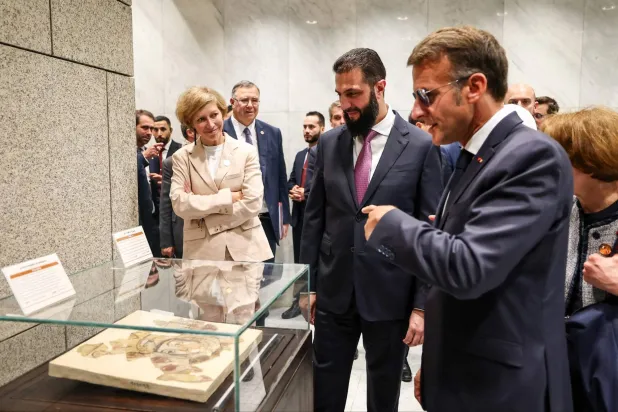
The new appointments made by President Ahmad al-Shara, which included a number of senior security positions, represent a radical re-institutionalization and restructuring of the Syrian security apparatus...
Syrian researcher, security and strategic expert Ismat al-Abssi considered the new appointments made by Syrian President Ahmad al-Shara on Sunday, which included a number of senior security positions, as a radical re-institutionalization and restructuring of the Syrian security apparatus, evidenced by the presence of the Ministers of Defense, Major General Marhaf Abu Qasra, and Justice, Mazhar al-Wais, within the 'National Security Office,' and in response to internal (security) and external (political and economic) pressures at a pivotal time.
In a statement to Asharq Al-Awsat, al-Abssi explained that the new appointments reflect a clear trend towards centralizing security authority in the hands of President al-Shara and Interior Minister Anas Khattab, by merging the files of 'Public Security' (police and internal security) and 'National Security' and placing them in the hands of one person.
President Ahmad al-Shara issues a new package of appointments in security institutions, including a number of leadership positions.▪️ The appointments included the appointment of Engineer Anas Khattab as Director of the National Security Office, in addition to his duties as Minister of Interior.▪️ Appointment of Hussein al-Salama as Assistant Director of the National Security Office, and appointment of Mulham al-Shantout... pic.twitter.com/HdntyBDIip
— Syrian Arab News Agency - SANA (@Sana__gov) July 19, 2026
This means, according to al-Abssi, ending any duplication or competition between the 'Interior' and 'Intelligence,' and making Minister Khattab the sole axis for strategic and executive security decision-making, 'while Hussein al-Salama is shifted to an assistant executive role directly under his command in the (National Security) file, and the General Intelligence is placed under the leadership of Abdul Qadir Tahan, who works within this unified structure.'
These appointments come within the framework of ending the chaotic transitional phase and building a unified central security structure, after previous concerns about the dispersal of powers among multiple agencies with different backgrounds (Hay'at Tahrir al-Sham, the Syrian Democratic Forces, and others). The researcher explains that 'by appointing Khattab at the head of both the (National Security Office) and the Interior, a (single general secretariat for security) is created, a model that enhances direct presidential control and reduces the margin of maneuver for other military or security leaders; thus contributing to the consolidation of the institutional legitimacy of the new state.'
Members of Syrian security near the Four Seasons Hotel after two explosions in Damascus on July 7, 2026 (AFP)
Explosions and Border Gaps
The factors driving these appointments at this time, according to al-Abssi, are the direct and tense security pressure recently after the explosions that occurred in Damascus, and the discovery and seizure of weapons smuggling operations from Iraq on their way to Lebanese Hezbollah, noting that the recent explosion operation and the thwarting of smuggling operations revealed gaps in coordination and border and urban area monitoring.
He added that 'the appointment of a strong figure like Khattab at the head of the (National Security Office) aims to impose stricter oversight and faster coordination between field (internal) and intelligence agencies to effectively combat terrorism and organized crime.'
The Syrian researcher and security and strategic expert pointed out that the West, especially the United States and the European Union, conditions the resumption of aid and political support on the existence of security agencies subject to civilian and legal control, not to armed factions.
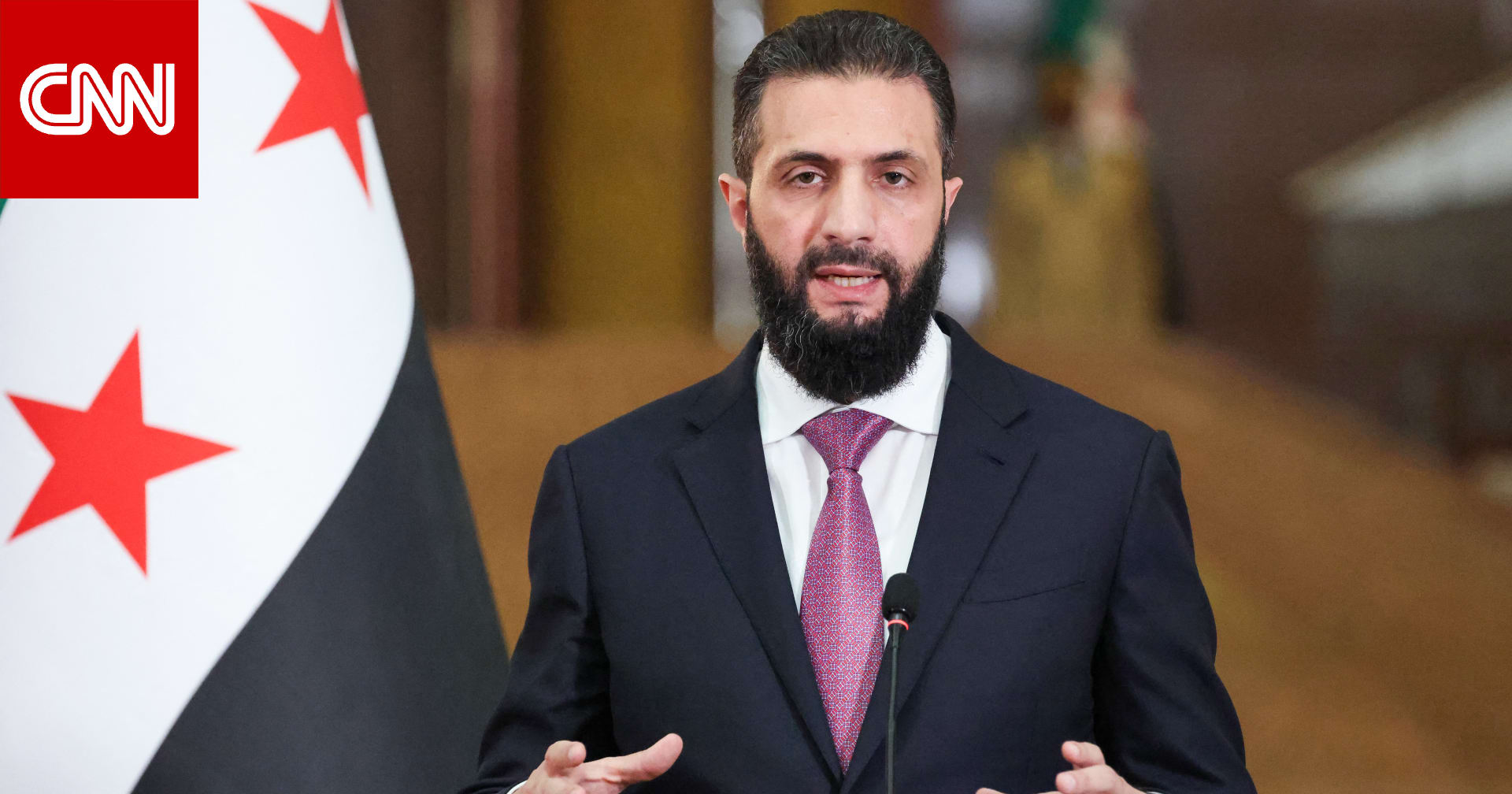
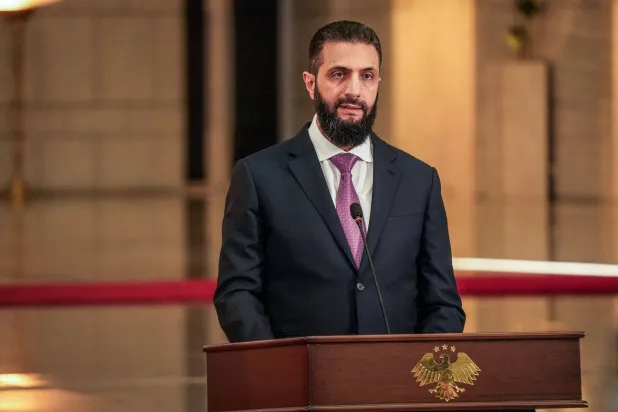
Syrian President Ahmad al-Shara (SANA)
Likewise, placing the 'National Security Office' and the Interior under the leadership of a single civilian/security minister is considered 'a positive step in the view of international partners towards (modernizing) the security institution and making it more transparent and accountable; thus opening the door to greater political and economic support.'
Al-Abssi mentioned that 'potential investors need a guarantee of real, predictable security stability, and security chaos or competition between agencies scares capital. Thus, sending a message that there is (one security leader) responsible for everything is a reassurance to the global market that the Syrian state is capable of protecting its interests and those of investors; which is an essential condition for starting major reconstruction projects.'
Al-Abssi concluded his statement by saying that 'these appointments are not just a change of names, but a radical re-institutionalization of the Syrian security structure; evidenced by the presence of the Ministers of Defense, Major General Marhaf Abu Qasra, and Justice, Mazhar al-Wais, within the (National Security Office), and a response to internal (security) and external (political and economic) pressures at a sensitive pivotal time, after the visit of French President Emmanuel Macron to Damascus.'
Part of an old souk near the Umayyad Mosque in Damascus on July 9, 2026 (AFP)
The French president's visit, which he made on July 6 of this month and lasted two days, is the first of its kind by a major Western head of state to Syria since President Ahmad al-Shara assumed power in late 2024. During the visit, two explosive devices detonated hundreds of meters from the Four Seasons Hotel, Macron's residence. Syrian security authorities announced the arrest of the cell responsible for the two explosions, and initial investigations showed that it belongs to the 'ISIS' organization.
President al-Shara holds a meeting with Interior Minister Anas Khattab, his deputies, and security leaders in the provinces during November 2025 (SANA)
Dr. Abdul Rahman al-Hajj reads the security changes from the perspective of an academic and political researcher with many publications on Syrian affairs, and sees in it 'a major step towards building the security institution and enhancing its capabilities, as the (National Security Office) acts as a coordination center between different sources of information and integrates them.'
'Until recently,' al-Hajj notes, 'coordination was done in an unorganized manner, but now the security scene can be seen as integrated, and this new structure is a necessary step for the (National Security Council) to do its work. Consequently, we will likely witness in the coming period an integrated security strategy and policies designed according to an appropriate methodology to achieve this strategy. I believe this development is a mixture of the internal need to build state institutions and the need to face the security challenge. It is difficult to separate them in the transitional phase of a country that has just emerged from war and suffers from significant security fragility. It is also difficult to separate that from the relationship with the (International Coalition), and the regional security challenge linked to the International Coalition and Turkey in particular. Meaning that the factors cannot be separated from each other, but the first step begins with the effort to complete the building of the state and its institutions, while other factors act as a motivator for acceleration and improvement.'
A Safe Environment to Attract Investments
Dr. Firas Shabbo, researcher and economic academic, believes that one of the goals of these moves is 'to create a safe and stable environment; this is a fundamental precondition for attracting investments and reassuring investors, as these changes aim to unify the top security leadership; thus contributing to reducing the state of fragmentation and overlap among security agencies.'
Original source: Asharq Al-Awsat

Comments (0)
Be the first to comment.