Israeli Organization: Government Response Does Not Address Doctor Abu Safiya's Health Condition
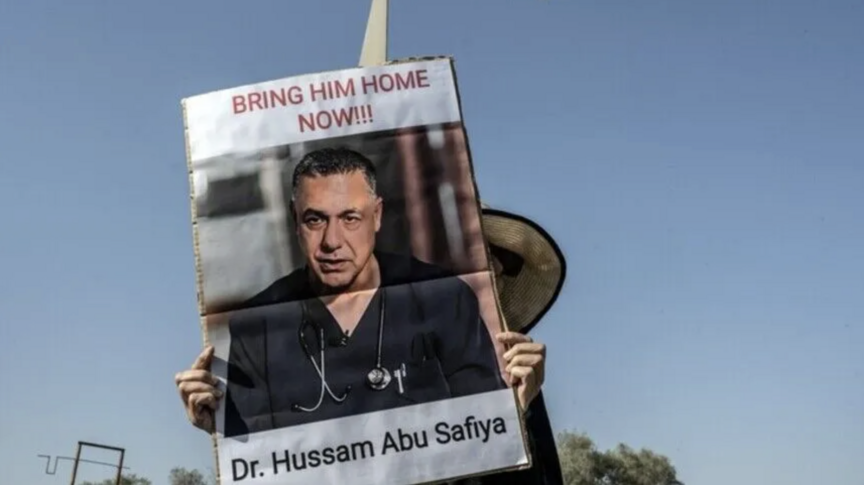
Israeli Physicians for Human Rights says government's response does not answer substantive questions raised by Abu Safiya's lawyer's affidavit that he was beaten and 'fears being killed during his detention'.
JERUSALEM (AA)
The Israeli organization Physicians for Human Rights said Wednesday that the government's response to the Supreme Court regarding the petition it filed for the release of 14 Palestinian doctors from the Gaza Strip detained in Israel "does not address the serious allegations concerning the health condition of the director of Kamal Adwan Hospital, Hussam Abu Safiya."
The organization added in a statement that the government's response "also does not answer the substantive questions raised by the sworn affidavit submitted by Abu Safiya's lawyer, Nasser Odeh."
It continued that the government's response "merely provides a general denial, without addressing most of the facts documented by the lawyer during his visit to Dr. Abu Safiya in the underground Rakevet ward last week."
The organization explained that the government stated in its response submitted to the court, following an internal review, that "no indicators emerged suggesting a threat to his life."
It noted that the government mentioned that Abu Safiya, detained in the Rakevet ward of Nitzan Prison since June 24, 2026, had undergone several examinations by medical teams since his transfer to the ward.
However, the organization clarified that the government did not specify the date of those examinations, the entities that conducted them, or their results, nor did it clarify whether the injuries described by his lawyer in his affidavit had been documented or recorded in his medical file.
The organization had previously published the sworn affidavit submitted by lawyer Nasser Odeh following his visit to Abu Safiya on July 2, 2026.
On December 27, 2024, the Israeli army arrested Abu Safiya during its raid on Kamal Adwan Hospital, where he served as hospital director, amid the genocide war Israel is waging on the Gaza Strip.
According to the affidavit, Abu Safiya arrived at the meeting with his lawyer suffering from "serious injuries to his head and neck, difficulty breathing, and had trouble sitting without losing his balance, and appeared on the verge of losing consciousness."
The affidavit added that Abu Safiya informed his lawyer that he had been repeatedly beaten during his detention in solitary confinement, and then beaten again after his transfer to the Rakevet ward, following the last hearing on his appeal regarding the extension of his detention order.
The affidavit also quoted Abu Safiya as saying that he "fears being killed during his detention."
The organization said the government's response "raises more substantive questions than the answers it provides," explaining that it did not reveal the reason for subjecting Abu Safiya to repeated medical examinations since his transfer to the Rakevet ward, or the results of those examinations, or whether they were conducted following the complaints filed after the lawyer's visit.
It added that the government did not address most of the facts contained in the lawyer's affidavit, including the described injuries, allegations of continuous exposure to violence, loss of consciousness, and concerns about Abu Safiya's life.
It also noted that the government did not respond to the organization's requests to allow an independent medical examination, obtain the doctor's medical file, or send an independent official body to visit him at his detention location and assess his health condition.
The organization pointed out that the government's response was submitted at a time when the lawyer's request for a second visit to his client had not yet been approved, despite the request being submitted immediately after the previous visit ended.
It added that the Israel Prison Service has not yet transferred Abu Safiya's medical file to the organization, despite the official request submitted in this regard, nor did the government's response address requests for an independent medical examination or organizing an independent visit to his detention location.
The organization stated that the Israeli government requests the court to reject the petition and dismiss it without holding a hearing, "without providing concrete information or evidence justifying the continued detention of the fourteen doctors."
Physicians for Human Rights affirmed its rejection of this position, noting that the government's response "ignores the essence of the petition," which is the continued detention of 14 Palestinian doctors without indictments or trial, at a time when the Gaza Strip suffers from a severe shortage of medical staff and a continuous collapse of its health system.
The organization said the government did not answer the central legal question raised by the petition, which is whether it conducted an independent and genuine review of the continued detention of the doctors, and did not respond to the claim that their continued detention without fair legal procedures constitutes a violation of their fundamental rights and increases the difficulty of recovering the health system in the Gaza Strip.
According to a previous statement by the Palestinian Prisoner's Club (NGO), the number of Palestinian prisoners in Israeli prisons is approximately 9,400 as of early July 2026, including 1,320 detainees classified by Israel as "unlawful combatants," along with administrative detainees held without charge or trial.
According to the Al-Mezan Center for Human Rights (independent Palestinian), the Israeli Knesset enacted the "Unlawful Combatant Law" in 2002, which allows the detention of individuals for indefinite periods without filing an indictment or presenting sufficient evidence before the court.
This law deprives detainees subject to it of the guarantees granted to prisoners of war under the Third Geneva Convention, or to civilian detainees under the Fourth Geneva Convention of 1949, and grants Israeli courts broad powers to extend detention based on security suspicions, without obligating the authorities to disclose to the detainee or his lawyer the detailed reasons for the arrest, according to the center.
Original source: Anadolu Agency

Comments (0)
Be the first to comment.