Lebanese army surveys risks in experimental areas to ensure return of civilians

The Lebanese judiciary is examining a legal and procedural mechanism that allows the Lebanese army to conduct inspections on private properties without obstacles, after the army entered the first experimental areas in the town of Zawtar al-Gharbiyya, which was visited by Prime Minister Nawaf Salam on Wednesday, raising the Lebanese flag there.
The Lebanese army entered the town of Zawtar al-Gharbiyya on Tuesday, and continued on Wednesday to inspect its landmarks to dismantle weapons and ammunition left over from the war, in order to secure the area and return residents safely. A security source told Asharq Al-Awsat that the return of residents cannot take place before the engineering units completely finish securing the area, to protect returning civilians from any threats to their lives, which delayed their entry.
The source denied rumors in local media that army commander General Rodolphe Haykal had visited the town from which Israeli forces withdrew, saying that the Prime Minister took a specific route to the town, which the engineering units had finished securing during their work over two days since Tuesday.
Lebanese Prime Minister Nawaf Salam raises his country's flag in the square of Zawtar al-Gharbiyya (AFP)
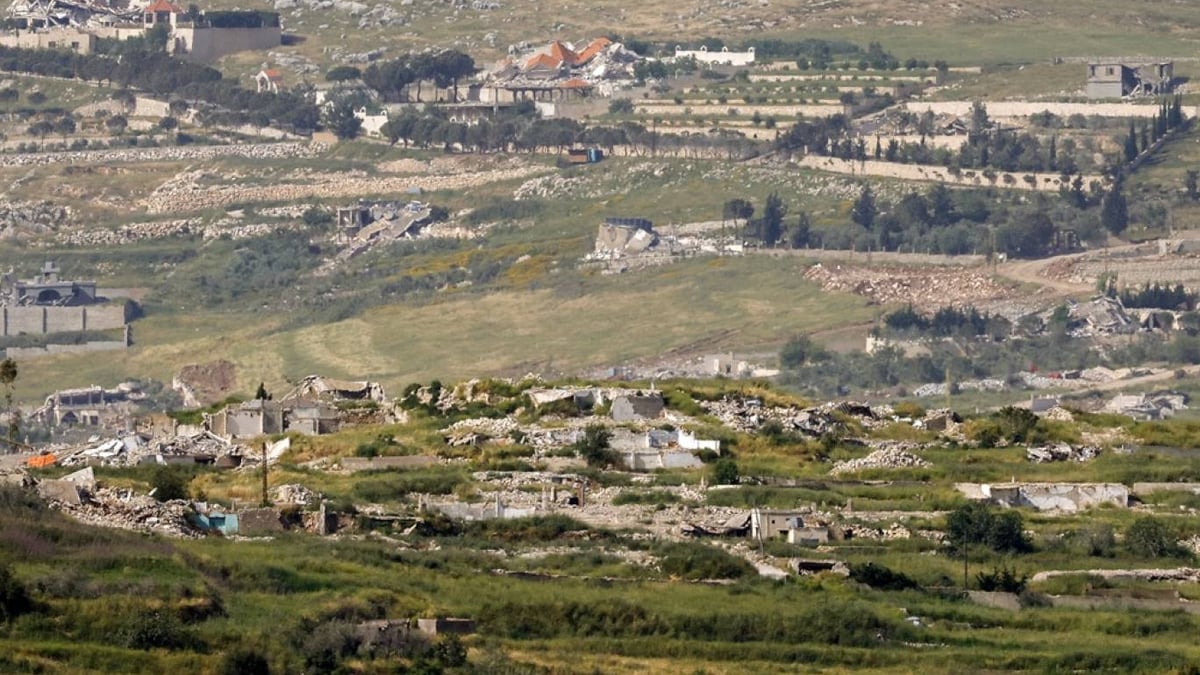
The army is working intensively on multiple fronts, implementing the security mission in the experimental area under the framework agreement between Lebanon and Israel with American sponsorship. Military units have deployed in the area from which Israeli forces withdrew, and the army is tightening security measures, including checking identities of those crossing and entering the area, searching cars, vehicles, and public properties. However, the issue of inspecting private properties—houses and owned land—has not yet been resolved, noting that Zawtar al-Gharbiyya has no remaining houses, as it was almost completely destroyed by Israeli bombardment.
Proposals for inspecting private properties
To resolve the issue of judicial permits for inspecting private properties, a judicial source told Asharq Al-Awsat that three proposed mechanisms are being examined to facilitate inspections and overcome legal and procedural obstacles. The formula that the judiciary intends to adopt is being studied and discussed with the army command. The first mechanism involves granting an open authorization for the army to inspect private properties. The source considered this formula 'difficult to apply because it opens the door to arbitrariness.' The second mechanism involves obtaining a judicial permit each time the army wants to enter a property. The source also considered this formula 'complicated' as it 'requires continuous coordination on a moment-by-moment basis with the military judiciary.' Therefore, the source leans toward the third formula, which stipulates granting inspection permits 'area by area,' i.e., an entire town, neighborhoods, or zones within a town. He said that what has been presented remains within the framework of proposals.
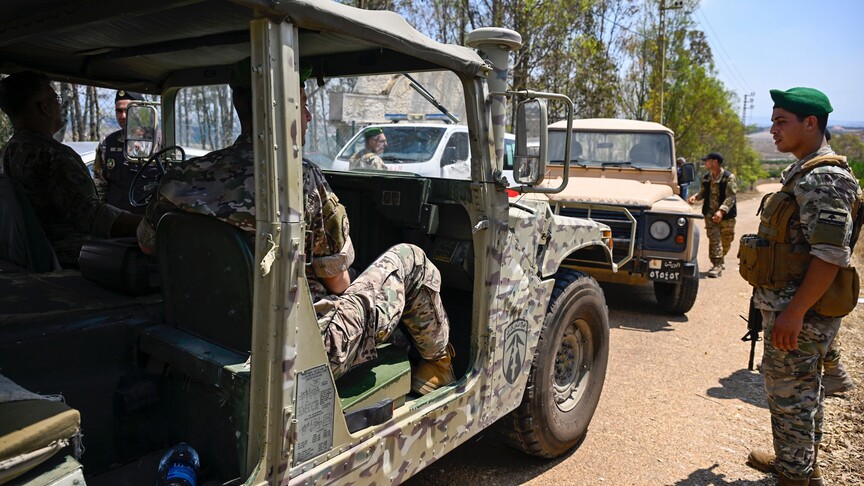
Local residents gather near a military vehicle at the entrance of Zawtar al-Gharbiyya, where the army deployed on Tuesday (Reuters)
According to Lebanese law, entering private properties requires a judicial permit, while no such permit is needed for entering public properties such as common areas. Under the framework agreement, the Lebanese army's role is to deploy in southern Lebanon and dismantle non-governmental military infrastructure in exchange for a gradual Israeli withdrawal, in coordination with the Military Coordination Group for Lebanon (MCG4L), a US military unit.
The tasks of the Lebanese army, according to the framework agreement signed on June 26 in Washington, include controlling the lands and towns in southern Lebanon from which Israeli forces gradually withdraw, removing weapons and non-governmental military infrastructure from areas covered by the agreement, opening roads, and facilitating the return of displaced civilian residents to their villages in the experimental areas.
Military movements in the Lebanese interior
Parallel to these Lebanese measures, the Israeli army continues its military movements on Lebanese territory, violating the ceasefire agreement. An Israeli force advanced into the town of Shaqra, according to the official National News Agency, noting that the Israeli force penetrated towards the Doubeh area on the outskirts of southern Shaqra, reaching the vicinity of the 'Doubeh Archaeological Castle' and the Wadi al-Salouqi. This means the Israeli army crossed the yellow line it had drawn in Wadi al-Salouqi towards the Lebanese interior.
A truck transporting an Israeli tank in the Upper Galilee area near the border with Lebanon (AFP)
Similarly, the Israeli army advanced to the outskirts of Burj al-Muluk, on the main road between Tell al-Nahas and Burj al-Muluk, where it broke into a citizen's home and searched it, also searched his mobile phone, interrogated him, and confiscated his passport, before withdrawing towards Tell al-Nahas.
An Israeli force infiltrated the town of Sarabin, coinciding with bursts of heavy machine gun fire in the area. Repeated artillery shelling targeted the Ali al-Taher hill on the outskirts of Nabatieh al-Fawqa, and similar shelling targeted the town of Houla. A drone strike also targeted the Nabatieh al-Fawqa area.
At night, Israeli forces carried out explosions in the towns of Baraachit and Haddatha, and other explosions in Kounine and Beit Yahoun in the Bint Jbeil district, in addition to another explosion in the town of Majdal Zoun in the western district, and a third explosion in Kfar Tibnit in the Nabatieh district.
Original source: Asharq Al-Awsat


Comments (0)
Be the first to comment.