"Mount Axe".... The Story of the Most Dangerous "Nuclear Fortress" in Iran
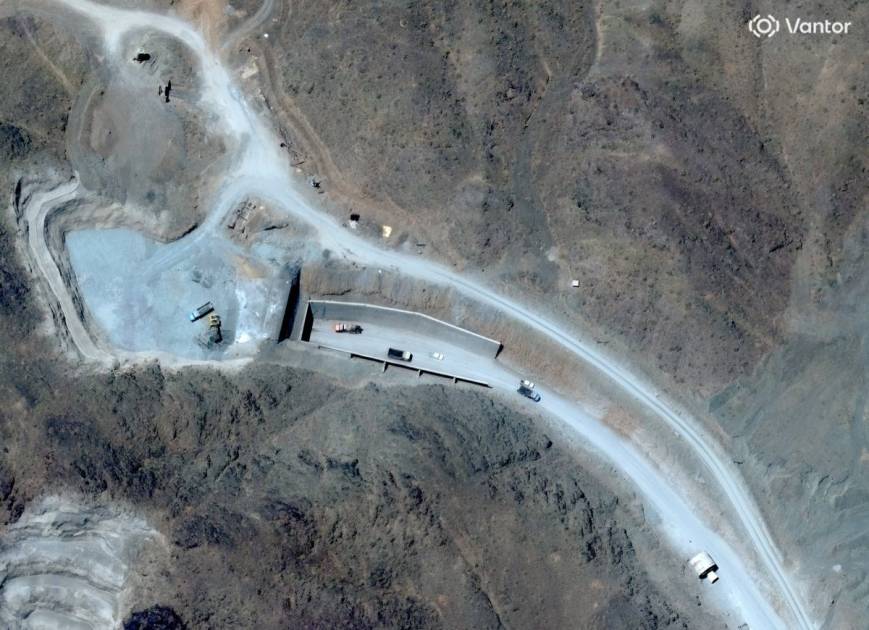
Summary: For months, Western research centers have expressed fears that "Mount Axe" is a stronghold for sensitive nuclear activities, noting that continued construction on the mountain, where images show vehicle movement on roads leading to the western entrances, suggests that work inside the tunnels has not stopped.
After vowing to destroy it and calling on Iranians to prepare for a strike "in the near future," US President Donald Trump’s announcement of his intention to destroy what is known as "Mount Axe" in Iran raised questions about the nature of this nuclear complex, described by reports as one of Iran's most fortified facilities, coinciding with the return of military escalation and exchange of strikes between Washington and Tehran in recent days.
According to several reports, "Mount Axe," known as "Peakax Mountain" in English, or "Kuh Kolang Gaz La" in Persian, consists of a tunnel complex located inside a mountain about 1.6 kilometers underground south of the "Natanz enrichment facility," and is widely believed to be one of the most important sites through which Tehran could rebuild its nuclear program, after its major sites were hit by US and Israeli strikes during the 12-day war last year and the recent 40-day war.
In an interview with the "Hugh Hewitt" show published on Monday, Trump announced his intention to eliminate "Mount Peakax," saying "Tell the Iranians to get ready," adding, "We are watching 'Mount Peakax' closely. We see no activity there. They are not making any progress on their nuclear program. Every time we hear about something there, we bomb it and destroy it. So they don't like to talk about it anymore. But we are likely to strike Peakax relatively soon."
What do we know about "Mount Axe"?
Among several Iranian nuclear sites and facilities, the "Mount Axe" nuclear facility, construction of which began in 2020, is described as the "most fortified" in Iran, as it is located at a great depth, estimated at about 1.6 kilometers underground, in the Zagros mountain range in Isfahan province, 90 miles south of "Fordow," and near the "Natanz nuclear facility" (south of the capital Tehran in central Iran).
The size and depth of the "Mount Axe" facility reflect that it has a large enrichment capacity that may equal or exceed the damaged plant in "Fordow" (AFP)
Intelligence and security estimates indicate that the complex consists of a network of tunnels dug at a depth of up to 600 meters beneath layers of granite rock, making it deeper than the "Fordow facility," which was previously considered the most fortified, and capable of withstanding the most powerful US bunker-buster bombs currently available, such as the "GBU-57" used to destroy other Iranian sites in Natanz, Fordow, Isfahan, and elsewhere.
The complex contains four main tunnel entrances, two on the eastern side of the mountain and two on the western side, each six meters wide and eight meters high, greatly complicating any attempt to seal it with airstrikes.
In explaining the extent of the site's fortification, the British newspaper The Telegraph says it is an ideal place to hide Iranian enriched uranium, especially since the facility is located under a mountain 1,608 meters above sea level, more than 50 percent higher than the 960-meter mountain housing the "Fordow facility," providing enhanced protection and possibly larger underground chambers for nuclear operations.
In a previous report, researcher Rouel Marc Gerecht of the Foundation for Defense of Democracies compared the "Fordow" and "Mount Axe" nuclear facilities, considering that the size and depth of the latter reflect that it is a facility with a large enrichment capacity that may equal or exceed the damaged plant in "Fordow," as its underground chambers extend to a greater depth, possibly exceeding 100 meters below the surface, compared to Fordow's depth ranging between 80 and 90 meters. Thus, deeper construction could significantly reduce the effectiveness of US bunker-buster bombs designed to penetrate underground facilities, arguing that the massive 30,000-pound US bombs used against Fordow might struggle to reach their targets hidden in "Mount Axe," in addition to the tunnels and security perimeter around the facility further complicating any commando raid attempting to sabotage the complex.
"Alternative Stronghold" for Tehran to Restore Its Nuclear Program
Given the level of fortification and engineering complexity with which the "Mount Axe" facility was designed, several intelligence and Western estimates indicate that the site could be a secret uranium enrichment facility representing a "security zone" for Iran's nuclear program, as well as the ideal place to hide and intensify Iran's production of enriched uranium, after the destruction of most other nuclear sites and facilities due to US and Israeli strikes in 2025 and the recent war this year.
Intelligence estimates suggest that this site is Iran's destination for rebuilding its centrifuge program, starting from component production, through centrifuge assembly, to future uranium enrichment.
The US website Al-Monitor reported that Western intelligence agencies suspect the site is a "secret Iranian enrichment facility," enabling Tehran to revive its nuclear program, a claim that Iran denies, as it has not officially declared the nature of activities inside, stating that since construction began in 2020, the site is only for assembling and manufacturing advanced centrifuges.
Meanwhile, The Telegraph quoted experts on Iran's nuclear program saying that the site may be intended to transfer sensitive parts of the nuclear program to deeper and more protected facilities, with the possibility of its future use in uranium enrichment.
Read more
Shadows Over Iranian Uranium... From 'Fordow' to 'Mount Axe'
US Push for Iran to Reveal Fate of Its Nuclear Sites
"Hormuz" Strangles Iran's Coasts
Iranian Uranium... Can Enrichment Be Reduced?
According to another analysis published by the Institute for Science and International Security and the Center for Strategic and International Studies, based on satellite imagery, continued work on "Mount Axe" aims to provide an "insurance policy" for Iran, enabling it to possess an advanced nuclear facility while rebuilding its centrifuge program, from component production, through centrifuge assembly, to future uranium enrichment. The analysis estimated that the complex is large enough to accommodate a full enrichment facility, but at the same time clarified that it is not yet ready for operation and there are no indications that it is currently operating or contains a stockpile of enriched uranium.
The Institute for Science and International Security believes that Iran is capable of secretly deploying thousands of advanced centrifuges in the new tunnel complex at "Mount Axe," which could allow Iran to continue enrichment activities even if known facilities are destroyed, consistent with US intelligence assessments that Iran is implementing a dispersal strategy for its nuclear program, spreading its capabilities across multiple sites to ensure survival in case of an attack.
Original source: Independent Arabia




Comments (0)
Be the first to comment.