Over 15,400 violators of Saudi Arabia's residency, labor, and border laws arrested in one week

Over 15,400 violators of Saudi Arabia's residency, labor, and border laws arrested in one week
3:06 PM, July 12, 2026
Saudi authorities regularly conduct nationwide security campaigns to enforce residency, labor, and border regulations.
July 12, 2026 | 03:06 PM
Last Updated: July 12, 2026 | 03:06 PM

3 minute read
AA
Resize

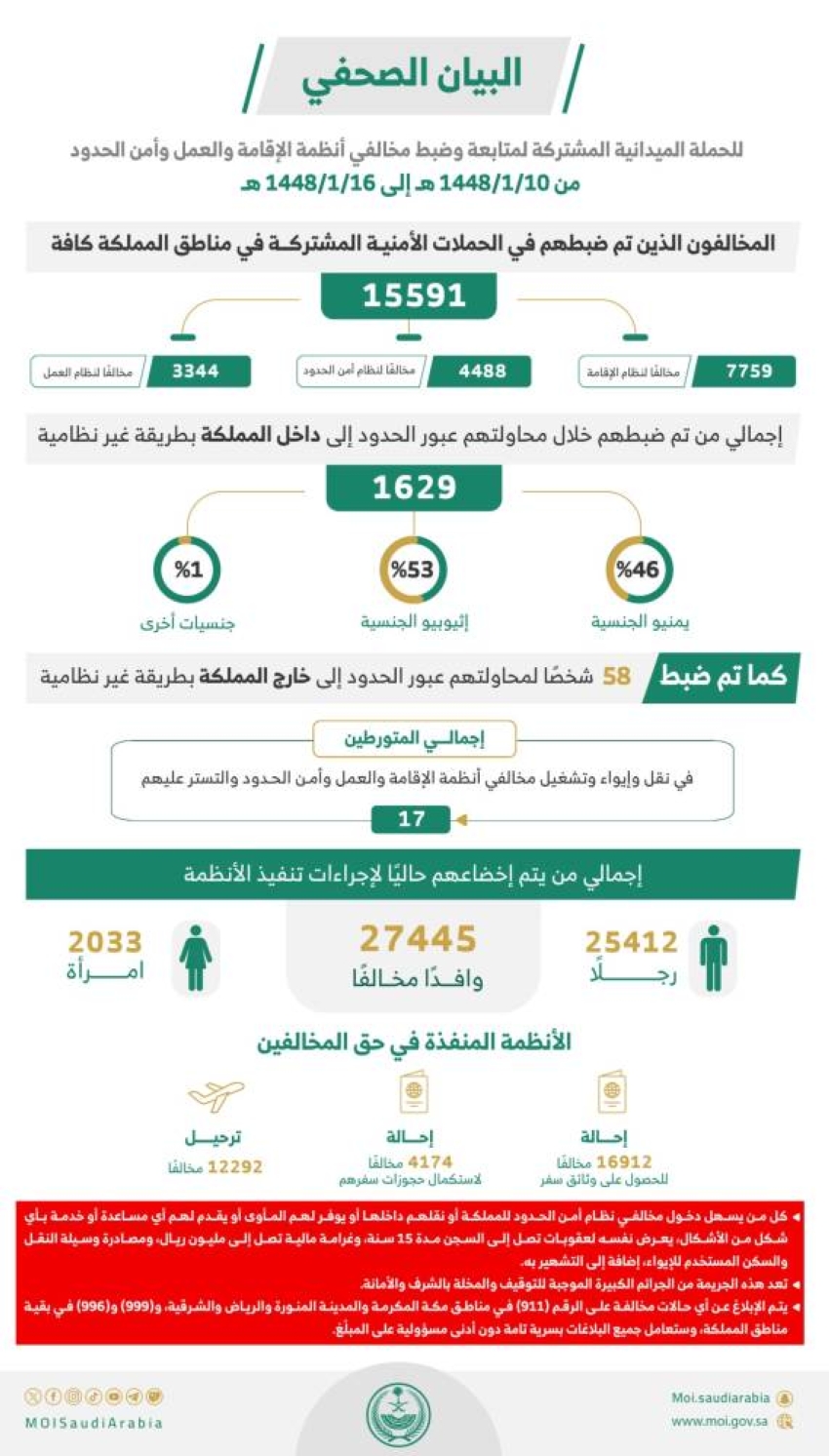
RIYADH — More than 15,400 violators of residency, labor, and border security regulations were arrested across the Kingdom between July 2 and 8, the Ministry of Interior (MOI) announced.
Across the country, joint security operations resulted in the apprehension of 15,430 individuals.
According to the ministry, those arrested included 7,913 violators of residency regulations, 4,037 violators of border security regulations, and 3,480 violators of labor regulations.
Among those detained while trying to enter unlawfully, Ethiopians made up 53%, Yemenis 46%, and other nationalities 1%.
In addition, 30 people were apprehended while attempting to leave the Kingdom illegally.
The ministry said 27 individuals were arrested for transporting, sheltering, employing, or otherwise assisting violators of residency, labor, and border security regulations.
A total of 29,286 violators—including 27,127 men and 2,159 women—are currently undergoing procedures to enforce the relevant regulations.
These procedures include referring 17,353 violators to obtain travel documents, referring 5,438 to complete travel arrangements, and deporting 11,800 violators.
The ministry reiterated that facilitating the illegal entry of border security violators into the Kingdom, transporting them, providing them with shelter or assistance, or offering any form of support or service constitutes a major crime punishable by up to 15 years' imprisonment, a fine of up to SR1 million, and the confiscation of any vehicles or properties used in committing the offense.
The weekly crackdown reflects the Kingdom's intensified enforcement of its legal frameworks. Such operations aim to deter illegal residence and employment, which are persistent challenges in the region. The high proportion of Ethiopian and Yemeni nationals among border violators highlights ongoing migration pressures.
Original source: Saudi Gazette





Comments (0)
Be the first to comment.