Three Statements... and One Message to the Houthis and the World

Book, Three Statements... and One Message to the Houthis and the World, Dr. Khaled Mohammed Batarfi, Date of Publication: July 21, 2026, 12:29 KSA.
The address by the President of the Yemeni Presidential Leadership Council, the statement from the Saudi Ministry of Foreign Affairs, and the statement from the Joint Forces Command of the Coalition to Support Legitimacy came at a highly sensitive time, following the escalation of Houthi threats to international navigation and attempts to impose a new reality in the Bab el-Mandeb Strait. Although each statement approached the issue from a different angle, they all converged on a single political and legal message: it is no longer acceptable to allow Yemen to be transformed into a platform for executing an Iranian agenda, or to use the suffering of the Yemeni people as a cover to justify threatening regional security and international shipping.
The importance of these statements lies in the fact that they did not rely on traditional political rhetoric, but were instead based on verifiable facts, figures, and events. They systematically refuted the Houthi narrative regarding the so-called 'blockade,' confirming that the ports of Hodeidah, Salif, and Ras Issa remained open, that hundreds of commercial vessels entered them loaded with food, fuel, and essential supplies, and that Sana'a Airport remained operational via the national carrier before the militia itself caused the suspension of its activities, hijacked Yemenia Airways planes, and rejected repeated initiatives to resume flights in a legal and safe manner. This refutation is of particular importance because it shifts the debate from the level of political propaganda to that of documented facts, revealing that the humanitarian crisis in Yemen was not the result of closing ports or airports, but rather the result of choices made by the Houthi militia itself—whether by banning oil exports, disabling state institutions, or diverting public resources to serve its military project.
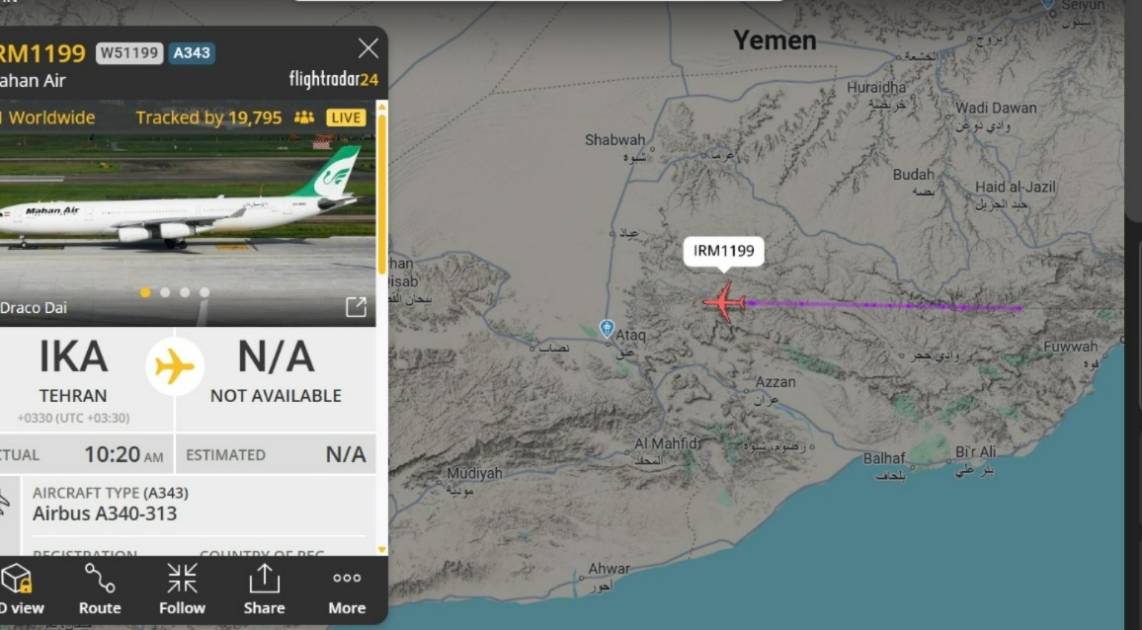
Perhaps the most striking aspect of the Yemeni President's address is the redefinition of the root cause of the crisis. According to this narrative, the problem is not merely an internal political conflict, but a coup against the national state, followed by tying Yemeni decision-making to the Iranian project. This has dragged Yemen into regional conflicts that do not serve the interests of its people and has cost it a significant portion of its resources and economic and developmental opportunities. This reading gains even greater importance in light of the clear link between the Houthis' insistence on opening direct air routes with Iran via companies subject to international sanctions, and fears that these flights will be used to transport experts and military equipment. This constitutes a violation of UN Security Council resolutions and turns Yemen into an advanced theater within Iran's regional strategy. Conversely, the Saudi statement was keen to highlight another aspect that is often absent from the discourse: that the Kingdom did not merely support the Yemeni government politically and militarily, but also bore significant economic and developmental burdens to maintain a minimum level of stability in the Yemeni economy. This was done through budget support, funding the oil derivatives necessary to operate power plants, and continuing developmental projects, despite the Houthis' continued targeting of oil exports, which represent the main source of state revenue. The irony is clear here; while the Yemeni government and the Kingdom were working to alleviate the suffering of citizens and maintain essential services, the militia was banning oil exports, depriving the state of its most important source of income, and then blaming others for the economic deterioration. As for the statement by the Coalition Command, it shifted the message to a different level—that of maritime security and international law. The announcement of the start of measures to protect ships transiting the Bab el-Mandeb Strait, and the assertion that any threat to navigation will be met 'with full firmness and force,' reflects the Coalition's transition from the stage of warning to the stage of practical deterrence. Furthermore, characterizing the targeting of ships as acts of maritime piracy, rather than merely military action, gives any subsequent defensive measures a legal basis grounded in the United Nations Convention on the Law of the Sea and Security Council resolutions concerning freedom of navigation. This message carries an international dimension no less important than its regional one, because Bab el-Mandeb is not a passage that concerns Yemen or the countries of the region alone, but is one of the most important global commercial arteries; any attempt to disrupt navigation therein represents a direct threat to the global economy and international supply chains. It is also noteworthy that all three statements maintained a balanced equation between military firmness and political openness; they assert the right to protect navigation, but at the same time renew the commitment to a political solution, support for United Nations efforts and the roadmap, and the opening of doors for peace whenever the militia commits to its references and respects the sovereignty of the Yemeni state. The final message carried by these statements goes beyond responding to situational threats. They assert that the future of Yemen cannot be built on the logic of militias, nor on turning the country into a bargaining chip in regional conflicts, and that the international community is required today not only to protect international navigation, but also to implement Security Council resolutions and support the Yemeni state in reclaiming its institutions and resources, so that Yemen's wealth returns to the Yemenis, and peace becomes a state project, not a temporary truce imposed by the balance of power. @kbatarfi
Original source: Al-Madina



Comments (0)
Be the first to comment.