What is the magic recipe that led Spain to win the World Cup?

Aragonés pioneered the idea of committing to a unified plan for the Spanish federation to train
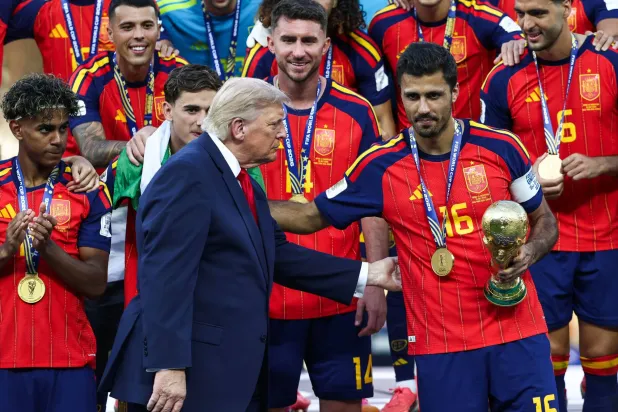
coaches and players, as celebrations sweep Spanish cities following their team's coronation as World Cup champions in 2026. Football experts are still searching for the 'magic recipe' that led La Roja to sit atop the world of the round ball.
Spain has strengthened its position as the best national team of the 21st century by adding another World Cup star to its shirt badge, with a second World Cup title, after the first in 2010 in South Africa.
Aragonés behind the journey of Spanish success and dominance (Getty)
Perhaps the 2010 and 2026 teams differ slightly, especially as football itself has changed, but there is an unmistakable link between them: a shared understanding of the game. The success of the Spanish model was not limited to the men's team; the women's team also won the World Cup in 2023.
Alexia Putellas, star of the Spanish team, explained in a recent interview with FIFA's website that she sees many similarities between the men's and women's teams, as they are ultimately part of the same system, from the youth teams up to the senior side.
For his part, David Gutiérrez, director of the National School of Coaches at the Spanish Football Federation, attributes the magnificent success of La Roja to one person and a specific year: Luis Aragonés in 2008. He is joined in this opinion by José Francisco Molina, who served as the federation's sporting director for men's football from 2018 until the end of 2022.
Mbappé, captain of France, ended the World Cup as the all-time top scorer (AP) cut out
Molina spoke to FIFA.com, saying: 'He was the one who recognized the quality of the players coming out of Spanish clubs; ultimately, it is the source of talent. The clubs develop and nurture the players, then the national team calls them up, and he decided to bring this group together, and that's how the journey of the team and the federation began. Given the phenomenal success this approach achieved, we started adopting it.'
Gutiérrez added: 'Aragonés made us realize that, perhaps genetically, we are not the fastest or the strongest physically, but there is one area where we excel, which we strongly emphasize when training coaches: understanding how to play as a unit.'
Aitor Karanka, the current sporting director of the Spanish Football Federation, believes that the way Spain develops its coaches seems fundamental to understanding its success. He explained: 'Spanish coaches benefit from their training and instill a deep understanding of the game in players from a young age, not only to develop individual talent but also to think about collective performance.'
Eloi Room, goalkeeper of Curaçao, without his name in history (Reuters)
He added: 'The methodology is based on possession training and building a set of skills that enable players, regardless of their innate abilities, to understand the game from an early age.'
When watching the Spanish national team play, perhaps the most striking feature is the thought that every player has a keen sense of what is happening around him and an exceptional ability to read the match, giving them more than just instinct to make runs.
Initially, during Aragonés's tenure between 2004 and 2008, the development of the Spanish team was rooted in Barcelona's youth academy, which formed the backbone of the 2010 World Cup squad and remains key to understanding Spanish football.
The generation that won the World Cup this year, however, is more diverse, with players like Rodri and Fabián Ruiz in midfield, neither of whom ever played for the Catalan club. Molina affirmed: 'It all depends on the players and coaches, but of course it stems from the clubs. The work done by everyone, from the top division to the lower divisions, because there are many clubs and academies doing a great job developing young talent.'
The solid methodology is a key factor in the progress made by Spanish national teams. The late José Manuel Ochotorena, who worked as a goalkeeping coach under Rafael Benítez – one of the early prominent Spanish coaches to achieve success abroad – recounted years ago that English Liverpool players were not very enthusiastic about the training sessions provided by the Madrid-born Spanish coach, because he constantly interrupted them to explain a specific concept. Ochotorena recalled how they wanted to maintain a fast pace without stopping play, while Spanish players valued the reflective side of the game and the tactical guidance they received. This focus on methodology and tactical training has been a recurring trait among Spanish coaches working abroad.
Karanka revealed how the Spanish approach influenced his work during his time in England, saying: 'If you follow the English Premier League now, you will find many Spanish coaches following our methodology. I was the first foreign coach at Middlesbrough, and when I arrived, I had to change the system and work on getting the players accustomed to the idea that it shouldn't take five or ten seconds to reach the opponent's penalty area, and instill a philosophy that shapes our patterns of play.'
Gutiérrez described the structure of the training courses offered by the Spanish Football Federation, saying: 'Everything is based on a deep understanding of the game, so that coaches have the necessary tools, and players are not bound by a rigid framework, but must understand all aspects of attack and defense in our sport. On this basis, they can adapt to the flow of the game.' He hinted: 'It's not about knowing what will happen next, but about the players' ability to create those situations and find those spaces for themselves.'
Molina, who currently coaches the Honduras national team, believes this approach improves players' decision-making and adaptability, and explained: 'Innate talent plays an important role, but it requires great effort.' He affirmed: 'When you have a clear idea of your playing style, your teammates' positions, their movements, and the available spaces, decision-making becomes much easier. Things don't always go as expected, but that is your goal. Creating those opportunities is what you can work on.'
These concepts were embodied in Pedro Porro's goal against France in the World Cup semifinal, which doubled Spain's lead (2-0) in the match, featuring a long series of passes and precise movements from every player.
Gutiérrez stressed: 'You cannot achieve this kind of collective play and create those spaces in a more restrictive game plan. It's about understanding all aspects of the game, so we run a lot, but more importantly, we move intelligently and use the ball effectively. This is not an innovation by those of us currently involved in this field. Rather, it is the product of years of development within the federation, starting from young players and progressing through their growth stages in academies, because we are fortunate to have great clubs that seek to develop players with initiative and high football intelligence.'
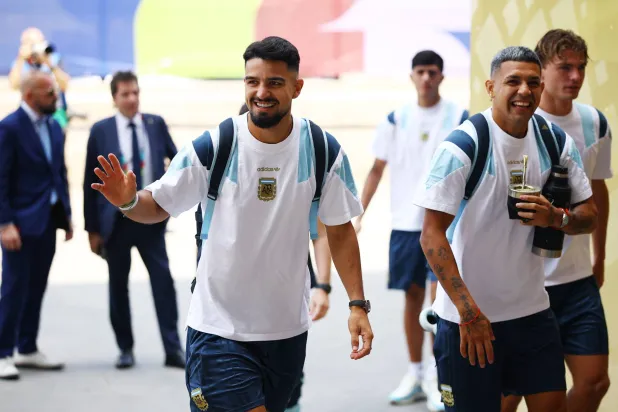
For his part, Pier Luigi Cherubino, who completed a coaching course through the Spanish Football Federation alongside Lionel Scaloni, the Argentina coach who lost the final to Spain at MetLife Stadium in New York, emphasized how much has changed since his playing days, which ended in 2007 after a 17-year career.
Original source: Asharq Al-Awsat



Comments (0)
Be the first to comment.