Cement Tile Inspired by Elephant Skin for Cooling
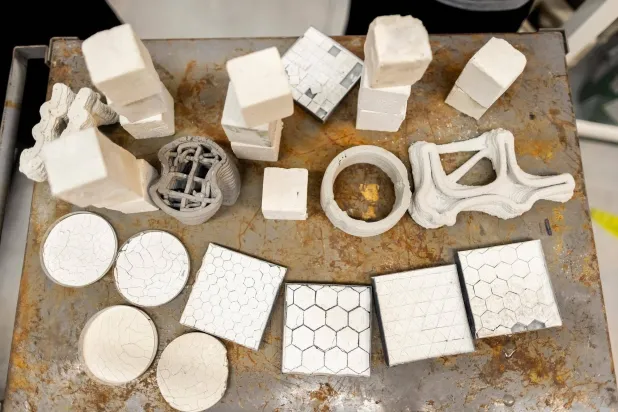
Researchers at the University of Pennsylvania have drawn inspiration from the cracked skin of elephants to create a low-cost cement tile capable of cooling buildings by absorbing water and slowly evaporating it, turning what appears to be a structural flaw into a climatic solution.
Dorit Aviv, associate professor of architecture and one of the study's researchers, said in a statement Wednesday: 'Elephants have a network of cracks in their skin that can retain water. When they spray themselves with water, this water stays inside these cracks before slowly evaporating, helping them cool their bodies.'
The idea was first proposed to Aviv by her longtime colleague, Shu Yang, a materials scientist at the University of Pennsylvania School of Engineering. Aviv, whose research focuses on making buildings more efficient in a warming world, welcomed the idea.
Some members of the research team (University of Pennsylvania)
In a research paper published in the journal Advanced Materials, Aviv, Yang, and Kun-Hao Yu of Syracuse University in New York transformed this idea into a new type of cement tile that captures and retains water, then slowly evaporates it, cooling surfaces without the need for fans or complex moving technologies.
Yang said: 'In traditional construction, cracks indicate material weakness and the beginning of deterioration. However, by engineering their locations and how they form, we have created networks of microchannels that act like capillaries, capable of drawing water across the surface and holding it in place.'
The researchers began their creation with a mixture of ordinary Portland cement and a porous material called diatomaceous earth, made from fossilized algae. The mixture is poured into thin molds and left to partially absorb water, then dried under precisely controlled conditions. As it shrinks, stress accumulates and then releases along pre-designed patterns, forming a regular network of cracks.
Elephants have a network of cracks in their skin that can retain water (Advanced Materials)
According to the study's results, the microscopic pores inside the material act as small reservoirs that quickly absorb every drop of water, while the engineered crack network acts as a channel system that redistributes water across the surface.
When water contacts the surface, it is absorbed extremely quickly — in a fraction of a second — rather than splashing. The water penetrates the crack network and is redistributed over the surface of the honeycomb-like tile, even against gravity on tilted surfaces. This extended contact keeps the surface wet longer, allowing evaporation to do its job.
According to the results, the hexagonal shape of the designed tile forces water to flow laterally in a zigzag pattern rather than draining vertically, providing continuous cooling for up to 20 hours.
Yang explained that unlike mechanical air conditioning systems that consume fossil fuels and contribute to outdoor heat buildup by expelling indoor heat outside, this system is completely passive, cooling the building's 'envelope' itself.
Cement tile capable of cooling buildings by absorbing water and slowly evaporating it (University of Pennsylvania)
In the future, the researchers aim to develop smart control systems that integrate irrigation cycles based on real-time weather data, ensuring the building is supplied with water only when forecasts require it.
Hao Yu said: 'Now that we understand how water moves through these textured tiles, we can integrate these materials with weather forecasts and automated water delivery systems, exactly where and when needed, to maximize cooling while minimizing water consumption.'
Original source: Asharq Al-Awsat





Comments (0)
Be the first to comment.