From AI to Drones: Baykar Shapes Turkey's Tech Generation
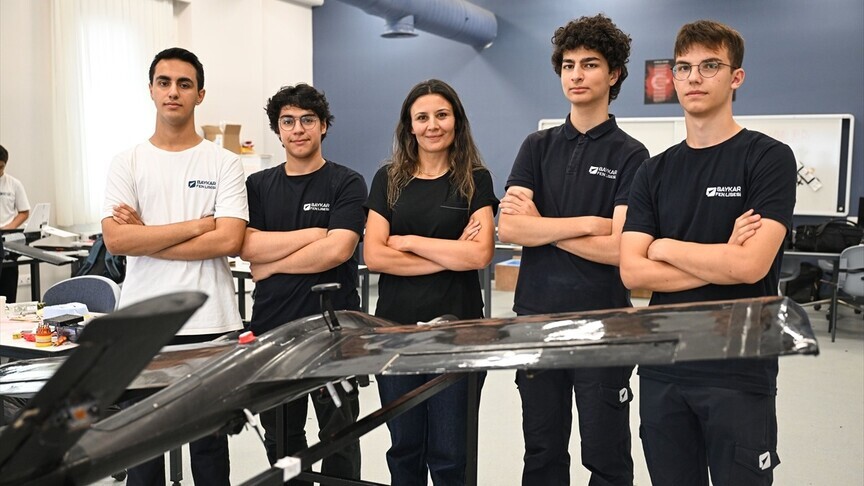
Baykar Science High School in Turkey opens admissions for top students
ISTANBUL (AA)
A special educational program allows students to work in Baykar's workshops and collaborate with its engineers to develop drone and AI projects.
The special aptitude test will be held on July 19 in 25 provinces.
The school offers 72 seats: 24 in information technology and 48 in aviation and space.
Baykar Science High School is the first and only school in Turkey to implement a special educational program aimed at preparing young people for the future of the 'National Technology Initiative,' through its specialized curricula in information technology, aviation, and space. Its admission test will be held on July 19 in 25 provinces.
The school contributes to strengthening Turkey's qualified human resources in the technological field by enabling secondary school students to transform their theoretical knowledge in information technology, aviation, and space into practical projects and products.
In an interview with Anadolu, school principal Vedat Karabayır said that students who ranked in the top 1% in the high school entrance exam can apply to the school via the official e-school system (E-Okul) after results are announced.
Karabayır explained that the special aptitude test will be held on July 19 at 10 a.m., consisting of 30 questions: 10 in mathematics, 10 in science, 5 in information technology, and 5 in aviation.
He noted that last year, 1,618 students took the school's test; 72 were accepted to the main list and 210 to the reserve list.
He added that the school currently has 226 students in preparatory, 9th, and 10th grades, most of whom reside on campus, which provides all needs through workshops, educational buildings, and student dormitories.
Karabayır also stated that the test will be organized in 25 provinces, including two centers in Istanbul.
He pointed out that 61 of the 72 students who enrolled last year were from Anatolian cities.
**Preparing Cadres for the National Technology Initiative**
Karabayır emphasized that Baykar Science High School is one of the educational institutions forming the infrastructure of the National Technology Initiative.
He explained that students go through two stages of admission.
He noted that the school does not limit itself to traditional science school curricula but also offers specialized courses in information technology and aviation.
He added: 'Our students take these lessons from the preparatory grade and undergo an intensive program of 45 class hours per week. After school, students can continue working in the workshops until 10 p.m., sometimes until morning, because their main goal is production and innovation.'
Karabayır continued: 'These young people will work, succeed, and serve their country in the future; that is our goal.'
He added that students work side by side with Baykar engineers, saying: 'They go to Baykar facilities, work in its workshops, and handle machines directly.'
Karabayır explained: 'We aim for them to graduate with knowledge comparable to what is taught at many universities.'
He noted that geopolitical developments in the region around Turkey and advances in the defense industry are a great source of inspiration for young people.
Karabayır said: 'When we look at what is happening around us, we see that Turkey lies in a circle of crises, yet we live safely in our homes.'
He continued: 'Contributions of important institutions like Baykar to the defense industry give this nation strength and confidence.'
Karabayır pointed out that young people look up to Selçuk Bayraktar, Chairman of Baykar, and Haluk Bayraktar, the company's General Manager, as role models.
In this regard, he said: 'They follow in the footsteps of those they consider role models and believe that we can make the best and achieve.'
**Applications Continue Until July 14**
Meanwhile, Mahmut Sami Başarıcı, the representative of the Turkish Technology Team Foundation (T3) at the school, said applications will remain open until July 14.
Başarıcı explained that students in the top 1% can apply for the special test via the e-school system, and the test will be held in 25 centers across provinces on July 19, with results announced in the following days.
He noted that the school offers 72 seats: 24 in information technology and 48 in aviation and space technology.
Başarıcı stressed that achieving the National Technology Initiative depends on young generations.
He said: 'We believe this initiative is realized through generations who turn their curiosity into discovery, their knowledge into production, and their dreams into a future that serves the homeland.'
He added that the school is the first and only in Turkey to implement a special program at the science school level, allowing students to develop their skills in various sub-disciplines of information technology, aviation, and space through advanced courses.
**Students Prepare for Global Competitions**
Başarıcı explained that they place great importance on students' participation in international competitions and visits to scientific centers around the world.
He noted that there are 8 drone teams, 1 armed drone team, and 3 teams preparing for global robotics competitions.
Başarıcı added that students are working on reverse engineering projects for humanoid robots and autonomous vehicles, and aim to improve their models according to international competition requirements.
He stated that the drone teams aim to reach the finals of the Teknofest festival, while the armed drone team prepares to compete in the SUAS competition to be held in the United States in September.
Başarıcı said: 'We always believe that the only difference between advanced nations and underdeveloped nations is qualified competencies. We believe that the projects our students carry out at this age will develop rapidly and contribute strongly to our country's future.'
Student Yunus Emre Karlı said his team drew inspiration for their drone design from the Akıncı drone produced by Baykar.
Karlı explained that the drone, named 'Deli Vişek' (Wild Bullet), is entirely their design and software.
He continued: 'We developed the airframe, software, and electronic components of the drone with a team of ten students, and received support from Baykar engineers.'
Karlı noted that they conducted the first test flight two weeks ago at Hezarfen Airport in Istanbul, and their next goal is to achieve outstanding results in the SUAS competition, which brings together university and high school students from around the world.
**A Drone for Earthquake Zones**
Student Ahmet Burak Demiralay, from Antalya province (southwest), said he completed the preparatory grade and will start 9th grade next year.
Demiralay explained that he has been interested in aviation since the third grade.
He added: 'I came to Baykar School to realize this dream, and I am grateful for the education I receive here. My future goal is to become an aeronautical engineer.'
Demiralay noted that they are developing a drone dedicated to disaster and earthquake zones, which scans debris sites using image processing and artificial intelligence techniques.
Original source: Anadolu Agency




Comments (0)
Be the first to comment.