Trump administration adds 200 utilities to voluntary deal on AI energy costs

President Trump's administration is widening a voluntary agreement with tech companies to cover the full cost of data center power, aiming to prevent AI-driven rate hikes for households and businesses.

This report was compiled by the staff of Al Jazeera and the Associated Press.
The rapid expansion of data centers to support artificial intelligence has raised concerns about surging electricity demand and potential rate increases for households and businesses.
Published On 23 Jul 202623 Jul 2026
US President Donald Trump’s administration has said it will expand a voluntary pledge seeking to shield consumers from the energy costs of the rapid expansion of data centres, mostly used by artificial intelligence companies.
On Thursday, the White House revealed it is bringing state governors and electric utilities into the accord, originally established with technology and AI companies in March. However, the administration refrained from imposing binding measures.
Recommended Stories
list of 3 items
- list 1 of 3Hundreds of experts warn the world must prepare now for AI’s impact
- list 2 of 3Can AI systems make moral decisions in war?
- list 3 of 3‘Unprecedented’: OpenAI says AI models autonomously hacked another company
end of list
The White House called the expansion of the pledge “historic”, saying 200 additional utilities, data centre developers and states would join it.
The pledge outlines a 'public commitment' requiring large-scale tech firms, AI companies, and the utilities and data center developers that support them to generate, procure, or purchase all the kilowatts their operations require and to finance the entire infrastructure needed to supply that power.
The agreement specifies that the financial burden of AI's energy consumption will not fall on consumers.
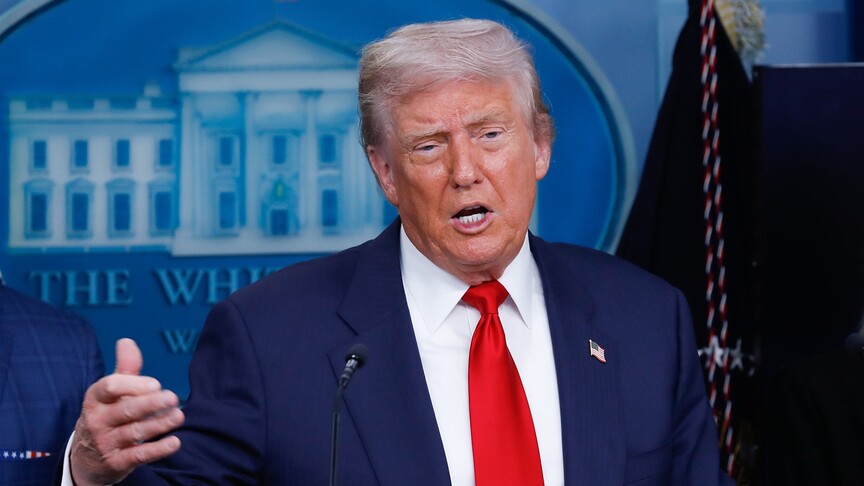
In remarks about the pledge at the Environmental Protection Agency on Thursday, Trump called on the gathered executives and governors to sell the public on data centres, stressing that the cities and towns that have them will be “rich.”
“You have to convince your community. You can’t fight it. You have to go with it,” Trump said.
“If you don’t take all that money, somebody else is going to take it. You might as well do it yourselves.”
The US president has been a strong advocate for AI, which has become an enormous source of investment and a key priority for the country’s powerful tech sector. Trump has approached the sector, which includes some of his close allies, with a light regulatory touch during his second term.
But increased electricity demand from AI data centres could spur an increase in monthly utility bills between 15 and 40 percent by the year 2030, according to an analysis by the consulting and technology services company ICF.
A May Gallup poll suggested that seven out of 10 people in the US oppose the construction of AI data centres in their area, with about 48 percent saying they were strongly opposed. Slightly more than 25 percent said they favoured such efforts, with only 7 percent saying they strongly favoured them.
Concerns over the impact of such centres on the cost of utilities, such as electricity and water, are commonly cited as reasons for opposition, along with quality of life concerns and scepticism about the benefits of AI.
Some elections across the country have seen AI data centre construction emerge as a prominent issue, but the industry has pushed forward with plans to rapidly scale up infrastructure for the technology.
A poll from Johns Hopkins University in June suggested that Americans strongly favour greater regulation of AI, and about 60 percent of respondents said they expected AI to increase inequality over the next decade.
Four in 10 respondents said that AI companies stand to increase their power the most from the expansion of the technology, while just one in 10 said that individuals would gain the most.
The voluntary nature of the pledge has drawn criticism from consumer advocates who argue it lacks teeth. Trump's remarks urging executives to 'sell' data centers to communities underscore the political sensitivity of the issue. With 200 new signatories, the agreement now covers a significant portion of the industry, but compliance remains optional. Observers will watch whether states and utilities follow through on commitments, and whether future administrations might impose mandatory rules to protect ratepayers.
Original source: Al Jazeera


Comments (0)
Be the first to comment.