Dust Columns Swirling: A Meteorological Phenomenon Caused by Earth's Surface Heat
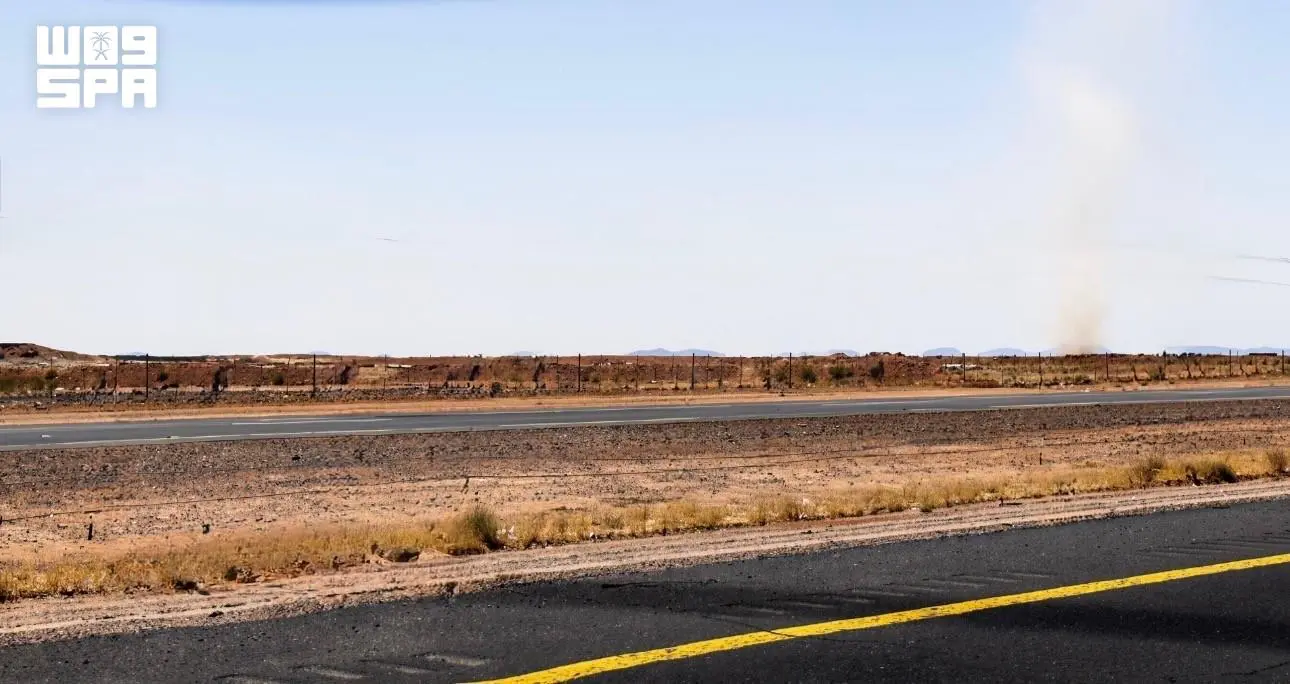
Dust devils, locally known as 'dust whirls,' are common local meteorological phenomena in desert and open areas during the summer, as they form due to the significant rise in the temperature of the Earth's surface, accompanied by ascending air currents that rotate around a vertical axis, stirring up sand and dust and lifting them to varying heights. Burjis Al-Fulayh, a member of the 'Afaq' Society for Astronomical Sciences, explained to the Saudi Press Agency (SPA) that a dust devil is a short-lived phenomenon whose size and activity intensity vary depending on the nature of the Earth's surface and soil type, forming as a rotating column of sand and dust that moves for limited distances before gradually dissipating.
He stated that this phenomenon forms as a result of the temperature of the air in contact with the Earth's surface rising compared to the surrounding air, which causes the hot air to rise and cooler air to flow in to replace it. With slight differences in wind directions, a rotational motion occurs, producing an air vortex capable of carrying sand, dust, and light objects.
He pointed out that the recurrence of this phenomenon has noticeably decreased in recent years, thanks to improved vegetation cover, through the expansion of nature reserves, intensified afforestation efforts, prevention of illegal logging, and regulation of grazing activities, which has contributed to reducing the formation of dust devils.
He noted that dust devils are frequent during periods of atmospheric stability and are usually not associated with thunderstorms or low-pressure systems, unlike tornadoes that form within cumulus clouds and are characterized by their strong impact and wide range.
Al-Fulayh emphasized that dust devils, despite their generally limited impact, can lead to a temporary reduction in horizontal visibility, stir up dust, and move light objects, necessitating caution, especially on open roads, desert areas, and field activity sites.
He explained that this phenomenon is a seasonal natural feature in dry environments, and its formation opportunities increase during noon and afternoon hours with the rise in Earth's surface temperature, before gradually weakening as surface heating decreases and evening approaches.
Original source: Al-Mowaten



Comments (0)
Be the first to comment.