Severe Heat Wave Tests Egyptian Government 'Promises'
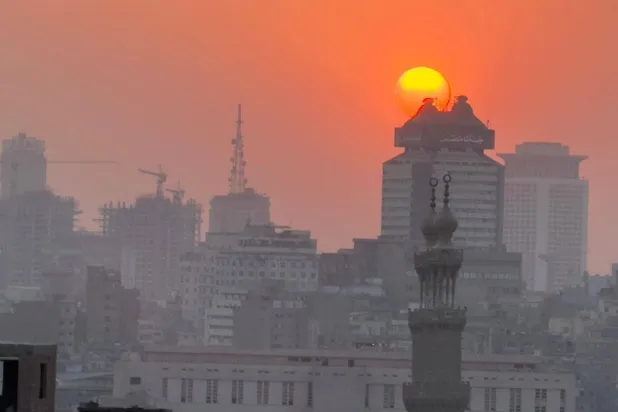
Complaints have multiplied in Egypt about sporadic power outages in some areas, especially those with high population densities, coinciding with a severe heat wave across the country, testing repeated government promises not to resort to the 'load shedding' plan that had been implemented in previous years.
Residents in several governorates, most notably the capital Cairo, Giza, and the Red Sea (east), have complained of power cuts in recent days. Social media platforms saw interaction from some of those affected by the outages, demanding an explanation for their continuation for long hours at different intervals.
5 hours at night
Mohamed Sayed, who lives in the working-class Faisal area of Giza governorate, indicated in a post on his Facebook page that the power cut off widely in the area for 5 hours at night, and that officials gave various justifications, with some confirming it was part of a 'load shedding plan' and others denying it, pointing to a fault in the main electricity grid in the area.
Local newspapers reported a complaint from tourism sector workers in the city of Hurghada in the Red Sea governorate, a prominent tourist destination in Egypt, noting that outages occur almost daily without an official announcement explaining the reasons for the cut or the expected time for service restoration.
Urgent statement
Member of Parliament from the 'Homeland Protectors' party, Faisal Abu Areeda, submitted an urgent statement on Wednesday addressed to the Prime Minister and the Minister of Electricity and Renewable Energy, regarding the crisis of severe voltage fluctuations in the city of Saff, one of the cities in Giza governorate.
Abu Areeda described the recurrent rise and fall in voltage as 'gross negligence threatening citizens' lives and property,' calling for rapid intervention to take urgent measures to ensure stability of the power supply and protect citizens from the damages resulting from this crisis.
The Egyptian government has repeatedly denied any intention to implement a load shedding plan or return to scheduled power cuts, affirming that the national grid is operating stably, and that the outages in some areas are due to emergency technical faults resulting from the significant increase in loads and temperatures, and are being dealt with and repaired immediately.
Lack of coordination
Member of Parliament from the 'Egyptian Democratic Party', Ihab Mansour, attributed the repeated outages to several factors, most notably the lack of coordination between local administrations and ministries regarding road and utility development projects in various areas, which results in frequent faults in electricity cables or water pipes.
In a statement to Asharq Al-Awsat, he explained that most areas experiencing outages suffer from infrastructure problems, unlike new cities, which is reflected in the electricity networks that need continuous maintenance, adding: 'Negligence causes a decline in network performance rates, especially during peak periods when electrical loads increase, leading to constant failures.'
However, he stressed at the same time that the Egyptian government remains committed to its previous pledges not to resort to the 'load shedding' plan during the summer months, and that reliance is on continuing this until the end of the peak months.
Egyptian Minister of Electricity follows up on the stability of the national grid (Egyptian Ministry of Electricity)
Local newspapers quoted sources at the Ministry of Electricity as saying that the sporadic power outages are due to sudden technical faults in some components of distribution networks, as a result of high loads and high temperatures, and that the relevant electricity distribution companies dispatched emergency and maintenance teams as soon as reports were received, gradually restoring power to areas that had completed repairs.
The Ministry of Electricity had announced at the beginning of this month 'raising the state of readiness to the maximum level in all electricity distribution companies, with intensified preventive maintenance work, and deploying emergency and rapid intervention teams to ensure prompt handling of any emergency faults and continued power supply, especially during evening peak periods.'
The Egyptian General Authority of Meteorology announced on Wednesday that high temperatures will continue until next Monday, noting that Wednesday and Thursday will see the peak of the heat wave, with temperatures on the northern coasts ranging between 33 and 35 degrees Celsius, in Greater Cairo and the Nile Delta between 38 and 39 degrees, while southern governorates will record between 40 and 43 degrees Celsius.
The Egyptian Ministry of Electricity said on Wednesday that the 'Unified National Electricity Grid' recorded its highest load rates since the beginning of this year, with the maximum load reaching 39,000 megawatts on Tuesday evening, an increase of 2,000 megawatts compared to the same period last year, amid the significant rise in temperatures and increased electricity consumption rates during the summer.
Original source: Asharq Al-Awsat

Comments (0)
Be the first to comment.