90 Million Years Old: Russia Reveals Secrets of the Oldest Fossil Pearls
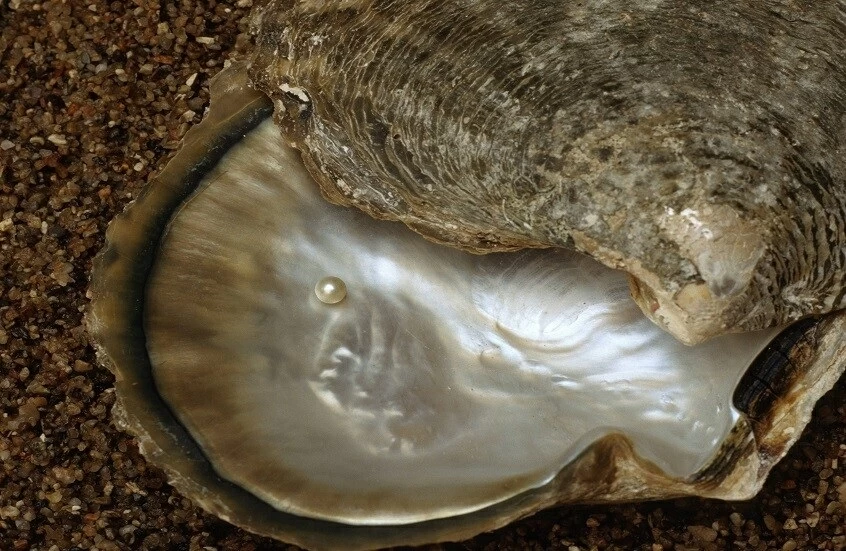
Russian researchers have successfully documented and studied a rare fossil pearl dating back about 90 million years, found in Cretaceous marine deposits in the Voronezh region. The discovery is described by scientists as an important addition to understanding the evolution of marine mollusks and the environmental conditions that prevailed in Earth's seas millions of years ago.
Russian researcher Lev Shelekhin explained that the pearl was discovered in marine deposits from the Upper Turonian stage, near the village of Losevo in the Voronezh region, noting that it is the first fossil pearl from bivalve mollusks to be scientifically described at this level of detail in Cretaceous deposits within Russia.
Shelekhin emphasized that the importance of this discovery lies not only in its rarity, but in the scientific information it provides about the mechanisms of pearl formation in ancient mollusks and how they interacted with foreign bodies and injuries they encountered in ancient marine environments.
He pointed out that large bivalve marine mollusks were widespread in Cretaceous seas and were characterized by large shells with thick layers of the mineral calcite, which helped preserve the pearl inside them in good condition for tens of millions of years.
He added that fossil pearls are among the rarest fossils found by scientists, due to their high content of organic materials, which decompose easily over time, making their chances of survival in the geological record extremely limited.
Geological treasure from the age of dinosaurs
Microscopic examination of the sample revealed that the pearl initially formed as a free pearl inside the mollusk’s body, then later attached to the inner surface of the shell, transforming into what is scientifically known as a 'blister pearl'.
Researchers also found a small nucleus inside it, believed to have formed after a foreign body, such as a fragment of shell or a grain of sand, entered the space between the mantle and the mollusk's body, prompting the marine animal to secrete successive layers of minerals to protect itself. This is the same natural process by which modern pearls are formed.
The Cretaceous period extends from about 145 to 66 million years ago and is the last period of the Mesozoic Era. It witnessed the flourishing of dinosaurs before their extinction at its end, and was characterized by widespread shallow seas that hosted a huge diversity of marine organisms, including bivalve mollusks, ammonites, and gastropods.
A pearl forms when a foreign body enters the mollusk, prompting the animal to secrete successive layers of minerals and organic materials around it to isolate it. This is a natural defensive mechanism that transforms over time into a pearl.
Original source: Okaz






Comments (0)
Be the first to comment.