Germany: Fears of Future War Involvement and Concerns Over Slow Military Expansion
Germans are increasingly worried about their country becoming embroiled in a war within the next five years, amid concerns that government plans to expand the Bundeswehr may not be successful.
Germans are increasingly concerned about the potential for their country to be involved in a war within the next five years, amidst fears that the government's plans to increase the size of the Bundeswehr may not succeed. A survey published by Tagesspiegel magazine showed that one-third of respondents believe Germany will be involved in a war in the coming years, and 86 percent stated that cyberattacks and disinformation campaigns have increased recently.
A session of the German Parliament (Bundestag) (Reuters)
The Federal Office for the Protection of the Constitution, Germany’s domestic intelligence agency, mentioned in its annual report earlier this month that hybrid attacks, espionage operations, and disinformation campaigns have indeed increased in Germany, holding Russia primarily responsible.
U.S. President Donald Trump hosting German Chancellor Friedrich Merz at the White House early last March (Reuters)
According to the survey, which polled 2,500 people and was conducted by the consulting firm PwC in cooperation with the Civey research institute, more than half of Germans believe the government's plans to reduce social welfare spending to increase military expenditure are "justified." Furthermore, 70 percent no longer reject the idea of a European defensive nuclear umbrella. The main reason for this is that half of the respondents no longer view the United States as a reliable partner in the event of war.
Chaos inside the Bundestag after Merz failed to secure the necessary votes in the first round (DPA)
The United States has stationed secret nuclear weapons in Germany since the end of World War II and maintains between 35,000 and 39,000 troops spread across nearly 40 military bases throughout the country. Germany has relied on the U.S. for its security since the end of the war, but recently, U.S. President Donald Trump announced his intention to withdraw 5,000 American troops from Germany.
Despite the symbolic nature of the number, the deteriorating political relations between Germany and the United States since the beginning of the Trump era are causing significant concern in Berlin, raising questions about its ability to continue relying on the American security umbrella for protection.
German Chancellor Friedrich Merz and the Minister of Defense inside the Bundestag during the vote on the conscription law (Reuters)
Despite rising security concerns in Germany, 75 percent of respondents do not believe the Bundeswehr will become the "strongest army in Europe by 2035," as claimed by Chancellor Friedrich Merz and his government's plans to increase the number of troops from the current 180,000 to 480,000 by 2035, including more than 200,000 reservists.
Members of Parliament vote on the 2026 government budget bill during a plenary session (Reuters)
To achieve this, the German government approved plans for voluntary conscription, and the army began sending out forms at the start of the year to every 18-year-old, asking about their willingness to perform military service. Although the first part of the year saw an increase in the number of recruits compared to the previous year, progress in recruitment remains slow. Out of more than 300,000 forms sent out since the beginning of the year, approximately 530 individuals have been recruited.
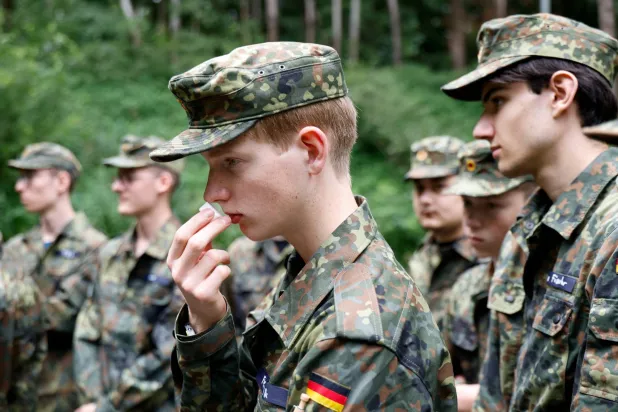
The German flag on a Bundeswehr uniform (Reuters)
According to government plans, the size of the army is supposed to grow in the first year following the passage of the conscription law—adopted at the end of last year—from 180,000 to between 186,000 and 190,000. In fact, the army announced at the beginning of the year, before the distribution of forms began, that the number of personnel had risen to approximately 186,500 as of January.
Lieutenant Colonel Wolfgang, head of the consulting department at the Bundeswehr recruitment center in Berlin, told Asharq Al-Awsat that the increased interest in joining the military began in 2023 and continued to rise over the following two years. He added that he "noted a significant rise this year in general inquiries, consultation requests, appointment scheduling, and actual enlistment applications" as the new military service model began implementation.
Military training for the Bundeswehr at the Pfreimd barracks in Bavaria (Reuters)
According to Lieutenant Colonel Wolfgang, young people joining the army carry a general concern about the security situation in the country. "Fortunately, many of them also realize the value and purpose of military service, specifically making a substantial contribution to national security and the defense of the country." The Bundeswehr periodically organizes recruitment campaigns in public spaces and schools, targeting students over the age of 15.
From left: German Chancellor Friedrich Merz, Ukrainian President Volodymyr Zelenskyy, French President Emmanuel Macron, and British Prime Minister Keir Starmer speaking at a press conference following the "Coalition of the Willing" summit on security guarantees for Ukraine in Paris, July 13, 2026 (AP)
Lieutenant Colonel Wolfgang said that at these events, professional military advisors try to highlight the positive aspects, focusing for example on the "sense of purpose and contributing to national security and national defense." Advisors also try to attract young people by discussing other positive aspects such as "building team spirit." The Lieutenant Colonel says: "We have our motto, 'We Serve Germany,' which reflects our identity as a military community serving the nation and the country. It is about the bigger picture, camaraderie, training, and professional development."
A prototype of the "Capint" tank that will emerge from German-French KNDS factories, shown at a defense exhibition in Villepinte near Paris, June 15, 2026 (Reuters)
The Lieutenant Colonel does not believe the legacy of the German army plays any role in attracting new recruits, even though the image of the Bundeswehr in many people's minds still carries negative connotations due to its history. He says the German army is now part of a democratic system, adding: "This is part of our work, and critical voices are also part of democracy; we face them with an open mind."
With the introduction of the conscription law and increased fears of Germany potentially being involved in a war soon, applications from young people requesting exemption from military service based on "conscientious objection"—which is permitted by law—are also increasing. According to figures from the Federal Office for Family and Civil Society Affairs, the military has received more than 5,800 applications for exemption based on conscientious objection, an increase of approximately 2,000 compared to last year.
Tomahawk missiles are primarily launched from submarines and warships (AFP - CENTCOM)
German military advisor Martin Bieber attributes the hesitation of young people toward military service to them being "burdened by many issues, from the effects of the coronavirus pandemic to the high cost of living, high rents, and limited job opportunities, in addition to a strong climate movement that affects many of them." He adds: "Faced with all this, many young people feel dissatisfied and do not want to take on additional responsibilities, nor carry the burden of the country's security."
The German Chancellor and the Ukrainian President on the sidelines of the Paris Summit, Monday (AFP)
Original source: Asharq Al-Awsat



Comments (0)
Be the first to comment.