With orange lips and a roar-like call... New monkey discovered in Congo forests
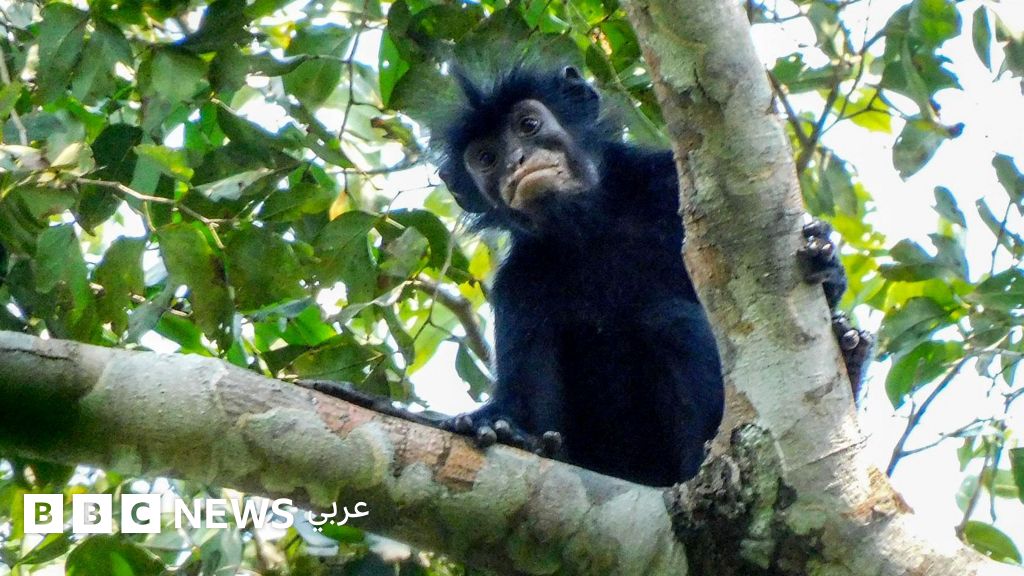
First spotted in 2008, and after a second sighting and observation, scientists confirmed that the 'Likweli' monkey represents a new primate species.
With orange lips and a roar-like call... New monkey discovered in Congo forests
Image caption, The black monkey has orange lips and is called 'Likweli' by locals
Article Information
Author, Victoria GillRole, Science correspondent
Published 3 hours ago
Reading time: 3 minutes
In the forests of the Democratic Republic of Congo lives a monkey with a black face and pinkish-orange lips, which scientists have discovered belongs to a previously unknown species.
The monkey was spotted and photographed hiding among the high treetops in the dense tropical forests of Lomami National Park in the east-central part of the country.
Wildlife conservationists first reported sighting this unusual animal in 2008, but were only able to capture a single blurry photo of it at that time.
Discovery of a new species of 'orangutan'
After spotting it again a decade later, an international team began searching for and studying it, revealing it to be a new species unknown to science.
This is the fifth species of African monkey discovered in the past 75 years.
Junior Amboko, a PhD student at Florida Atlantic University, played a key role in the research, which included recording the monkey's calls, photographing it, and conducting detailed genetic studies.
The results of the study were published in the scientific journal PLOS ONE.
Skip most read and continue reading
Iran responds to Washington with attacks on several Arab countries, warning 'anyone who hosts American bases on their territory'
Egypt's Future Apparatus: State withdrawal from the economy or reshaping its role?
This is our last chance to defeat the rising right in Britain – The Guardian
"The Odyssey" in cinemas, what do we know about Christopher Nolan's film?
Amboko told BBC News that looking at the face of an animal that very few people know exists was 'an amazing feeling'.
A shy species living in hiding
Image caption, Junior Amboko (left) and Mardochée P. Koko recorded the distinctive, resonant roar-like call of the newly discovered monkey in Lomami National Park in the Democratic Republic of Congo.
The 'discovery' of this species does not mean the monkey was unknown before; rather, scientists have officially recorded its existence and confirmed it is genetically different from other species due to an independent evolutionary path.
Some local residents were aware of its existence and call it 'Likweli'.
But Amboko said these monkeys are 'somewhat shy' and often hide in the treetops.
He added: 'During the research, we interviewed residents of 52 villages near the areas where these monkeys live, and only residents of eight villages had ever seen them.'
The research team, which included scientists from the Democratic Republic of Congo, the United States, and Germany, gave the species the Latin scientific name Colobus congoensis, referring to the country's natural diversity.
The monkey belongs to the broader group known as colobus monkeys.
Professor Kate Detweiler from Florida Atlantic University said: 'They are extremely important African monkeys, and one of their most notable features is that they lack thumbs.'
Skip content and continue reading
How scientists benefited from the blood of an American who injected himself with snake venom and was bitten hundreds of times? And what would you do if you were bitten by a snake?16 May/May 2025
end content
Professor Detweiler said: 'These monkeys feed on plants and live in the upper layers of the forest, playing a key role in the ecosystem. We believe they contribute significantly to seed dispersal and helping seeds germinate.'
Detweiler suggests that the bright and unusual markings on their faces may be a means of visual communication with other animals, helping them attract a mate or distinguish each other.
These monkeys also have a distinctive roar-like call. Amboko said: 'You often hear their calls without being able to see them.'
Researchers believe their numbers are small, and their presence is limited to a specific area of the forest that provides their food and habitat needs.
These monkeys are hunted for their meat, so researchers hope that classifying Colobus congoensis as an independent species will allow it to be placed under official protection.
The team says many questions remain about this newly described species that is difficult to spot. The researchers plan to conduct a more detailed survey to estimate its numbers and study its behavior.
Skip short clips and continue
Short clips
End of short clips
We can now track animal panic from space, why does it matter?28 May/May 2026
No males for 100,000 years: the fish that baffled evolution theory6 June/June 2026
A squirrel inspires scientists to trigger a medical revolution in treating critical conditions, what's the story?5 July/July 2026
Original source: BBC Arabic






Comments (0)
Be the first to comment.