Constitutional and legal crisis rocks Mauritanian parliament
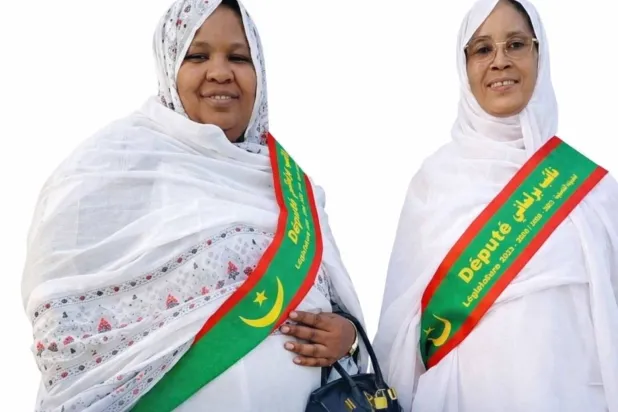
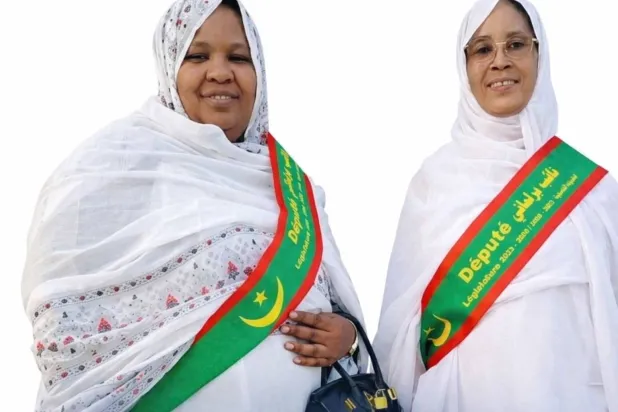
Mohamed Ould Mekt, the President of the Mauritanian Parliament, defended sanctions he imposed against two opposition female lawmakers following a sit-in in the parliament building, a penalty that sparked widespread controversy and was firmly rejected by the opposition, who considered it evidence of the absence of separation of powers in the country. Several parliamentary groups also denounced the sanctions decision, describing it as legally and politically void and contrary to the spirit of the constitution.
Last Monday, the Mauritanian Parliament decided to temporarily expel lawmakers Mariam Cheikh and Gamou Aichour, due to what it said were 'gross acts' committed by the two lawmakers when they staged a sit-in inside the parliament building, which it considered an 'infringement on the sanctity, dignity, and proper functioning of the parliamentary institution.'
President of the Mauritanian Parliament during a parliamentary session last Monday (Mauritanian Parliament)
The case began last April when police arrested the two lawmakers after they appeared in a live broadcast on Facebook containing statements described as 'personal insults' against the president. In May last year, the criminal chamber of the West Nouakchott Court of First Instance convicted the two lawmakers and sentenced them to four years in prison. However, the Court of Appeal reduced the sentence to two years and added a ruling barring them from political and civil rights for five years. But they left prison under a presidential pardon.
However, despite the presidential pardon, controversy escalated over the ban on their political and civil rights, especially after they were prevented from entering the parliament building, even though the Constitutional Council issued a decision refusing to confirm the loss of parliamentary membership for activists Mariam Cheikh and Gamou Aichour.
The dispute escalated when the two activists managed to enter parliament secretly in a car belonging to one of the deputies and decided to stage a sit-in to protest what they said was the government's attempt to prevent them from taking their seats in parliament. However, after negotiations with the activists, the President of Parliament decided to resort to public force to compel them to end the sit-in, before deciding to punish them with temporary expulsion.
* Separate case
In a public parliamentary session yesterday (Tuesday), the President of Parliament said: 'We believe in the separation of powers, and no party can force us to take any decision we are not convinced of. What drives us is only the law and the internal regulations,' indicating that the sanctions were imposed in accordance with the internal regulations of Parliament and in line with the constitution.
The President of Parliament added: 'We respect the Constitutional Council and respect its decisions, and no one will put us in conflict with the Constitutional Council or in confrontation with the judiciary,' stressing that the sanctions imposed by Parliament are separate from judicial rulings and that he took the Constitutional Council's decision into account. In this regard, he said: 'My duty as President of Parliament is to apply the law. If we had not taken the Constitutional Council's decision into account, we would not have imposed the punishment on them as deputies. But it is not their right to exploit their parliamentary status to cause chaos and turn the parliament building into a platform outside official working hours.'
* Opposition rejection
Despite the President of Parliament's defense of his decisions, the opposition rejected them strongly. Opposition lawmaker Kadyata Malick Diallo said that the Parliament Presidency 'is evading the Constitutional Council's decision,' explaining during a parliamentary session that expelling deputies due to a sit-in is unprecedented in the history of the Mauritanian Parliament.
From a previous session of Mauritanian parliament members (Mauritanian Parliament)
Diallo added that opposition deputies had previously staged a sit-in in the parliament building for two days to protest the 2008 coup, 'and they were not expelled from parliament. We repeated that in 2019 when the parliamentary session was not opened at the time it should have been, always in defense of the constitution.'
In this context, several parliamentary groups denounced the sanctions decision, describing it as legally and politically void and contrary to the spirit of the constitution, and labeling what is happening as a 'constitutional and institutional crisis' and a 'serious deviation' due to the obstruction of Constitutional Council decisions.
In a joint statement, the opposition parliamentary blocs said that what the two activists faced, starting from being prevented from entering parliament and being forcibly removed, to being penalized, represents an 'unprecedented legal and political paradox, which can only be interpreted as an attempt to circumvent the Constitutional Council's decision and empty it of its content.'
The opposition decided to boycott some parliamentary sessions in protest against the process followed against the two lawmakers, Gamou Aichour and Mariam Cheikh.
Original source: Asharq Al-Awsat




Comments (0)
Be the first to comment.