Date back eight decades.. Rare photos of Istanbul join Anadolu's archive
Turkey Reports
Date back eight decades.. Rare photos of Istanbul join Anadolu's archive (Report)
The visual archive of Anadolu Agency has received a rare collection of historical photographs taken by the renowned Swedish photographer Carl Werner Göllers in the Turkish city of Istanbul in the late 1940s.
Hişam Sabanlıoğlu, Nisanur Koç
July 22, 2026 • Updated: July 22, 2026
ANKARA
ANKARA / Nisanur Koç / Anadolu
- More than 200 photos taken by the famous Swedish photographer Carl Werner Göllers in 1947
- The photos document architecture and daily life in Istanbul and enrich Turkey's visual memory
- They reveal a transitional phase experienced by Istanbul following World War II and the blending of modernity with traditional patterns
The visual archive of Anadolu Agency has received a rare collection of historical photographs taken by the renowned Swedish photographer Carl Werner Göllers in the Turkish city of Istanbul in the late 1940s.
The photos were transferred to Anadolu after completing the necessary legal procedures to obtain their usage rights, becoming part of Turkey's documented visual memory.
This step came within the framework of a project implemented by the Special News Directorate for the Visual Archive at Anadolu Agency, aimed at recovering photos related to Turkey preserved in libraries, museums, and cultural institutions outside the country, and making them available within the agency's archive to contribute to documenting and preserving the country's visual history.
The agency obtained the rights to use the photos preserved within the Nordiciska Museum collection in Sweden, in compliance with intellectual property rights regulations, before transferring their high-resolution copies to the agency's archive upon completing all legal procedures according to internationally approved standards in archive management.
The collection includes photos taken by Göllers during his visit to Istanbul in 1947, documenting the city's architectural features and daily life, alongside special photos taken for the Swedish national airline at the time.
The photos include scenes from the airport in Istanbul, shots of passengers and pilots, as well as various scenes of daily life details.
Through these initiatives, Anadolu continues to enrich its visual archive by collecting historical photos related to Turkey found in museums and libraries outside the country, thereby enhancing the preservation of the national visual memory for future generations.
** Precise details about daily life in Istanbul
The photos reflect the condition of Istanbul in an important historical phase, as they document a city that did not suffer the destruction left by World War II and preserved its traditional urban fabric and social vitality thanks to its adherence to neutrality throughout the war.
The photos highlight precise details of daily life in the city, giving them a documentary value that transcends the artistic aspect.
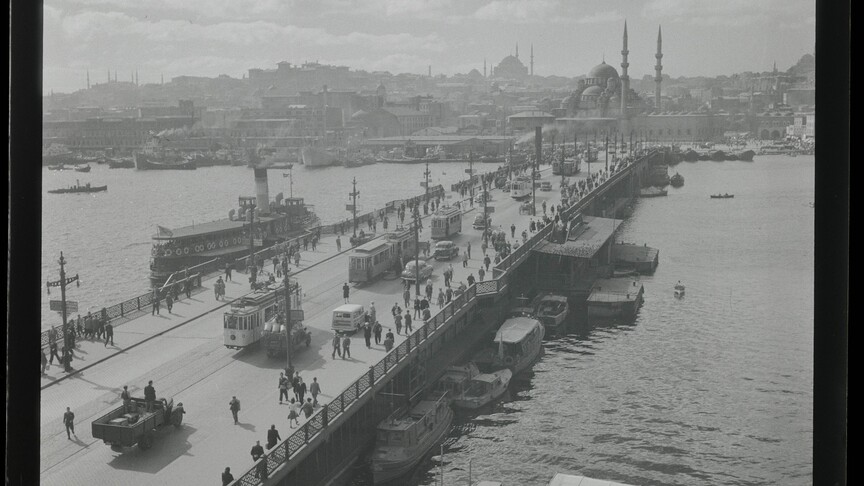
The collection includes more than two hundred photos stretching from the Galata Bridge to the Karaköy area, and from the Eminönu area to the inner alleys, combining Istanbul's busiest areas and its quiet places at the same time.
Göllers' interest was not limited to photographing buildings and historical landmarks only, but he placed humans at the heart of his works, so the photos came full of scenes reflecting the details of daily life for the city's residents.
Among the most prominent things documented by the collection is the Grand Bazaar, one of the oldest shopping centers in the world, where its historical corridors and antique arches appear flooded with light sneaking through the windows, in scenes that provide a visual document of one of the most important landmarks of Istanbul's cultural memory.
The photos also document the daily movement inside the market, from the activity of merchants to the interaction of customers.
Göllers repeatedly relied on natural light sneaking from windows to highlight the details of faces and shops, a style that characterizes many of his photographic works.
The photos also reveal the continuation of a number of professions whose roots date back to the Ottoman era, such as porters, carpet sellers, and watch repairers.
In one of the shots, two porters appear carrying large baskets on their backs while crossing the Galata Bridge, in a scene reflecting an aspect of the economic and social life of the city at that stage.
Other photos also document scenes of life in the streets, including small boats moored on the coast, and a street vendor displaying watermelons, details that reflect the rhythm of daily life in Istanbul about eight decades ago.
** A city combining modernity and traditions
Göllers' photos reveal a transitional phase experienced by Istanbul, where modern manifestations coexisted with traditional patterns of life in the city.
Street photos highlight the vitality of daily movement, while costumes, such as flat caps and elegant European hats, reflect the social and cultural diversity that characterized Istanbul during that period.
In one scene in front of the Galata Bonmarché store in the "Karaköy" area, tramways and modern cars appear alongside horse-drawn carriages designated for transporting firewood, in an image embodying a transitional phase in which modern and traditional means of transport shared the city's streets.
Small boats also appear in one of the photos sailing in the Golden Horn, with the minarets of the Süleymaniye Mosque rising in the background, in a scene reflecting the continued presence of the city's historical landmarks despite the modernization manifestations that began making their way then.
** Photos including the photographer himself
The collection is not limited to Istanbul's scenes alone, but also includes a number of photos in which the Swedish photographer himself appears while working.
In one of the shots, Göllers appears shaking hands with a photographer working in the street, while the latter's camera stands fixed on a tripod, in a scene reflecting the spirit of the profession and communication between photographers despite their different nationalities and languages.
Göllers is considered one of the most prominent photographers in Sweden during the 20th century, as he started practicing photography when he was twelve years old, before training under the famous portrait photographer Jan de Meyer, and later establishing his own studio.
He worked on preparing photo reportages for a number of famous magazines, including "Picture Post", "C", "V", and "Allers", and he also published about a hundred black-and-white and color photo books.
His works also included photographing some of the most prominent international figures, including Charlie Chaplin, Ingrid Bergman, and Alfred Hitchcock.
Today, his photos join the archive of Anadolu Agency to document an important phase of Istanbul's history and preserve it within Turkey's visual memory.
Original source: Anadolu Agency




Comments (0)
Be the first to comment.