Destroyed Bridges and the Story of Death on the Banks of the Euphrates in Syria
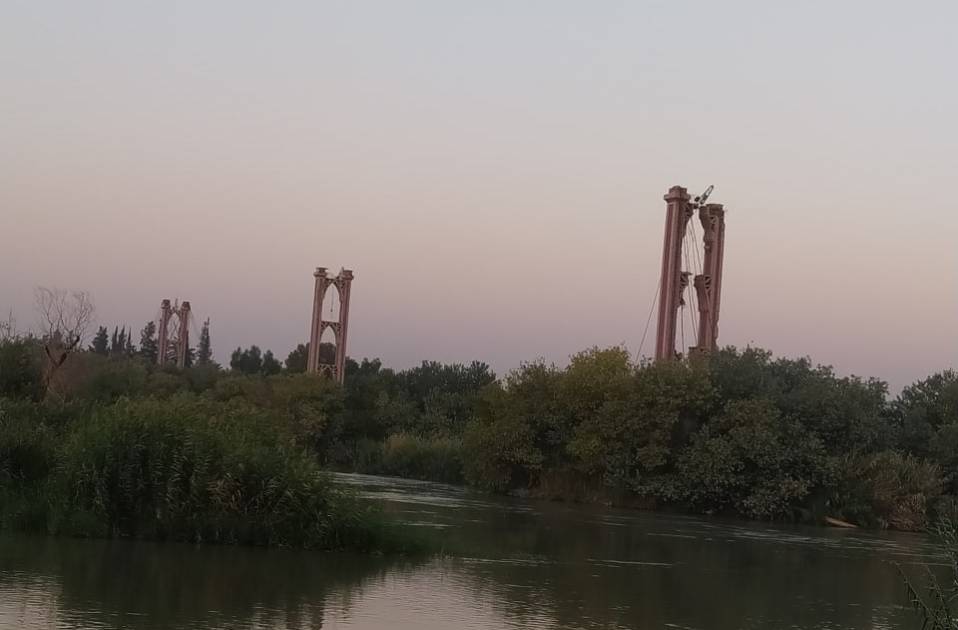
Summary The missing bridges, the severed links on both banks of the Euphrates in Syria. Their absence increases the likelihood of human disasters.
For the third consecutive day, rescue teams from the Syrian Civil Defense continue search operations for the missing of the 'river ferry,' the vessel that residents of Deir ez-Zor province rely on as the sole means of crossing between the banks of the Euphrates River, amid ongoing challenges facing search efforts to reach the missing.
The Repeated Story of Death
In an incomplete toll, the capsizing of the river ferry, which carried civilian residents of the area on July 12 of this month, resulted in the deaths of six people, including four children and two young men. The cause of the accident is attributed to the riverboat running out of fuel, the river sweeping it away with complete loss of control, and then its collision with the military bridge in Deir ez-Zor city, leading to the drowning of all aboard.
The dependence of residents of the Euphrates River area, on both banks, on the river ferry as a means of transport increased after widespread destruction of bridges due to the war in Syria, and the isolation of the eastern city, which tore apart rural areas from each other.
The Islamic State (ISIS) organization, before the fall of its 'caliphate,' besieged Deir ez-Zor and destroyed all supply routes in order to break the siege on its members. In 2013, upon taking control of the city, it destroyed main and secondary bridges, putting them out of service. This forced residents to rely primarily on boats and ferries for passenger transport, despite all the dangers posed by the only lifeline threatening the crossing process, in addition to the fact that the Euphrates River (originating in Turkey) has a strong current.
The story of the destroyed bridges in Deir ez-Zor is not a temporary humanitarian crisis but extends deeply for more than a decade, dating back to the height of the armed conflict in Syria (Independent Arabia)
Bridges and Lost Memory
Meanwhile, civil activist Ahmed al-Sheikh, a native of Deir ez-Zor, told Independent Arabia about the worsening bridge crisis after the recent flooding of the Euphrates River, and the total destruction of all emergency earthen bridges that residents, with the cooperation of the entire civil society, had built to transport emergency cases, patients, and the elderly, as well as small vehicles. However, the river's flood last May swept away the last glimmer of hope that people clung to, cutting the last thread of life, and returning Deir ez-Zor to its old isolation.
The destruction of bridges is not limited to cutting off the lifeline, but also destroys the memory and history of a country. The 'bridge' represents a connection, a story of life, and popular traditions. A decade ago, before the armed conflict and the popular movement to overthrow the Baathist regime and oust its head Bashar al-Assad, the passage of cars as part of wedding processions was one of the most prominent rituals of 'weddings' in Deir ez-Zor. The bride and groom would dismount and walk on the suspension bridge to take a commemorative photo.
The suspension bridge in Deir ez-Zor is more than an iron structure spanning the banks of the Euphrates; it is one of the most prominent main bridges in the city and its identity. Since it was put into service in 1931 during the French mandate, it has remained a symbol and witness to its place in the hearts of its people. From the heights of the bridge, adventure-seeking youths regularly line up to swim and dive into the depths of the roaring river, in addition to family gatherings at both ends of the bridge, a scene that enhances social cohesion among families, and friend meetings especially in the afternoon, and staying up on summer nights until the early hours of dawn.
For the third consecutive day, rescue teams from the Syrian Civil Defense continued search operations for the missing of the 'river ferry' (Independent Arabia)
Repair and Restoration
Faced with this reality, the people of Deir ez-Zor are at a loss, resorting to repeated crossings on river ferries, or previously via primitive bridges made by the local community. Aziz Kaser, a native of Al-Bukamal in the eastern countryside near the Iraqi border, speaks of 'a state of restlessness that the residents are experiencing.'
He added, 'Crossing by ferries involves a lot of great risk with the passing of torrential river currents. In addition, the cost of transport increases and the exploitation of people's need to cross, reaching more than one and a half dollars. With the daily repeated crossings of students, employees, and artisans to their workplaces, all this constitutes a financial burden.'
The story of the destroyed bridges in Deir ez-Zor is not a temporary humanitarian crisis but extends deeply for more than a decade, dating back to the height of the armed conflict in Syria.
Read more
Drowning in the Euphrates... Daily casualties amid lack of solutions
Who is behind attempts to export an insecure image of Syria?
The Euphrates River drowns Deir ez-Zor... What are the causes and dangers?
The Syrian Network for Human Rights documented attacks on bridges, which led to the repeated dismemberment of the city, reaching about 29 attacks, nine of which were by the former regime. The international coalition forces destroyed 15 bridges, while militant groups were responsible for destroying two bridges, and Russian forces destroyed one bridge.
In addition, the government in Damascus allocated a special budget of $30 million, including four projects aimed at rehabilitating and repairing destroyed bridges, along with a technical study for constructing two new bridges to increase connectivity between cities on the banks of the Euphrates.
Civil engineer and bridge construction and restoration expert Issam Alawani pointed to the need for serious studies and attention to the issue of time due to the hardships of crossing endured by the people of Deir ez-Zor and the risks of crossing that lack public safety conditions.
He added, 'The damage that has partially affected some bridges, and the work to restore them, seems more like emergency solutions, especially since Deir ez-Zor relies on six bridges out of about 26, most of which have turned into rubble.' He added, 'I propose inviting all specialized engineers in Syria to participate in studies and implementation works to construct all bridges. We can start by repairing and restoring the least damaged bridges, then move to the most critical, and so on.'
The people of Deir ez-Zor are at a loss, resorting to repeated crossings on river ferries, or previously via primitive bridges made by the local community (Independent Arabia)
Among the most important bridges in Deir ez-Zor city, after the 'suspension bridge,' which is the most famous, the 'Siyasiya Bridge' stands out, which took its name from the Political Security branch in the city. Examples of bridges also include names like Hatla, Al-Huwayjah, Al-Bukamal, Kanamat, Al-Joura, Al-Ashara, and Al-Ayur.
Accidents occur almost daily between the banks of 'Al-Shamiya' and 'Al-Jazira,' and residents along with those living in villages near the riverbed, in cooperation with rescue teams, often save people from drowning. Meanwhile, a resident of the city speaks about the river ferries made in primitive ways lacking proper strength conditions, as cars or heavy equipment they carry sometimes fall into the riverbed.
Original source: Independent Arabia



Comments (0)
Be the first to comment.