Egypt: Funerary Unit and 560 Statues Document Commercial Relations in the Greco-Roman Period
Funerary Unit and 560 Statues Document Commercial Relations in the Greco-Roman Period
22 July 2026 - 17:34 | Last update 22 July 2026 - 17:38
Egypt 5
Egypt 6
--:--
Follow Okaz channel on WhatsApp
Mohamed Sadiq
The Egyptian Ministry of Tourism and Antiquities announced a new archaeological discovery in the cemetery of Tell Aathar Quesna in Monufia Governorate, after an Egyptian archaeological mission affiliated with the Supreme Council of Antiquities succeeded in finding a complete funerary unit and a large number of archaeological artifacts, in a discovery that sheds light on funerary practices and commercial and cultural relations that Egypt witnessed during the Late and Greco-Roman periods.
The discovery comes within the ongoing scientific excavation work at the site, which is considered one of the most important individual cemeteries in the central Delta region, and includes archaeological evidence reflecting the evolution of burial methods and religious beliefs over successive historical periods.
The Minister of Tourism and Antiquities, Sherif Fathy, confirmed that the importance of the discovery is not limited to the diversity of the discovered artifacts, but extends to the new scientific information it provides, which helps researchers understand funerary practices and cultural and economic interactions, and to redraw a more complete picture of the religious and economic life of the area's inhabitants during that era.
Egypt
A Funerary Unit with Distinct Architectural Planning
The Secretary-General of the Supreme Council of Antiquities, Dr. Hisham El-Leithy, explained that the mission discovered a funerary unit characterized by organized architectural planning, featuring a main hall connected to several rooms with vaulted entrances. He pointed out that the archaeological evidence confirms that these rooms were topped with vaulted ceilings, while their original entrances still exist, allowing researchers to reimagine the complete architectural design of the tomb.
He added that the excavation work also resulted in the discovery of several human burials in Osirian positions with varying degrees of preservation, along with a collection of artifacts related to funerary rituals, representing an important addition to the study of burial beliefs in ancient Egypt.
Egypt 7
560 Ushabti Statues and Texts from the "Book of the Dead"
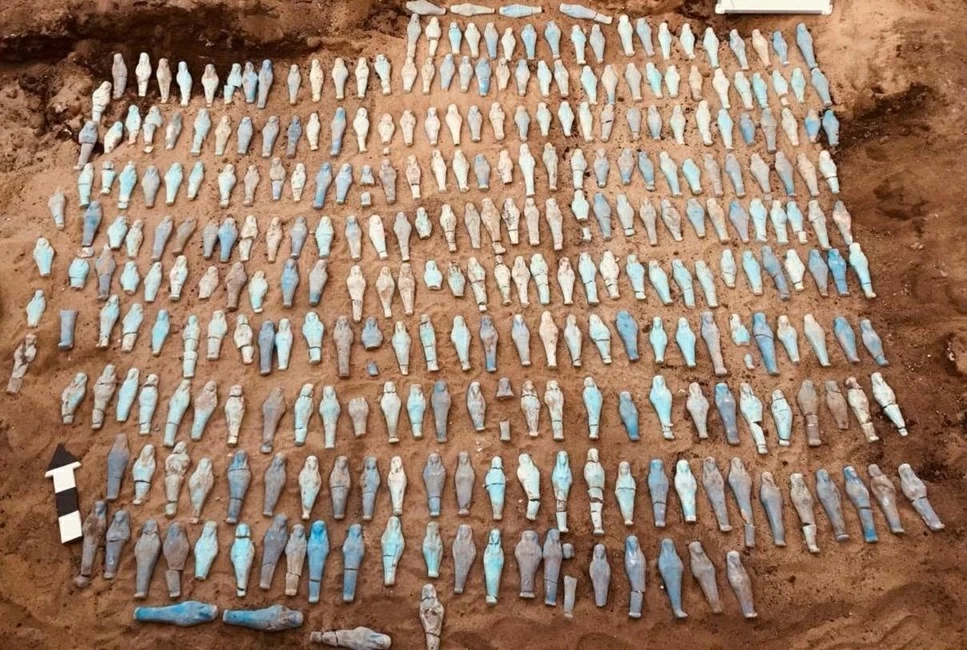
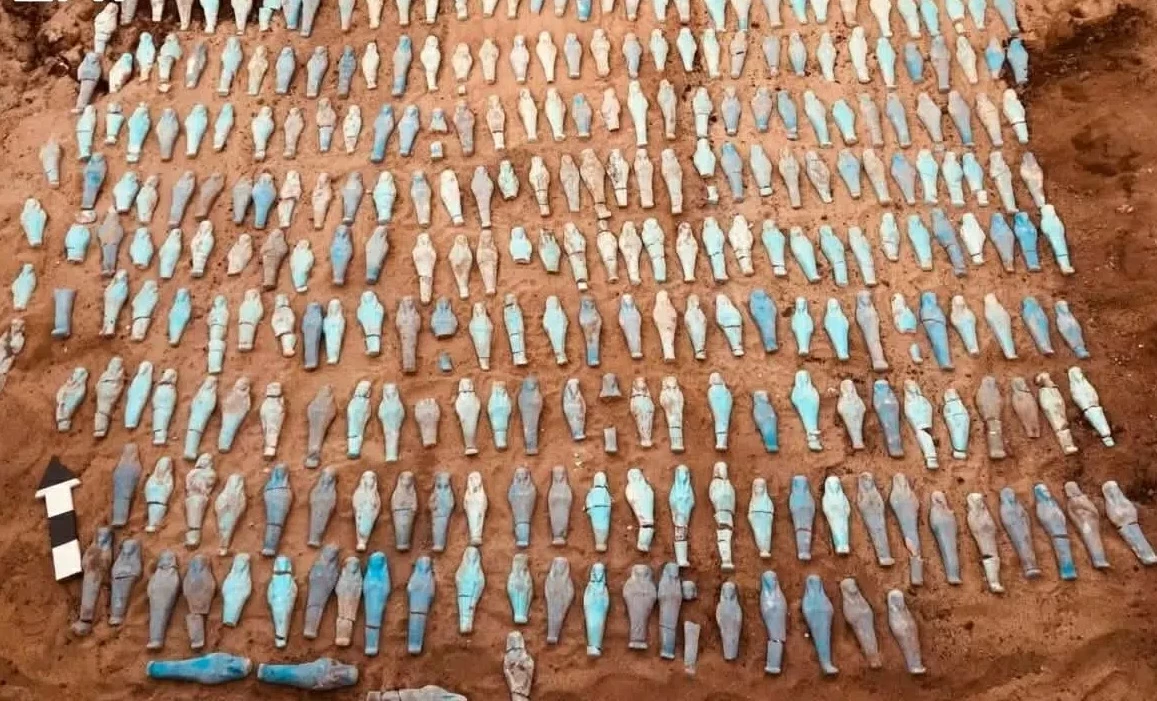
Among the most prominent discoveries, inside one of the chambers, two groups containing 560 ushabti figurines made of faience, in different sizes and shapes in their traditional Osirian form, were found.
The Supreme Council of Antiquities revealed that a number of these statues bear texts quoted from the Book of the Dead, one of the most prominent religious texts associated with the belief in resurrection and the afterlife among the ancient Egyptians.
Egypt 2
Protective Amulets and Vessels Used in Funerary Rituals
The mission also found a variety of protective amulets made of semi-precious stones, including the finger amulet, the Wedjat eye, the knot of Isis, in addition to amulets representing a number of ancient Egyptian deities, all associated with connotations of protection, power, and resurrection.
The discoveries also included various pottery vessels, including plates and bowls of different sizes, in addition to a vessel containing traces of materials likely used in mummification processes or rituals accompanying burial, as well as two pottery oil lamps.
Egypt 4
Faience Beads and Imported Pottery from the Island of Rhodes
In a related context, the excavation work uncovered large quantities of faience beads in blue and green, believed to have been part of a net or funerary covering for one of the burials inside the discovered unit.
The mission also found examples of pottery imported from the Greek island of Rhodes, including a part of a vessel handle bearing the name of its maker, which archaeologists considered material evidence of active trade relations between Egypt and the Mediterranean basin regions during the Late and Greco-Roman periods.
Egypt 3
Unusual Funerary Phenomena
The initial documentation work revealed a number of unusual funerary phenomena within the Quesna cemetery, including finding pottery plates placed under the arms of one of the burials in the Osirian position, and another plate between the thighs, while some vessels contained traces of materials currently under study, likely related to burial rituals.
Researchers believe that these discoveries may contribute to a deeper understanding of some funerary practices that were not previously documented at the site.
Egypt 1
One of the Most Important Burial Sites in the Egyptian Delta
The cemetery of Tell Aathar Quesna is considered one of the most prominent archaeological sites in the Egyptian Delta, as it was discovered in 1991, and includes funerary units dating back to multiple historical periods, making it an important source for studying the development of funerary architecture, religious beliefs, and burial methods in the central Delta region across the ages.
The Egyptian Ministry of Tourism and Antiquities has announced a new archaeological discovery in the cemetery of Tell Aathar Quesna in the Monufia Governorate, after an Egyptian archaeological mission affiliated with the Supreme Council of Antiquities successfully found a complete funerary unit and a large number of archaeological artifacts, in a discovery that sheds light on the funerary practices and the commercial and cultural relations that Egypt experienced during the Late and Greco-Roman periods.
This discovery comes as part of the ongoing scientific excavation work at the site, which is considered one of the most important cemeteries for individuals in the central Delta region, and includes archaeological evidence that reflects the evolution of burial methods and religious beliefs over successive historical periods.
The Minister of Tourism and Antiquities, Sherif Fathy, confirmed that the importance of the discovery is not limited to the diversity of the discovered artifacts, but extends to the new scientific information it provides, which helps researchers understand funerary practices and cultural and economic interactions, and to redraw a more complete picture of the religious and economic life of the area's inhabitants during that era.
Egypt
A Funerary Unit with Distinct Architectural Planning
The Secretary-General of the Supreme Council of Antiquities, Dr. Hisham El-Leithy, explained that the mission discovered a funerary unit characterized by organized architectural planning, featuring a main hall connected to several rooms with vaulted entrances. He pointed out that the archaeological evidence confirms that these rooms were topped with vaulted ceilings, while their original entrances still exist, allowing researchers to reimagine the complete architectural design of the tomb.
He added that the excavation work also resulted in the discovery of several human burials in Osirian positions with varying degrees of preservation, along with a collection of artifacts related to funerary rituals, representing an important addition to the study of burial beliefs in ancient Egypt.
Egypt 7
560 Ushabti Statues and Texts from the "Book of the Dead"
Original source: Okaz



Comments (0)
Be the first to comment.