Experimental Zones: An International Test to Build Trust in the Lebanese State
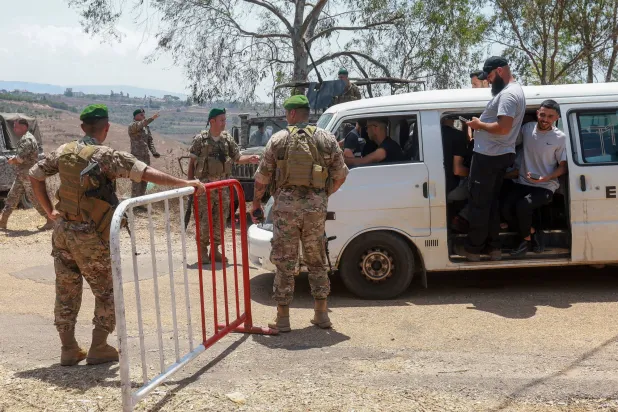
Attention is turning to the first phase of implementing the 'experimental zones' in southern Lebanon, as the first practical step within the mechanism being worked on in parallel with the negotiating track.
Attention is turning to the first phase of implementing the 'experimental zones' in southern Lebanon, as the first practical step within the mechanism being worked on in parallel with the negotiating track between Lebanon and Israel under American sponsorship. The results of this experiment are seen as a key factor in determining the possibility of expanding it to new areas, coinciding with the anticipated seventh round of negotiations in Rome in early August.
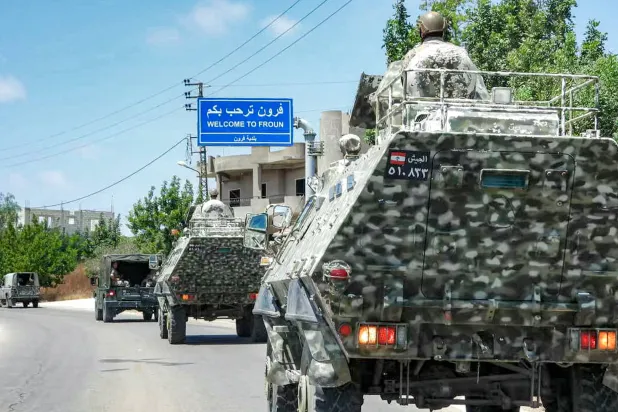
It appeared that the selection of Zawtar al-Gharbiya, Froun, and Sarifa as a starting point was not merely a field decision, but came as a result of understandings preceding the Lebanese-American summit, aimed at launching a model that could be built upon gradually, indicating that the evaluation of the first phase will not be limited to military deployment, but will include all implementation mechanisms in preparation for moving to subsequent phases if the experiment succeeds.
Residents of the town of Zawtar al-Gharbiya in southern Lebanon await permission to enter the town after the withdrawal of Israeli forces as part of a US-sponsored plan (Reuters)
Mneimneh: An approach to build trust and prevent disruption of the track
In this context, MP Ibrahim Mneimneh told Asharq Al-Awsat: 'The idea of experimental zones was launched to address the crisis of confidence in the ability of the Lebanese state to assert its authority.' He pointed out that 'adopting a gradual and parallel track between Israeli withdrawal, state deployment, arms control, and reconstruction constitutes the most realistic entry point for implementing commitments, and at the same time prevents any party from exploiting the file.'
Mneimneh explained that 'the main problem was related to the level of trust in the Lebanese state, in addition to the fact that some elements of the arms control file carry complexities and details that could be exploited to disrupt the track. Therefore, it was better to adopt a mechanism based on parallel tracks, starting with an Israeli withdrawal from specific areas, then the entry of the Lebanese state to establish its security authority and the monopoly of arms there, accompanied by the launch of the reconstruction track and the completion of the state's authority.'
He added: 'This phased approach prevents turning the arms control file into one big basket, because that would allow Israel to use it as a pretext to prolong the occupation, and would also give Hezbollah a justification to continue clinging to its weapons.' He explained that 'the gradual transition is better than burdening the state with a huge task all at once, because that would increase doubts about its ability to implement, and delay the required pressure on Israel to withdraw pending the completion of state capacity-building, a path that takes a long time.'
He affirmed that the Lebanese state 'has already begun building trust with the United States and the international community,' but stressed that 'the real challenge lies in the timeframe for implementation, because prolonging deadlines could disrupt the entire idea and allow Hezbollah to raise doubts about the intentions and effectiveness of this track.'
He added: 'What is required is for the Israeli withdrawal and the state's restoration of its authority to proceed in parallel, without linking one to the other in a way that hinders implementation. There must be a logical and rapid timetable, because any lax deadlines will be interpreted as entrenching the occupation. What is needed is a swift withdrawal, accompanied by strengthening the capabilities of the state and the army through international support, so that it can perform its tasks.'
Commenting on Hezbollah's recent positions, Mneimneh said: 'It was expected that the party would object to this track, but what is striking is that the tone of some positions seemed less harsh than what Lebanese are accustomed to, as if there is some acceptance of reality, although it is too early to build on that.' He added that 'the position of Speaker of Parliament Nabih Berri was advanced; he welcomed the track and affirmed that it is consistent with what he was calling for, and this position cannot be separated from political backgrounds worth noting.' He stressed that 'the experimental zones are not a substitute for Israeli withdrawal, because withdrawal is a non-negotiable right, but rather a mechanism to facilitate its implementation and prevent Israel from using any pretext to continue its occupation. The goal is to move gradually from one area to another, so that the Israeli withdrawal expands step by step with the deployment of the Lebanese state in each area.'
A Lebanese soldier makes his way between cars as residents await permission to enter the town of Zawtar al-Gharbiya in southern Lebanon (Reuters)
Karam: Its success opens a path to save Lebanon
For his part, MP Fadi Karam, a member of the 'Strong Republic' bloc, told Asharq Al-Awsat: 'The launch of the experiment of deploying the Lebanese army in the experimental zones constitutes a dual test for the Lebanese state and the international community.' He noted that its success would establish a path for the state to restore its authority and end illegal weapons, while its failure would lead to serious repercussions for Lebanon.
Karam explained that 'the experimental zones represent a new challenge for the Lebanese state and the Lebanese army in imposing security and extending state authority, which is why they were called experimental zones.' He pointed out that 'there is also a challenge on the United States to secure the necessary conditions and facilities that enable the Lebanese army to deploy and operate freely, and to prevent any Israeli obstruction of this track, in parallel with continued support for the army and strengthening its capabilities.'
He added: 'The bet also remains on Hezbollah not obstructing this track, because there are several factors that could affect its success. But if the Lebanese state has made its decision, things will go in the right direction.'
He saw that 'the Lebanese army is today undergoing a test on the ground that would enhance the confidence of the international community, led by the United States, in the Lebanese state if the experiment in these areas succeeds.' He noted that 'its success means launching a path to save Lebanon and liberate it from illegal weapons and armed factions outside state authority.'
He affirmed that the next phase 'will be expanding the scope of imposing state authority and the Lebanese army over wider areas, leading to a more serious handling of the illegal weapons file up to its termination, in parallel with ending the Israeli presence on Lebanese territory.'
In his assessment of the nature of the test, Karam said: 'It is certainly a test of trust, but also a security test. The Lebanese army is capable of undertaking it, but it requires a clear political decision to protect and ensure its success. The state or the army must not fail in this task, because failure would be a catastrophe for Lebanon.'
He saw that the success of this track would have direct repercussions on the upcoming negotiations, saying: 'Every step is linked to what comes before and after. There is a political track that has begun, accompanied by security steps on the ground. It may be a difficult track, but it is ongoing, and it is no longer possible to fail it, and those responsible for it, led by the President, the Prime Minister, and the Council of Ministers, are determined to succeed.'
Original source: Asharq Al-Awsat




Comments (0)
Be the first to comment.