Public Flogging of Woman on Adultery Charges Sparks Widespread Controversy in Libya

The execution of a flogging sentence on a Libyan woman in a street in Sabha, southern Libya, has sparked a wave of controversy and division, with many considering it 'contrary to the law.'
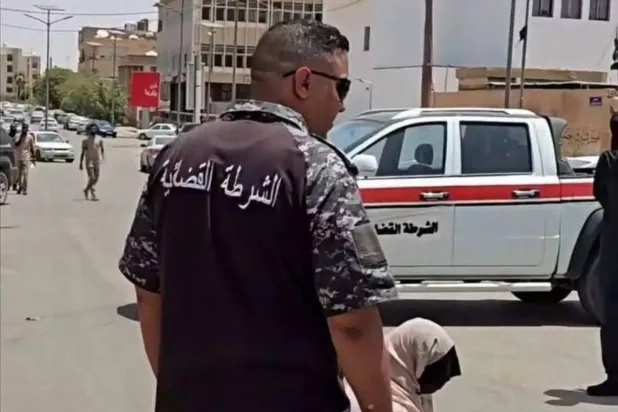
Libyans passing through the center of Sabha (south) were surprised to see a woman kneeling on the ground, her head and face covered, while a member of the judicial police flogged her with a long whip stripped at its end.
The incident, which came as the execution of a judicial ruling, sparked legal and social controversy and division, given its public execution in the middle of the street, which some considered 'contrary to the text of the law,' questioning why they do not see, for example, the execution of 'hand amputation' sentences for thieves.
#Sabha | The judicial police execute a judicial ruling against a woman in a criminal case, in a procedure carried out publicly in the city of Sabha. pic.twitter.com/rItwXbPZYN
— Militia Crimes (@NEFWEW7vyIiR9IA) July 23, 2026
In a circulated video clip, a policeman wearing a black uniform with 'Judicial Police' written on the back appeared next to the kneeling woman. As soon as another person finished reciting the text of the judicial ruling, which stated it was issued by the South Sabha Criminal Court on July 21 of this month, punishing her with 100 lashes, the executioner began carrying out the sentence.
The flogging process sparked legal and social controversy given its public execution in the middle of a public street (AFP)
The widely circulated flogging clip prompted broad reactions regarding the legality of this process, which took place on the street among passersby for the first time, according to their belief, while Libyan human rights activist Tariq Lamloum asked: 'Who is the adulterer?'
The South Sabha court is under the authorities in eastern Libya. The reasoning of the verdict has not been published so far, but some considered this incident 'a confrontation to the spread of immorality in society.'
Lamloum said: 'Apart from the religious or moral dimension of prohibiting sexual relations outside marriage, which everyone in Libya agrees on, legal questions remain and cannot be overlooked.'
Lamloum added, asking: 'How did the court prove the crime occurred? On what legal text did it rely to issue the verdict? What are the guarantees and judicial procedures that preceded the execution? Most importantly, where is the other party in the incident?'
Lamloum believes, in a post on his Facebook account on Thursday, that 'what happened is more of a display of punishment, and a message directed at public opinion rather than the implementation of justice based on a fair trial and equal legal guarantees.' He said in this context that 'the rule of law is not measured by the scene of implementing the punishment, but by the integrity of the procedures that preceded it, and the equality of all parties before the judiciary,' and added his question: 'Why do most cases deliberately show women as the basis of the crime, while the main perpetrator is acquitted or excluded?'
The text of the ruling, which was recited before the flogging, did not clarify the presence of other individuals against whom the punishment would also be executed in the same case, or whether all legal procedures and conditions established for the application of the hadd (fixed punishment) had actually been fulfilled.
For his part, Ahmed Abdel Hakim Hamza, head of the National Institution for Human Rights in Libya, believes that 'the law on the implementation of the hadd punishment for adultery (No. 70 of 1973) did not stipulate the publication of the execution of the flogging sentence, whether in newspapers or various media outlets,' and he points out that 'according to the same law, the flogging is carried out inside the police station in the presence of the competent deputy prosecutor and the specialist doctor, and the sentence is not executed unless it becomes final.'
Al-Siddiq Al-Sour, the Libyan Attorney General (Office of the Attorney General)
The crimes of theft and embezzlement of public funds by senior officials and prominent figures are widespread in Libya, according to the accusations and investigations of Attorney General Al-Siddiq Al-Sour, but no one has witnessed or seen the execution of 'hand amputation' of any of them, whether secretly or publicly.
Opponents of the Benghazi authorities exploited the incident, seeing in it 'a regression backward and a return to (Daeshism).'
The National Institution for Human Rights considered the incident 'a dangerous precedent in Libya,' especially since no suspect was announced. It said: 'The height of insult and discrimination is practiced by militia bodies with security titles, entrusted with the task of executing sentences.'
The institution asked: 'What is happening in Sabha? Have we truly defeated Daesh? Are only women being condemned today?'
Data indicates that Libya's ranking in the Corruption Perceptions Index dropped in the latest classification to 177th out of 182 countries in 2025, after being 173rd out of 180 countries in 2024. This reflects the continued worsening of corruption levels and the absence of any tangible improvement in the last two years.
For his part, Libyan activist Hossam Al-Qamati stated that the judicial police apparatus's act of publishing this material 'constitutes a violation of the provisions of the law, and an overstep of the limits of its authorized powers in executing sentences,' believing that this action 'requires legal accountability and holding the entity that published it accountable, in commitment to the principle of the rule of law and respect for the guarantees and procedures stipulated by legislation.'
Al-Qamati concluded that 'what happened is a complete crime, and if it is about Sharia and the application of Islamic law, that is a matter for the specialists to decide, not for the purpose of achieving a (trend) or pretending piety.'
Libya is experiencing a political division between two competing governments; the first is the 'Unity' government headed by Abdul Hamid Dbeibeh in Tripoli, and the other is appointed by Parliament headed by Hammad in the east and parts of the south, and enjoys the support of the Commander-in-Chief of the 'National Army,' Khalifa Haftar.
"); googletag.cmd.push(function() { onDvtagReady(function () { googletag.display('div-gpt-ad-3341368-4'); }); }); }
Original source: Asharq Al-Awsat


Comments (0)
Be the first to comment.