Soviet nuclear submarine wreck... 'Time bomb' threatens catastrophic pollution
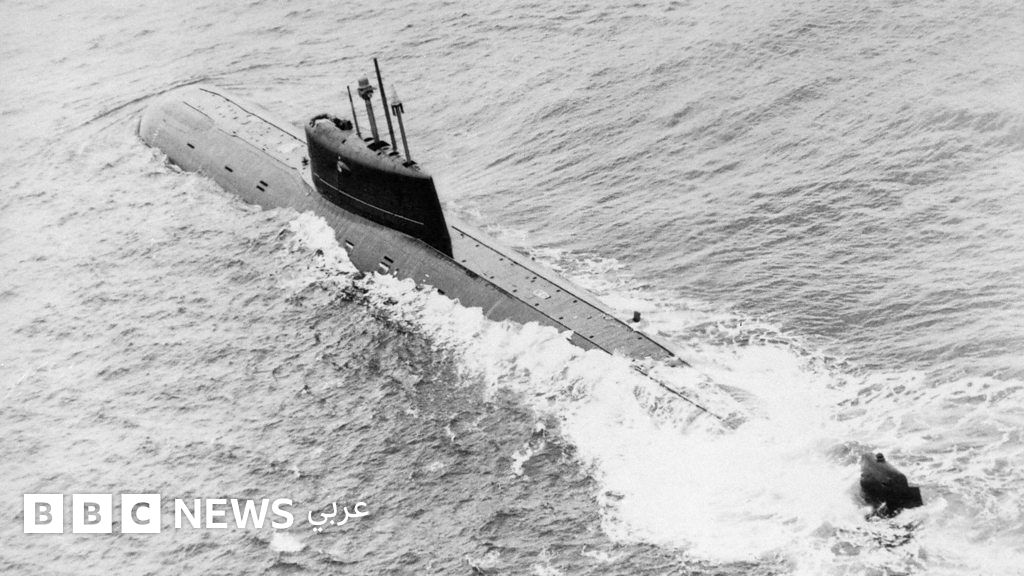
Why does a Soviet nuclear submarine still pose a threat after more than three decades?
Soviet nuclear submarine wreck... 'Time bomb' threatens catastrophic pollution
Published 4 minutes ago
Reading time: 4 minutes
In 1989, the Soviet submarine Komsomolets sank off the coast of Norway. Four years later, a BBC report discussed plans to seal its torpedoes containing toxic plutonium.
Russian Greenpeace activist Dmitry Litvinov said in a BBC news report broadcast in 1993: 'Komsomolets is a time bomb lying at the bottom of the Norwegian Sea. Unless action is taken quickly, we are all in danger.'
The submarine had settled at a depth of one mile, about 1.6 kilometres, near the Norwegian coast, after a fire caused it to sink, sparking widespread international concern.
Why are some scientists worried about the impact of radiation-contaminated water on the ocean?
Two torpedoes with nuclear warheads inside the submarine were corroding, raising fears of a leak of about four kilograms of plutonium into the Norwegian Sea.
The Komsomolets submarine was designed using the latest Soviet technology and was notable for its ability to dive to exceptional depths. NATO expected it to be the first in a new class of large attack submarines, but no other submarines of this type were built after it.
A documentary from the BBC programme Horizon broadcast in 1994 stated: 'Komsomolets was supposed to be the Soviet Union's invincible secret weapon, the only submarine in the world capable of sailing and launching nuclear missiles from a depth of one thousand metres; twice the depth at which Western submarines can operate. Today, however, Komsomolets has become a technical and scientific disaster.'
When the fire broke out on 7 April 1989, the crew managed to bring the submarine back to the surface, but it sank after remaining afloat for five hours, killing 42 of its 69 crew members.
As it sank, an escape capsule shot to the surface with five sailors trapped inside, but only one managed to get out before it filled with water.
Skip most read and continue reading
"How Israel recruited former Iranian President Mahmoud Ahmadinejad?" - New York Times
US military launches new wave of strikes against Iran, reports of Tehran threatening to close Bab el-Mandeb strait
Two Arab referees in World Cup quarter-finals, Geid and Makadama make history
What is the connection between pregnant women's placentas and anti-aging injections? And what do we know about the dismantling of a trafficking network?
Skip podcast and continue reading
Worth noting
In-depth explanation of key events and topics to help you understand the most important changes around you and their impact on your life
Episodes
End of podcast
When Komsomolets hit the seabed off the Norwegian coast, an explosion cracked its titanium pressure hull, allowing seawater to leak into the torpedoes with nuclear warheads.
A research mission led by Russian oceanographers concluded that parts of the submarine's hull 'exploded and shattered from the blast, like glass.'
After the disaster, scientists disagreed on the next steps. Russian scientist Igor Spassky from the Rubin Institute, which designed the submarine, told BBC correspondent Ben Brown in 1993 that the situation did not amount to a catastrophe, though he supported recovering the submarine from the sea.
Spassky told the US Naval Institute: 'Within a decade, the two nuclear warheads on board the submarine will be completely corroded as a result of an electrochemical reaction with salt water... and the highly toxic plutonium from the damaged torpedoes will leak into the environment.'
Brown said in his BBC report: 'According to environmental activists, if that happens, the sailors who died here will not be Komsomolets' only victims. The lives of far more people could be at risk because the rich fishing grounds here could face terrible pollution.'
However, a 1993 report by an international team of scientists concluded that the submarine was unlikely to contaminate fishing areas.
Despite conflicting assessments of the risk, measures were taken to reduce the likelihood of contamination. Between 1995 and 1996, deep-sea engineering operations were carried out to seal cracks in the hull and torpedo tubes, aiming to contain radioactive materials.
These works were completed in July 1996, 30 years ago.
But later investigations by the Norwegian government revealed that the submarine was still leaking, and the material used to seal the cracks was not expected to last more than 30 years.
Potential risk with no time limit
A report published in March 2026 concluded that although the torpedoes remain sealed, the nuclear reactor is deteriorating and occasionally releases visible clouds of radioactive material into the sea.
A team from the Norwegian Radiation Protection and Nuclear Safety Authority said the leak is not continuous but occurs in intermittent bursts from specific points on the submarine's hull, with a 'cloud' seen escaping from one of the ventilation ducts.
However, the team does not believe current levels pose a risk. Ingar Amundsen, acting head of the International Nuclear Safety and Security Department at the authority, said: 'The radioactive emissions from the reactor have had only a limited impact on the surrounding marine environment.'
This situation could change, as both the nuclear reactor and the torpedoes with nuclear warheads pose a risk, according to Hans Kristensen, director of the Nuclear Information Project at the Federation of American Scientists.
Kristensen told the BBC that continued corrosion of the submarine over time could affect current radiation levels, adding: 'It depends on other factors, including the oxygen level in the seawater around and inside the wreck, and the condition of the sealing material.'
He also noted that changes in ocean currents could affect the rate at which radioactive materials are released from the wreck and their potential transfer into the food chain via bottom-feeding organisms and fish.
Kristensen added: 'The fact that the submarine was sealed once before is in itself an official recognition of the existence of this risk.'
Amundsen said: 'The nuclear fuel is in direct contact with seawater and is deteriorating. Further studies should be conducted to understand the mechanisms behind these emissions, the ongoing corrosion processes, and any potential additional releases.'
But that will not happen soon, as he added: 'The depth at which the submarine lies, about 1,700 metres, makes it difficult to implement any risk mitigation measures, and we are not aware of any such plans at present.'
Kristensen believes more work is needed, saying: 'At a minimum, a new mission should be organised to determine the current state of the submarine. With the half-life of the plutonium in the nuclear warheads reaching 24,000 years, it will remain a potential risk indefinitely on human timescales.'
Skip short clips and continue reading
Short clips
End of short clips
How did the Titanic wreck create a new underwater environment never before known to humans? 9 September 2024
Visiting natural landmarks threatened by climate change might delay damage; how? 15 August 2025
Original source: BBC Arabic




Comments (0)
Be the first to comment.