"Human Hunting Safari": How Ukrainians Face the Persistent Russian Drone Threat?
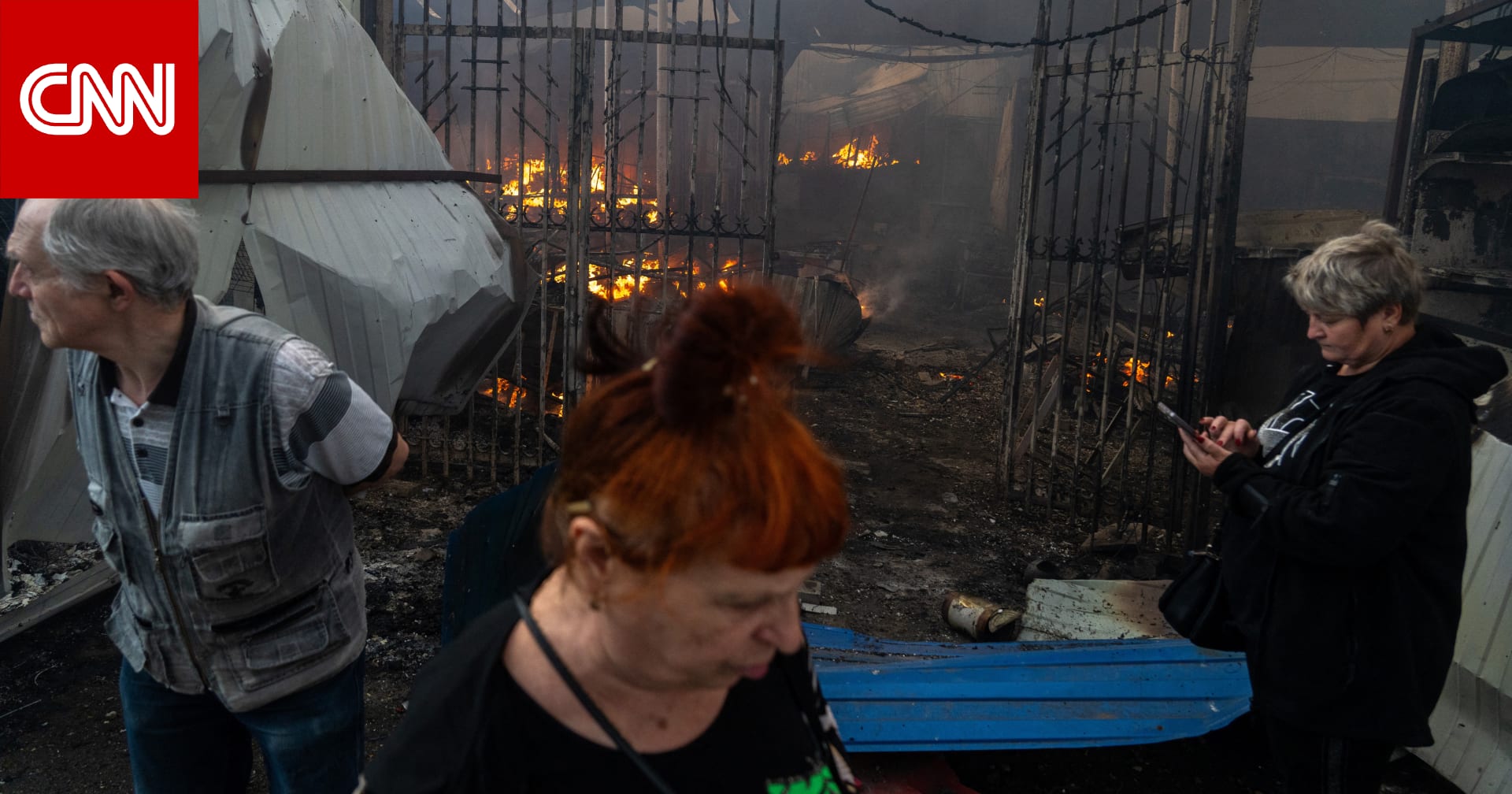
(CNN)-- Nikopol, a city in southern Ukraine, rarely makes headlines, overshadowed by threats surrounding the occupied Zaporizhzhia nuclear power plant on the opposite bank of the river. But this city, on the front line of Russia's full-scale war on Ukraine, has faced near-daily attacks since the war began, according to local authorities.
The city's proximity to Russian military positions, just about two miles away on the other side of the Dnipro River, means civilians face an increased risk of attacks from Russian short-range drones.
Oleksandr Varytsev, a poet who also runs a charity providing hot meals for the elderly and disabled, said: 'We have become somewhat accustomed to the danger, but the feeling of fear never goes away. It is very scary, and if I feel fear, imagine how the elderly who come to our volunteer center feel.'
A horrific video released by authorities in June showed a small Russian drone targeting an elderly woman in a wheelchair, an attack that killed three people, including the 87-year-old woman and her son. In April, four more people were killed in a drone attack on a bus in the city.
These two incidents are just examples of Russia's use of FPV (first-person view) drones to target civilians instead of military targets, a phenomenon also seen in the front-line cities of Kherson and Kramatorsk. Despite evidence of targeting civilians, Russia repeatedly says it is targeting threats from Ukrainian armed forces in Nikopol.
Varytsev says that in recent months, the number of drones spotted over Nikopol has increased from two or three per day to about three every hour, day and night.
This constant threat has forced residents to change their daily routines to avoid falling victim to what they describe as a 'human hunting safari' carried out by Russia. They now avoid standing in open places like bus stops, schools and kindergartens have been closed, and public services such as government post offices and public buses are frequently suspended.
Varytsev said: 'People are afraid to walk the streets, but they are adapting to the new reality. We now keep our heads up all the time, and we no longer look at our feet.'
Before the outbreak of the full-scale war, Nikopol's population was about 100,000, and it was known for producing strawberries for the Ukrainian market. Today, local officials estimate that half the population has left the city.
Oleksiy Kyrylov, who has worked in freight transport in Nikopol for more than two decades, said: 'The city is emptying before our eyes. The situation is extremely dangerous, and the attacks are increasing day by day.' He added that his focus since the start of the war has shifted from transport operations to assisting with evacuations.
Over the past four years, Kyrylov has learned to distinguish between combat drones and slower-moving reconnaissance drones. Although the intensity of fear has subsided over time, it has never disappeared, adding: 'Only fools are not afraid.'
Innovations to counter drones
Increasing parts of Nikopol are covered with fishing nets hung over roads, which can catch FPV drones, a sight now common in most front-line cities from Kherson to Kramatorsk. Residents say they are also working to expand these nets to cover sidewalks, aiming to make movement safer.
The growing threat of drones has also led to the development of other measures, including an app that sends warnings to residents when hostile drones are detected approaching the city. Some companies and emergency teams have also been equipped with drone detection devices known as 'Chuykas'.
Experts say these portable devices, which emit audible signals when a threat approaches, are effective at detecting drones that use analog radio frequencies, but cannot detect drones flying along pre-programmed routes, using fiber optic cables, or relying on digital signals.
Carmine Clementi, professor of radar systems at the University of Strathclyde in Scotland, said: 'They are better than nothing, but they are not a silver bullet. They might give you at least a minute or two to get off the bus and move to a place that offers some protection.'
According to Kateryna Bondar, a senior fellow at the Center for Strategic and International Studies (CSIS) in Washington, the Ukrainian manufacturer of these devices, BlueBird Tech, focuses on marketing them to the civilian sector rather than the military.
She added that the devices are widely used in areas close to the front line by transport companies, bus drivers, ambulance crews, and volunteers, as well as military personnel.
Bondar, an expert in defense innovations and a former advisor to the Ukrainian government, said: 'Any civilian can become a target, because the Russians use these areas to train drone operators or to conduct psychological terror campaigns by pursuing people.'
Mykola Koshelev, owner of a transport company in Nikopol, said the detectors are expensive, costing about $500 each, and are difficult for drivers to use while driving. So his company relies on the Zello app, run by a private company, to send alerts to residents when Russian drones approach.
He added: 'Drones are present every day, especially between 7 and 9 a.m., when they fly in swarms. If they get too close, the driver stops the bus, passengers get off and move away.' He explained that in areas without internet access, drivers use walkie-talkies to share information about drone locations.
Koshelev said: 'We have no other way to protect people except to be cautious,' noting that drivers are now afraid to go to work due to the increasing targeting of public transport. He added: 'I have been working in this field for a long time, and I never imagined we would reach this situation. It is true that the number of passengers has decreased, but people have become more trusting of drivers and more sympathetic.'
Local radio station Radio Nikopol has added a new feature to its app that allows anyone spotting a drone to report it immediately, prompting the DJ to interrupt the music and announce the danger location. During CNN's visit, a song was interrupted three times due to new warnings.
"It's like they're hunting us"
Across Ukraine, it has become common during train journeys to evacuate passengers when drones are spotted in the area. Civilians are instructed to disperse in different directions away from the stopped train, in an attempt to reduce the risk of mass casualties.
Ukrainian authorities say the railway network has been subjected to more than 5,000 attacks since the start of Russia's full-scale invasion in 2022.
Train driver Ihor Zachepylov told CNN: 'The situation on the railways has deteriorated significantly over the past year. It's like they're hunting us, not just freight trains but passenger trains as well.'
Original source: CNN Arabic




Comments (0)
Be the first to comment.