Gaza’s tents turn into murals documenting loss and resilience
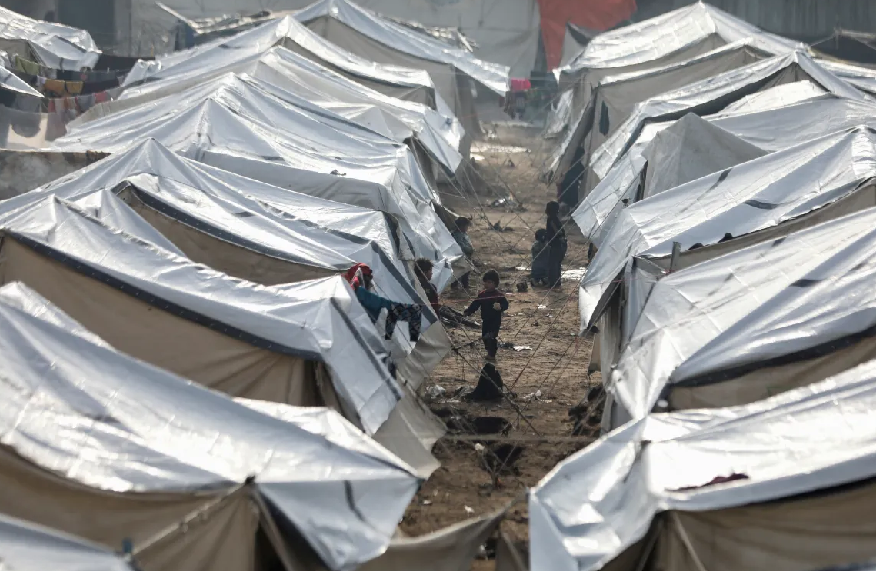
Summary: With charcoal and leftover paint extracted from under the rubble, the displaced inscribe the names of victims, their home addresses, and messages of reproach to the world. The tent has become an alternative Facebook page.
In a Gaza camp, calligrapher Mustafa bends in front of the canvas facade of his tent, gripping a rough brush and dipping it into remnants of blue paint he extracted from under the rubble of his home. His heart beats fast as he traces the first letter; the smooth fabric resists the ink, but he insists on completing the drawing.
Colors gather on the fabric to form the name and image of a young child, lost months ago during the forced displacement amid the military operations between Hamas and Israel. Neighbors are drawn to the sight of Mustafa drawing; they stand watching the ink slowly slide over the tent’s tarpaulin and dry under the sun.
Colors gather on the fabric to form the name and image of a young child (Reuters)
Observatory documentation
Before the war, concrete house walls provided privacy for families in the Strip. But the war destroyed those homes, forcing Gazans to live in tent camps, replacing concrete walls with thin fabrics that became a space for occupants to express their feelings.
When Gazans began writing and drawing on the fabric walls of their tents, the shelter turned into an observatory documenting social and historical moments. Each piece of fabric became a document recording details of the psychological and human hardships Gazans endure.
On the fabric of shelter tents, Gazans write whatever comes to mind: they inscribe victims’ names to immortalize them, their original home addresses to affirm return, and they write sad messages of reproach to the world, along with sarcastic phrases mocking the summer heat and the scarcity of drinking water.
In the Mawasi camp, Samar carries a small piece of charcoal and checks the back wall of her tent daily. With a trembling hand, the mother wrote the names of her three sons and her husband, who were killed in the bombing of their home months ago.
Samar says, "We couldn’t bury our children in real graves because of the shelling. I left them under the rubble of the house and fled as a displaced person. I wrote their names here on the tent so they would stay with me and I would never forget them."
Wiping the ash dust off the letters, she adds, "The tent has become our home and my children’s grave. I, and many families, found that writing on fabric is the only way to cope with the trauma of incomplete loss."
Ink of emotions
Indeed, victims’ names dominate the tent facades in the Gaza Strip. The fabrics have become open obituary boards where people write the names of loved ones killed in airstrikes to keep their memory alive in the hearts of passersby. This phenomenon has spread strongly as families lose the ability to bury their dead in regular cemeteries.
Alongside this, the fabric walls have turned into advertising platforms for searching for missing persons whose news has been lost amid the chaos of war. Families write the names of the absent, followed by phone numbers for contact, or pleas for anyone with information about them. Gazans have excelled at this method after the disruption of communication networks and the internet, making the camp itself a means of publication.
On a tent facade, written in bold red: "We are looking for our son Youssef al-Khatib, lost at the Salah al-Din checkpoint. Anyone who knows anything, contact tent number 40." His father Ahmed stands and explains the importance of writing: "The internet is cut off, communications are paralyzed, and people move between camps all day." He continues, "The tent wall has become our newspaper and alternative Facebook page. Through these phrases, the tent turned into a living contact point compensating for the absence of technological means."
Displaced people write their family names, original cities, and villages in bold letters on the front tent facades. They invented this to counter the chaos resulting from repeated displacements and the loss of many families’ identification papers under the rubble.
Geographical guide
In the alleys of the displacement camp, attention is drawn to a tent with black writing: "Al-Jamal family. Displaced from the Shujaiya neighborhood of Gaza." Young man Yahya stands before his tent and says, "Displacement erased the landmarks of our lives, and we became just identical tents in weather and color, as if we had no names and no history." He adds, "Writing the family name and original hometown is our new identity card before the camp community. This way, everyone knows where we come from, and so the children don’t forget our neighborhood’s name. These phrases have become symbolic title deeds."
Besides preserving identity, these writings have turned into a guide helping people find each other amid the disruption of communication networks. Visitors and relief organizations locate individuals by reading the family names written on the tarpaulins.
A few meters away, Hajj Khalil Abu Aita is looking for relatives who recently displaced from the northern Strip. The Hajj wanders between tents, reading the inscriptions on the fabric until he finds his target. "Without the names written on the tent fronts, families would be lost and no one would know each other’s way." Khalil adds, "When I spot a family name, I feel safe, because my friends or relatives are alive. Writing on the tarpaulin saved us long hours of search and loss among thousands of displaced people."
Graffiti challenges
Writing on tents faces complex challenges due to the siege, which has caused a scarcity of stationery and paint supplies. Displaced people do not have the luxury of regularly obtaining pens, brushes, and colors, forcing them to innovate alternatives from their surroundings.
People primarily rely on charcoal left over from cooking firewood, collecting thick charred pieces to use as black chalk sticks. Some salvage dried paint cans from under the rubble of destroyed homes and re-liquefy them. In other cases, women have resorted to using remnants of cosmetics and expired dyes to write words.
After securing colors, displaced people face the problem of the nature of the surfaces to be documented. The thick waxed fabric (tarpaulins) and smooth nylon easily reject ink, so they constantly retrace letters and drawings to ensure their messages remain.
Volunteer initiatives
In Gaza, individual initiatives have emerged, with displaced calligraphers and visual artists moving between tents. Volunteers carry their scant remaining colors and pens, moving from tent to tent to write family names and victims’ names.
Calligrapher Saed Obaid holds a reed pen and writes a name on a tent tarpaulin. Wiping sweat from his forehead, he says, "People are dying of depression and the color gray, so I decided to use my calligraphy to restore some dignity and beauty to them when I write the family name in Diwani script or a distinctive patch."
He adds, "Obtaining paint is a miracle. Arabic calligraphy for us is not just decoration; it is a tool of resilience and a declaration that we are a people of culture and civilization, even during our lives inside tents."
Psychological survival
On an inner tent wall, young woman Aya wrote: "The tent let us down in winter, but our hearts will not grow cold."
Original source: Independent Arabia




Comments (0)
Be the first to comment.