Lithuania Transfers Red Army Soldiers' Graves to Turn Page on Soviet Past
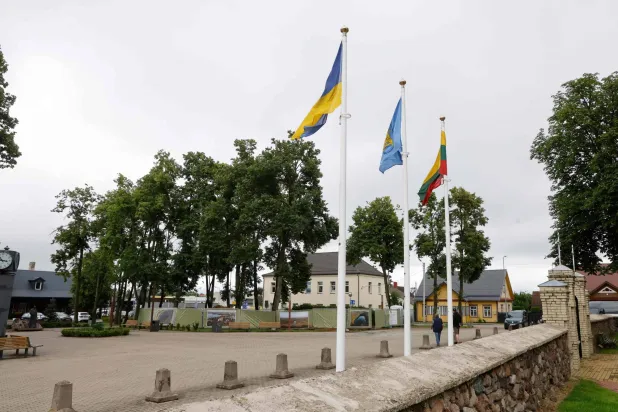
Nothing remains of an eternal flame erected in the Soviet era to commemorate what Moscow still calls the 'Great Patriotic War' except the twisted remains of a gas pipe.
A burial site near the Lithuanian capital has become the focus of a bitter dispute with Russia, as the Baltic state seeks to shed the last symbols of its Soviet past.
Sifting through layers of clay soil, archaeologists carefully retrieve the remains of Red Army soldiers in Vievis, west of Vilnius, one of the many memorial sites established by Moscow after World War II, according to a report by AFP.
Lithuania dismantled most Soviet monuments shortly after regaining independence in 1990, but Vilnius, a close ally of Kyiv, only decided to relocate the graves, which many considered the last visible symbols of Soviet domination, after Russia's invasion of Ukraine in 2022. Tadas Šimonauskas, head of the team of archaeologists working at the site, said the place was 'used as a propaganda tool.'
From the cemetery containing the remains of Red Army soldiers (AFP)
Among the remains, nothing is left of an eternal flame erected in the Soviet era to commemorate what Moscow still calls the 'Great Patriotic War' except the twisted remains of a gas pipe.
This term is used to describe the battles against Nazi Germany on the Eastern Front, but many countries that were part of the Soviet Union denounce it as a 'distortion of the fact of Moscow's occupation' of them.
Retiree Petras Martišius, near the work site, said 'the monument was placed here to remind us that the Soviets liberated us, as they claim'... adding that 'it should have been moved earlier.'
'De-Sovietization'
Lithuania, now a member of the European Union and NATO, and neighboring Russia and its ally Belarus, fears becoming Moscow's next target as the war in Ukraine enters its fifth year with no end in sight.
Shortly after the outbreak of the war, the Lithuanian parliament passed a law known as 'de-Sovietization,' paving the way for the removal of the last Soviet monuments and the relocation of graves. The country's cultural heritage register at the time listed 157 burial sites for Soviet soldiers killed in World War II.
Vilnius revoked the protected status of some of these sites, which it had originally granted to prevent Russia from altering them without state approval. Rita Kuntsevičienė, from the Ministry of Culture, said Russian representatives had already come to modify memorial plaques and increase the number of buried soldiers listed. She added: 'The more dead soldiers, the more Moscow could say that Lithuanians do not honor their liberators.'
Lithuania began in July 2023 to relocate Soviet graves in the small town of Pumpėnai in the north of the country, then in Šiauliai to the north, and now in Vievis. The exhumations have angered Moscow, which considers them an 'attempt to rewrite history,' and has repeatedly summoned Lithuanian diplomats to protest what it calls a 'barbaric project.'
Stages of remains transfer (AFP)
According to a recent report by investigative journalists from the Baltic states, the Kremlin intends to resort to an international court over alleged discrimination against Russian minorities. The file may include, according to the journalists, the relocation of Soviet graves.
Indrė Makaraitytė, an investigative journalist for the Lithuanian public broadcaster LRT, said 'Russia uses international forums to promote its narrative that the Baltic states support Nazism and discriminate against Russian minorities.'
'Traces of Their Presence'
Moscow accuses Lithuania and the other two Baltic states, Estonia and Latvia, which have taken similar measures, of 'discrimination against Russian culture and of committing a crime under Russian law.'
In response, Lithuania protested the destruction of monuments in Russia dedicated to the tens of thousands of people deported to Siberia and to the victims of Stalinist terror from the Baltic states and Poland.
In the churchyard adjacent to the Red Army soldiers' burial site in Vievis, the grave of a Lithuanian priest reminds that he was sent to Stalinist Gulag camps in 1950, around the same time the nearby Soviet monument was erected.
Vaidotas Andrijauskas, a resident of the nearby town of Elektrenai, said: 'It was only a Soviet symbol to mark their land, to say that we are under their control.' He added: 'We will build a small monument for the soldiers in the cemetery; we are not erasing traces of their presence.'
Original source: Asharq Al-Awsat

Comments (0)
Be the first to comment.