Moscow Seeks to Isolate Kyiv from the Black Sea
Russia continues its large-scale missile attacks on the Ukrainian capital, Kyiv, and supply, fuel storage, and military infrastructure sites in several other Ukrainian cities, thus expanding its list of strategic targets in an attempt to impose a new battlefield reality and inflict irreparable losses on Ukrainians.
The relentless and violent targeting of the port of Odesa (southwest) has revealed Russia's efforts to isolate Ukraine from the Black Sea, aiming to deprive it of revenues from raw materials and grain supplies and to strengthen the strategy of tightening the noose around Kyiv, after establishing a buffer security zone within Ukrainian territory along the eastern border.
The Ukrainian capital witnessed one of the most violent missile attacks since the start of the war on Monday night, according to a statement issued by the Russian Ministry of Defense. The Russian statement reported 'violent strikes on military targets in Kyiv, in a missile attack that was the most intense since the beginning of the Russian military operation in Ukraine.'
These attacks constitute a continuation of the strong escalation that began weeks ago, against the backdrop of the stalling peace process and the attempts by the Russian and Ukrainian sides to improve their field positions.
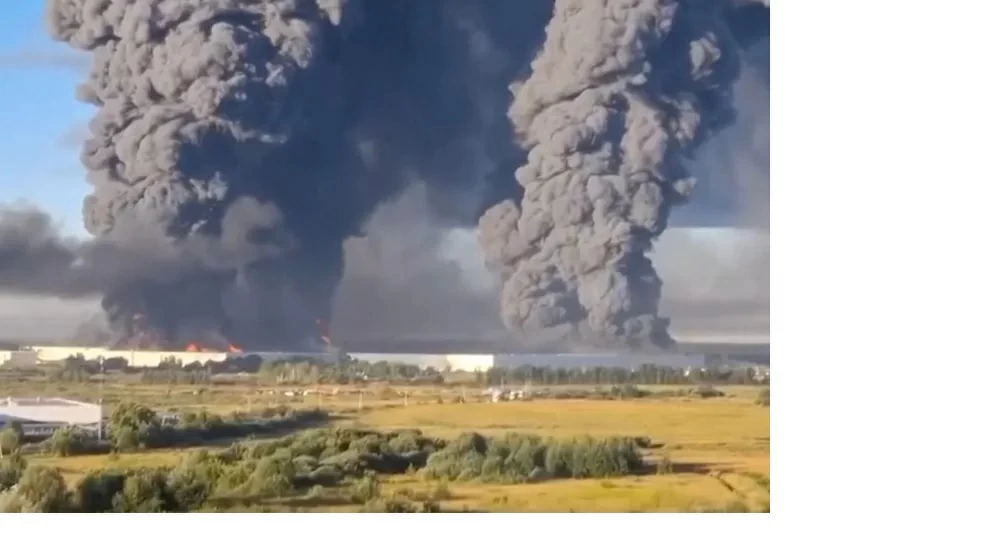
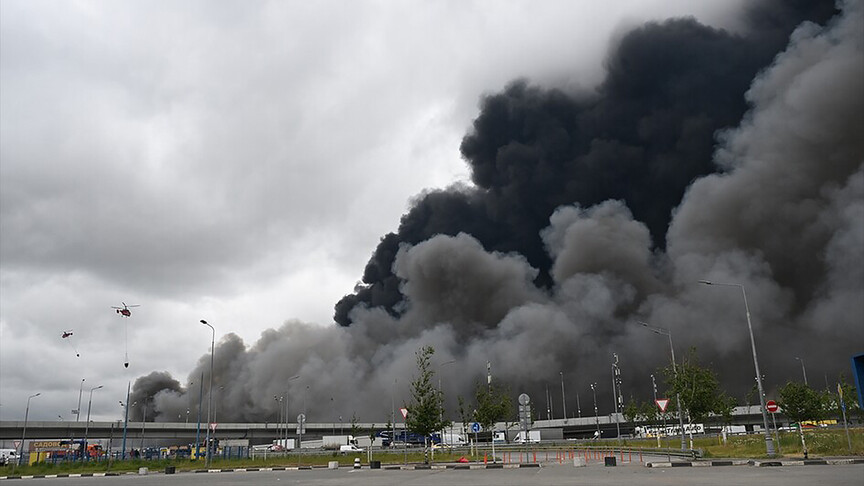
Smoke rises over an area near Moscow after the fall of an Ukrainian drone on Monday (EPA).
The Russian and Ukrainian sides exchanged painful attacks. In response to Russian missile attacks that hit various Ukrainian cities, Kyiv expanded its drone attacks on sites inside Russian territory. Ukrainian forces launched an intensive drone attack on Russian soil overnight, and Moscow said air defenses intercepted 381 drones after more than 400 drones targeted Moscow alone.
The ministry's statement said that the drones were shot down in the provinces of: Belgorod, Bryansk, Volgograd, Voronezh, Kaluga, Kursk, Lipetsk, Oryol, Rostov, Ryazan, Smolensk, Tambov, Tula, and Moscow, and the Krasnodar Territory, the Crimean Peninsula, the Sea of Azov, and the Black Sea.
Moscow Mayor Sergei Sobyanin announced that more than 400 drones flew towards Moscow last night, most of which were shot down far from the capital.
In the Moscow region, 10 people, including a child and two Chinese nationals, were injured as a result of the drone attack.
In an expansion of the scale and targets of Russian operations, the Russian Ministry of Defense announced on Monday morning 'the continuation of strikes on Ukrainian ports that serve Kyiv's forces.' The army statement reported a 'powerful new attack on the port of Odesa on the Black Sea, targeting fuel depots, Western weapons received by Ukraine, and infrastructure in the port.'
Moscow, according to military data, destroyed over the past 24 hours 5 fuel and lubricant tanks intended for the Ukrainian armed forces in an area near the port of Odesa in southern Ukraine.
The ministry said in a statement that the strikes were carried out using Oniks anti-ship missiles, air-launched cruise missiles, in addition to loitering munitions.
It added that the strikes targeted port infrastructure in the Novi Biliari area, located about 15 kilometers northeast of the port of Odesa.
Earlier, the Russian Defense Ministry announced the targeting of two BALKER-type cargo ships anchored off the port of Odesa, confirming that the ships were loaded with military supplies intended for Ukrainian forces.
Kyiv acknowledged painful attacks in Odesa. The Ukrainian Defense Ministry reported that Russian forces attacked ports used by the Ukrainian armed forces.
The Ukrainian ministry stated that 'air-launched precision weapons and loitering munitions targeted fuel and lubricant tanks in the port of Odesa.'
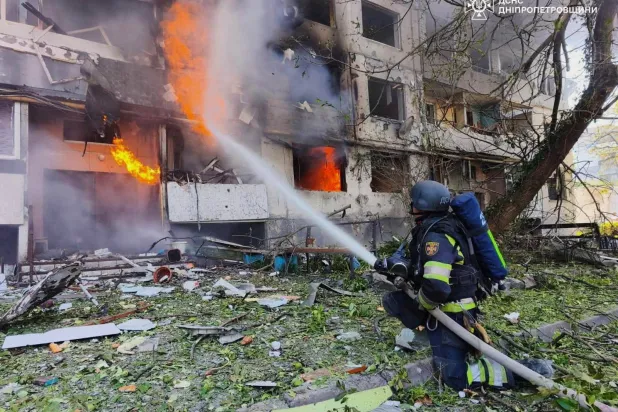
A fire in a residential building hit by a Russian airstrike in the town of Kramatorsk in the Donetsk region of Ukraine on Monday (AP).
Notably, the intensification of attacks in Odesa, which until recently remained calmer than other Ukrainian regions, reflected, according to Russian experts, a shift in the priorities of the Russian attack.
The political commentator for the official RIA Novosti news agency wrote that those who contemplate the major fires in the areas surrounding Odesa realize that 'the tactic of Kyiv and its European partners to try to isolate Crimea and destroy the Russian fuel and energy system has lost its meaning with the expansion of Russian attacks in the Odesa region.'
Prominent analyst Kirill Strelnikov opined that 'the Russian political and military leadership decided to put on its own show and began to completely isolate Ukraine from the Black Sea, something long awaited.'
According to the analyst, citing reports from Western sources, 'Russia has turned its attention to the Black Sea, targeting trade routes and deep-water ports to exhaust the Ukrainian economy during the war.'
Official data indicates that 'before the war, 90 percent of Ukraine's agricultural exports passed through seaports, and Ukraine's ability to keep three ports in the Odesa region open is vital for the country's survival.'
The Russian agency quoted The Wall Street Journal as saying that 'there is a sense of horror because the engine of the Ukrainian economy has been paralyzed by the air attacks, the most violent since the bombing of Europe during World War II.'
Kyiv says that civilian and commercial infrastructure is being targeted, but the Russian Ministry of Defense says the targets include logistics centers and warehouses, the railway network and its rolling stock, fuel and energy infrastructure facilities, ship repair yards, port stations and infrastructure, and enterprises of the military-industrial complex. According to the ministry, about thirty ships, which were carrying strategic military cargoes, have been repeatedly attacked since the beginning of the week.
Estimates indicate that storage capacity at the port of Odesa has decreased by a third due to ongoing Russian attacks.
Shipowners have also stopped providing tariff information, meaning the maritime shipping market in the region has effectively disappeared. Insurance premiums for some insurance companies have risen sharply, while other companies have completely stopped covering risks associated with voyages to Ukrainian ports. It is worth noting that this is not limited to Odesa alone, but includes all Ukrainian ports on the Black Sea, including Illichivsk (Chornomorsk), Yuzhny, and Izmail.
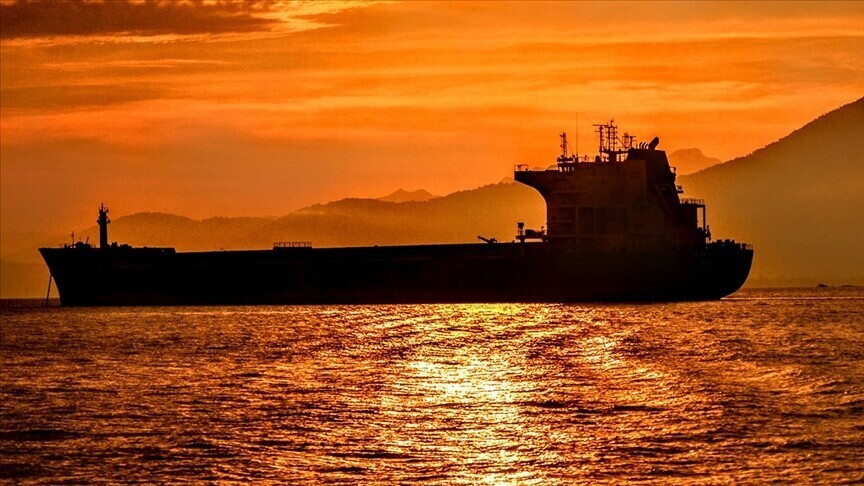
Smoke rises from a Ukrainian civilian ship following a Russian attack in Odesa on Sunday (Reuters).
The RIA Novosti report stated that international traders are actively discussing the possibility of diverting Ukrainian grain supplies and other goods via Danube River ports for onward transshipment in Constanta, Romania.
But Western experts acknowledge that land and river alternatives are structurally incapable of replacing Ukraine's deep-water ports - the capacity of main roads and railway stations is limited, and the effectiveness of land corridors is hampered by insufficient border infrastructure capacity.
As an example, experts say that 'for Ukraine, there is no viable alternative to the export route via the Black Sea'; it would require 10,000 trucks to replace one grain carrier with a capacity of 200,000 tons, which can only be loaded at a deep-water port.
Original source: Asharq Al-Awsat


Comments (0)
Be the first to comment.