Pakistan and China Discuss New Mediation Efforts to End the War
Three Pakistani sources said Islamabad is exploring a path to resume stalled talks between the United States and Iran aimed at ending the war that has been raging for nearly five months, as part of an initiative launched by China.
The sources said exploratory talks took place during Iranian Interior Minister Eskandar Momeni's visit to Islamabad this week, his second in the past ten days.
Data released by the Pakistani government indicates that Momeni, who is considered close to Iran's Islamic Revolutionary Guard Corps, met with Pakistani government leaders and Army Chief Asim Munir this week.
The three sources stressed that the obstacles facing any talks with the United States remain significant.
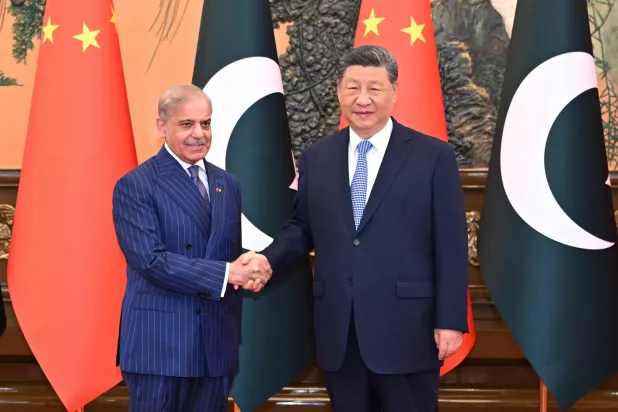
Chinese President Xi Jinping and Pakistani Prime Minister Shehbaz Sharif during a ceremony at the Great Hall of the People in Beijing (AP)
China and the Strait of Hormuz
Pakistan finds itself in a highly complex position as a potential future mediator. But Islamabad in turn relies on Beijing, which is a major financial backer and has economic interests in finding a diplomatic solution to reopen key trade routes in the Middle East.
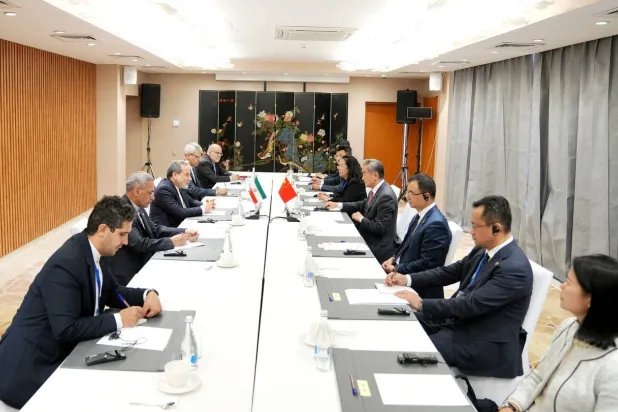
Three Pakistani sources, who requested anonymity as they were not authorized to speak publicly about the matter, said Pakistani Foreign Minister Ishaq Dar also discussed the new efforts in the Middle East with Chinese officials during his visit to China last week.
A Pakistani government official said: 'The Chinese are upset because Iran's attacks on other Gulf states and the closure of the Strait of Hormuz harm their interests.' He added that the unrest in the Red Sea would affect another major trade route that Beijing relies on.
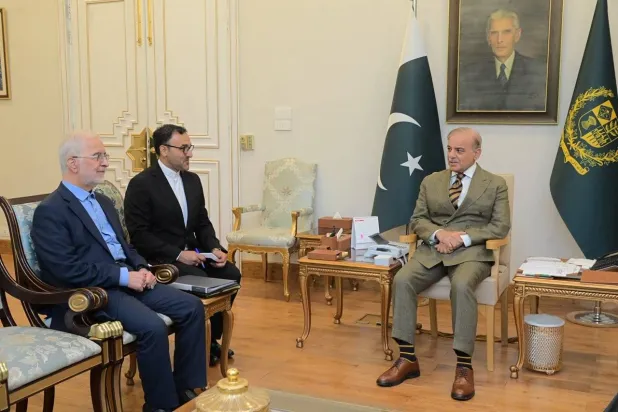
Pakistani Prime Minister Shehbaz Sharif during his meeting with Iranian Interior Minister Eskandar Momeni at the Prime Minister's House in Islamabad on Tuesday (Pakistan Prime Minister's Office)
China's Foreign Ministry said in a statement: 'China supports the mediation efforts made by Pakistan and other parties.' It added that Beijing will continue 'to play an active role in restoring peace and stability in the Gulf region as soon as possible.'
The biggest partner
China is Iran's largest trading partner and the main buyer of its crude oil, despite international sanctions on Tehran, benefiting from a large discount on crude. China has also over the years bolstered its support for Iran's security by supplying dual-use components, electronic chip equipment, and satellite navigation systems, although it has not provided overt military aid to Iran since the outbreak of the war.
Beijing has consistently supported Pakistan's mediation efforts, sending its special envoy in March to lead a round of shuttle diplomacy in the Middle East. The United States and Iran signed a memorandum of understanding last June to move towards ending the war, following mediation by Pakistan and Qatar.
The memorandum aimed to allow a 60-day window for negotiations to reach a permanent agreement. However, the indirect talks did not yield any progress, and both sides exchanged accusations of violations, until the conflict resumed.
Trump warns
Meanwhile, US President Donald Trump on Friday warned both China and Russia against selling weapons to Iran, saying he believes Xi Jinping and Vladimir Putin's assurances that they have not done so so far. Trump said on his Truth Social network: 'From here, the two major countries that are widely mentioned in the context of Iran, I see that they are not involved. If they do, it will be very bad for them, and certainly not in their interest.'
Trump's comment came in light of reports that Washington is investigating whether Moscow and Beijing are providing Iran with precise information, following a series of strikes on US bases. The US president said his Chinese counterpart told him during their meeting in Beijing in May that he would not arm Iran under any circumstances, adding: 'Given our relationship, I believe him.'
Trump noted that Putin made a similar promise despite the war in Ukraine, and continued: 'He knows that I don't sell weapons to Ukraine, but to NATO countries. They pay the full price. How these weapons are distributed, I have no idea.'
Sanctions
Meanwhile, the United States on Friday announced further sanctions on nine companies and four individuals linked to sanctioned Iranian financier Babak Zanjani, due to their efforts to circumvent US sanctions.
The Treasury Department said the new measures target Zanjani's operations in Iran under his conglomerate Dot One, as well as several companies that supported his digital asset exchanges already on the sanctions list, in addition to senior executives of those companies.
In Europe, EU foreign policy chief Kaja Kallas said the bloc imposed new restrictive measures against Iranian judges over accusations of human rights violations.
She added that sanctions were also imposed on a senior figure in an electronic group that enabled the regime to conceal information. She continued in a statement on X: 'At a time when Tehran is intensifying its repression at home, the European Union will continue to hold those responsible to account.' Kallas did not name those subject to the sanctions.
"); googletag.cmd.push(function() { onDvtagReady(function () { googletag.display('div-gpt-ad-3341368-4'); }); }); }
Original source: Asharq Al-Awsat


Comments (0)
Be the first to comment.