Pope praises immigrants 'who built the United States' on America's Independence Day
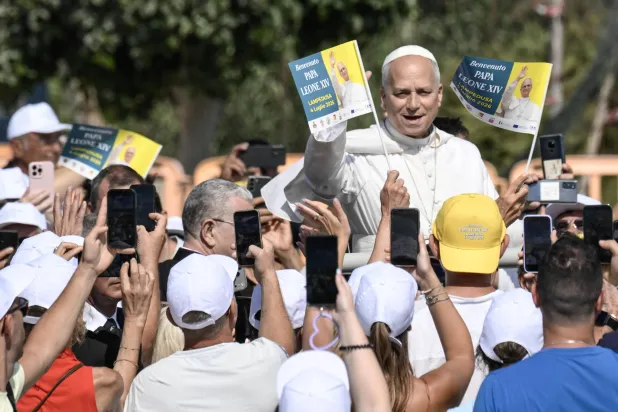
Pope praises immigrants 'who built the United States' on America's Independence Day from the island of Lampedusa in the Mediterranean.
It is well known that Vatican diplomacy is the oldest in the world, and it is no coincidence that Pope Leo XIV chose July 4, the U.S. national holiday and the massive celebrations organized by Donald Trump to mark the 250th anniversary of the founding of the United States, to spend his day on the island of Lampedusa; to celebrate Mass among migrants, and lay a wreath at the grave of an African child who died at the age of two with his family trying to cross the sea to Europe.
Composite image of Vatican Pope Leo XIV and U.S. President Donald Trump (AP)
Before leaving Rome on Saturday morning, the Pope had sent a video message to the National Constitution Center in Philadelphia, which awarded him the Liberty Medal, saying: "Glory to those brave men and women who dreamed of freedom and a better life for themselves and their children."
These remarks by the first American pope in history come days after the U.S. Supreme Court ruling that curbed Trump's attempt to abolish birthright citizenship for all those born on U.S. soil, which is one of the fundamental pillars of U.S. history.
Robert Francis Prevost (the Pope's name at birth on September 14, 1955) recalled a passage from the U.S. Declaration of Independence: "All men and women are created equal, endowed by their Creator with certain unalienable Rights, that among these are Life, Liberty and the pursuit of Happiness." He added: "That lofty vision made the United States synonymous with freedom, opening doors to successive waves of immigrants, allowing them and their children to play a fundamental role in building the nation's future."
The Pope blesses a commemorative plaque honoring his predecessor Pope Francis at a major migrant arrival point in the Mediterranean (EPA)
Leo XIV, born in Chicago to immigrant parents, distanced himself from Donald Trump by refusing the White House's invitation to visit the United States this year for the 250th anniversary of American independence, and decided instead to spend this day on the island that has become a symbol of the migrant tragedy as they attempt to cross the Mediterranean to Europe.
In Lampedusa, the Pope said: "The moral greatness of nations is measured, above all, by their ability to support, protect, and value the lives of all their children, especially the weak and those whose worth as human beings is doubted."
The Pope lays a wreath at a burial site containing graves of unidentified migrants and visits the 'Gateway of Europe,' a memorial dedicated to the victims (Reuters)
He added: "True freedom is much deeper than acting according to our own will; it is based on our ability to know the truth and commit to the good, no matter the cost."
Without naming the U.S. president, he said: "Americans know well that the path to building a society that embodies the lofty values of freedom and justice for all has never been easy, and this is a battle that passes from generation to generation, in the hope that the United States remains always faithful to the dream that gave it the title of land of the free and home of the brave." Pope Leo XIV also recalled religious freedom, which has always been a distinguishing feature of American society. He expressed hope that this tradition remains alive and fruitful for future generations.
Delivers his homily during his visit to the Italian island (EPA)
During his visit to the Italian island in the Mediterranean, the Pope blessed a commemorative plaque in honor of his predecessor Pope Francis, whose name will henceforth be given to a major migrant arrival point in the Mediterranean. The point, previously known as 'Molo Favarolo,' will now be called 'Molo Papa Francesco.' The move aims to commemorate the late Pope's commitment to refugees.
The Pope denounced measures aimed at curbing illegal immigration. He described the U.S. administration's treatment of migrants as 'inhumane.' He urged migrants to integrate by learning the language of the host country, respecting its laws, and getting to know its customs and traditions.
He urged Europe to address the migration problem 'comprehensively by integrating immediate relief efforts into a long-term strategic plan capable of welcoming, protecting, supporting, and integrating migrants.' He also appealed to European leaders to help improve conditions in migrants' countries of origin so that fewer people feel compelled to leave.
He spends his day on the island of Lampedusa and celebrates Mass there (EPA)
Filippo Ungaro, spokesperson for the UN High Commissioner for Refugees, told Agence France-Presse that 'the presence of Pope Leo XIV sends a clear message at a time when the global political debate on migration is increasingly focused on borders and deterrence policies, rather than protection and shared responsibility.'
Lampedusa is the second European destination for migration. The central Mediterranean crossing from North Africa is the world's deadliest migration route, according to the International Organization for Migration.
Lampedusa lies between Sicily and Tunisia, 145 kilometers from the Tunisian coast. The small island, with a population of about 6,000, has long been a major hub for migrants traveling from Africa to Europe. It has become one of the most prominent symbols of Europe's migration crisis.
U.S. Secretary of State Marco Rubio and Pope Leo XIV at the Vatican (Vatican)
In 2025, about 1,330 people died or went missing while attempting to cross this route, according to IOM reports. The route is monitored by a small number of ships from humanitarian organizations that accuse the European Union of failing to take action to prevent shipwrecks.
The Pope said in his homily on the island: 'Europe is capable (...) of addressing the crisis in an integrated manner, by incorporating initial rescue operations into a long-term strategic plan, able to welcome, protect, and integrate migrants, while at the same time working on development so that no one is forced to migrate.'
He denounced 'indifference to the common good, corruption in migrants' countries of origin, a global economic system that generates poverty and exclusion, fear that fuels prejudice and contempt (...) and the criminal calculations of those who profit from the tragedy of others.'
Pope Leo XIV, head of the Catholic Church (Reuters)
Before his homily, the Pope laid a wreath at a burial site containing graves of unidentified migrants and visited the 'Gateway of Europe,' a memorial dedicated to the victims, where he stood alone on a rock facing the sea, his cape fluttering in the wind.
The Pope has made defending migrants a central theme of his papacy, repeatedly emphasizing it as he did during his visit to Spain's Canary Islands last month, thanking those who extend a helping hand to the needy leaving their countries, and denouncing mass deportations in his own country, the United States.
); googletag.cmd.push(function() { onDvtagReady(function () { googletag.display('div-gpt-ad-3341368-4'); }); }); }
Original source: Asharq Al-Awsat
Comments (0)
Be the first to comment.