Primitive Means of Transport Take a Toll on Women's Bodies in Gaza
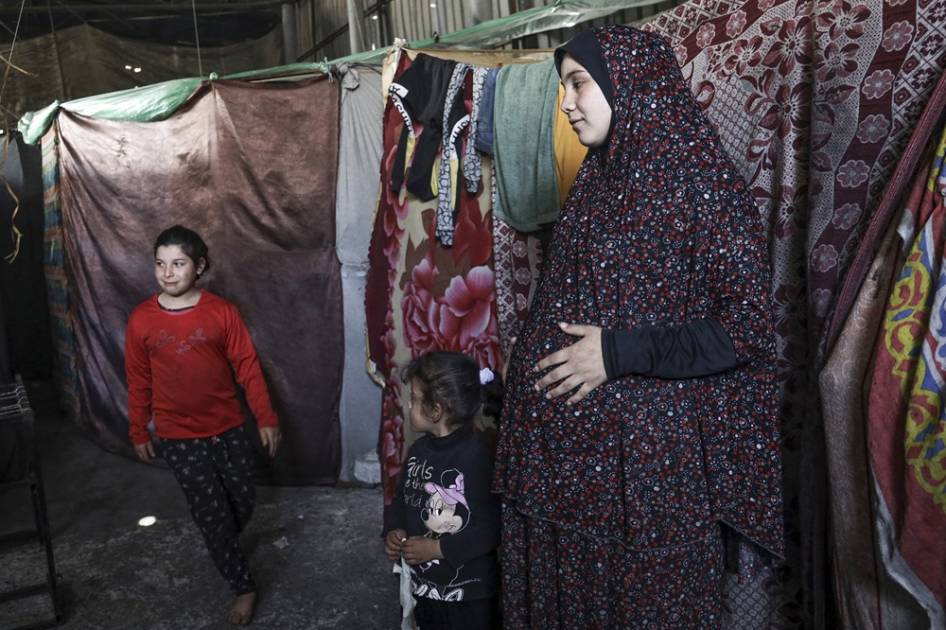
Summary: "Every time the wheel hits a stone, I feel like my spine is dislocating," Ghada, seven months pregnant, sums up her suffering during the daily death journey on rusty iron compartments. So how did the simplest trip turn into a brutal battle for survival for Gaza's women?
Ghada clings with all her might to the protruding iron edges of a rusty, dilapidated compartment, dragged behind a car with destroyed windows and chassis. The vehicle speeds over the rubble of the coastal Rashid Street, swept away by military operations in Gaza.
With her other hand, the seven-month pregnant woman tries to protect her belly with each violent jolt from the car and trailer compartment as they pass over potholes. Sweat beads on Ghada's pale face mix with the rising dust that covers her black clothes, and she muffles her groans for fear of falling.
Ghada is forced into this exhausting journey as she heads to the only remaining medical point in her area for a routine prenatal check-up. What eases her ordeal in transportation is that dozens of women suffering similar conditions sit beside her in this "compartment," united by the fear of losing balance and falling.
Primitive Means of Transport
Before the war, a trip by transport took just minutes in modern vehicles on paved roads, but because of the war, riding a taxi has turned into a torture journey lasting hours on rough iron compartments pulled by dilapidated cars lacking the most basic safety standards.
These conditions have made every woman's exit from her tent an adventure that often ends in injury. It's not just a transport crisis, but the damage caused by destroyed roads full of rubble, and how passengers are affected as vehicles move over those ruined streets.
The harsh transport conditions have become a dangerous mobility and health crisis affecting women in particular. A journey over destroyed roads can end in pelvic fractures, severe bleeding, or loss of fetuses before reaching hospitals.
Ghada's arduous journey on the trailer compartment behind the dilapidated car stretched for a full hour—a distance she used to cover in minutes before the entire landscape of the Gaza Strip changed.
Before the outbreak of fighting between Hamas and Israel, the Strip was bustling with active traffic, where residents relied on an organized public transport fleet of more than 88,000 vehicles and buses, moving smoothly over a network of main and secondary roads spanning about 1,200 kilometers.
The war machine crushed Gaza's transport sector, with data from the Ministry of Transport indicating the destruction of over 70% of the vehicle fleet and the leveling of more than 80% of streets and public roads.
This massive destruction prevented modern cars from functioning normally, especially with the scarcity and high cost of diesel, leading to the isolation of the Strip's cities and camps from each other.
Amid these conditions, Gaza residents found themselves forced to invent local solutions. They installed open, rusty iron compartments and boxes tied with ropes and chains behind old, dilapidated cars to serve as forced collective transport buses, sometimes using alternative cooking oils to run their engines.
Ghada moved through this dangerous transport system, her pregnant body absorbing the road's shocks. She said, "Women pay the highest price in terms of their physical safety just to move from one place to another. The simplest trip is a crime against a woman's body that can no longer bear more shocks."
A Palestinian mother tries to soothe her infant's pain with a caress (Reuters)
Pothole Shocks
Inside that "compartment," Ghada sits on a hard, rough edge, holding the rusty metal handle with one hand while using her other hand as a weak shield over her belly.
Every time the car or trailer wheels fall into a pothole, her entire body shakes, suffering a sharp shock that starts from the bottom of the trailer, then penetrates the iron frame and settles directly in her lower back.
Dr. Adnan Radi, a consultant obstetrician and gynecologist in Gaza, says, "What is happening to these women is exposure of the spine to continuous crushing, with the absence of shock absorption systems in these primitive trailers pulled by dilapidated cars. The lumbar vertebrae act as the first and last line of defense. The violent jolts cause acute disc herniations, compressing the discs between vertebrae due to sudden weight, explaining why women arrive completely unable to walk straight after an exhausting transport journey."
This immense pressure becomes more dangerous for pregnant women like Ghada, who carry extra weight altering their center of gravity, making the jolts not only threaten the back but also extend to the ligaments and pelvis with deep structural contusions that manifest immediately when the woman gets off the vehicle.
Ghada adds, "The problem isn't just the potholes, but also the rusty iron we sit on. The compartment doesn't move smoothly; it jumps with us behind the car. Every time the wheel hits a stone, I feel like my spine is dislocating. I reach my destination and can barely straighten my back, and sometimes I have to lie down for hours until the pain in my pelvis subsides."
Bleeding on the Roads
As the car approached a sharp turn, the rear wheel of the compartment slammed into a massive concrete block, causing the iron area and its occupants to shake violently.
At that moment, Ghada felt not a shock in her back but a sudden sharp cramp in her lower abdomen, making her cling tightly to the sides of the rusty compartment, whispering that this pain was not the beginning of the end for her long-awaited fetus.
Pregnant women in Gaza are haunted by fear when using primitive transportation. Thousands are forced to travel to reach remaining health centers, aware that these primitive means may cost them their lives and their fetuses. Dr. Munir al-Barsh, Director General of the Ministry of Health in Gaza, says, "What pregnant women in the Strip face is a direct threat. Anemia and malnutrition, which affect more than 57% of pregnant women, make their bodies fragile against any physical shock. The successive violent jolts women experience on these compartments behind dilapidated cars increase the likelihood of premature placental abruption, leading to immediate fetal death in the womb and causing severe bleeding in the mother."
Due to the terror of transport on rough roads, miscarriage rates have risen shockingly. In just one month, about 921 miscarriages were recorded in the Strip. Ghada continues, "Every time the car pulled the compartment and shook violently, I felt my fetus moving aggressively as if crying for help. I put my hand on my belly, trembling in fear of any sudden pain. We live in real terror from these roads and the endless vibrations."
By the Numbers
While Ghada tried to absorb the road's shocks, the numbers of the catastrophe spoke clearly of the impossibility of safe access. Data from the Ministry of Transport indicates that only a very small number of dilapidated cars modified to tow deformed iron compartments operate in Gaza.
According to the data, Gaza lost 32,000 taxis and trucks in the war, and because of this shortage, women were forced to rely entirely on dangerous means of transport.
Original source: Independent Arabia



Comments (0)
Be the first to comment.