Rafiq Khouri | The Game of the Strait of Hormuz...Bigger than America and Iran

Summary: It is understood that Benjamin Netanyahu is daily inciting America to complete the war. Tehran is no longer afraid of an American-Israeli war against it after the experience of the incomplete war. Trump repeats a threatening formula: a deal in America's interest or completing the mission, but Netanyahu is unable to go to war alone without America despite his bet on war to win the battle in the fall elections.
Nothing is harder than negotiation except returning to war. That is the problem of America and Iran, which practice diplomacy and fighting amid uncertainty and mutual distrust. It is not easy to have to negotiate between those who assassinated Supreme Leader Ali Khamenei and those who raised in the million-strong funeral processions in Tehran, Qom, Karbala, Najaf, and Mashhad slogans: 'Revenge, death to America, and kill Trump.'
Likewise, it is not normal that negotiations are conducted on selected items from the 'Memorandum of Understanding,' amid President Donald Trump's announcement that the ceasefire which is the basis of the memorandum has ended, and that he gave orders to launch thousands of missiles to completely destroy Iran over a year if it tries to assassinate him, amid the call of Supreme Leader Mojtaba Khamenei for 'the free people of the world to take revenge,' which recalls Khomeini's fatwa to kill Salman Rushdie, and besides, the problem is bigger than the difficult management of negotiations in a post-incomplete war phase, and more complex than the two parties' insinuation that they are ready to resume war.
It is understood that Benjamin Netanyahu is daily inciting America to complete the war. Tehran is no longer afraid of an American-Israeli war against it after the experience of the incomplete war. Trump repeats a threatening formula: a deal in America's interest or completing the mission, but Netanyahu is unable to go to war alone without America despite his bet on war to win the battle in the fall elections.
Supreme Leader Mojtaba Khamenei focuses in his messages on a sensitive issue: 'The eye on the interior.' Trump is afraid of war and rising oil and gas prices leading to the loss of his Republican Party in the midterm congressional elections, thus tying his hands in the remaining months in the White House.
Stalin used to warn against 'the dizziness of success,' but the three parties are afflicted with this dizziness in claiming victory. The already high steam pressure in Trump's head has reached the point of delirium. Netanyahu still insists that he has 'changed' the Middle East. The Revolutionary Guards act as if devastated Iran has become a major power through which nothing passes in the region and the world without its opinion.
But the facts bring everyone back to reading the real interests and the difference between desire and ability. The discussions at the 'Herzliya Conference' 2026 focused on the difference between Israel and America in their view of Iran, as it is in Tel Aviv's view an 'existential threat,' and in Washington's view a 'chronic regional challenge': Israel 'thinks about Tehran' and America 'thinks about Taiwan.' What occupies America is the 'engineering' of the Middle East in the post-Iran-war phase, so the title is 'Trump's Peace.' This frightens Israel because it ends hopes for the 'Greater Israel' project, and worries Tehran, which sees Israel as a 'cancerous gland' according to Imam Khomeini, and the 'American' Middle East as the end of the ambition for an 'Islamic' Middle East under its leadership.
Read more
Navigation traffic through the Strait of Hormuz drops to its lowest levels since May
Escalation in the Strait of Hormuz... War of routes and the return of the blockade
Options for 'Sailors of Hormuz' are confined to corridors: 'the sweetest is bitter'
'Hormuz' chokes Iran's coasts
Will Egypt pay the bill for tensions in the Strait of Hormuz?
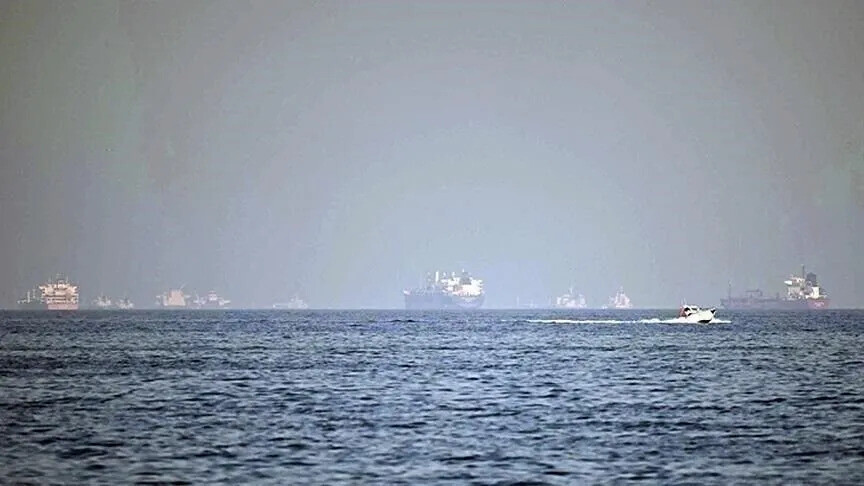
That is because the hot topic currently is the Strait of Hormuz, but the game is bigger than it and than the Islamic Republic and the American superpower. The war opened Tehran's eyes to a weapon stronger than nuclear weapons, which cannot be used even if possession is a guarantee for the regime. As for the Strait of Hormuz, it can be used by total or partial closure in case of war, and it brings in money instead of the nuclear program in which Iran invested billions and endured the harshest sanctions and military strikes, and is preparing to abandon it in negotiations with America.
However, Hormuz is a double-edged sword. Threatening with it is one thing, and using it is another. The militarization of international straits, playing with them, and underestimating the laws of the seas and freedom of maritime navigation is a very dangerous matter. What may prevent an attack or war on Tehran will certainly lead to a big war because the closure of sea straits is a declaration of war on the entire world, and the world will not tolerate the closure for days or more before warships, aircraft, and missiles are launched.
But Iran appears determined on two things: asserting the 'right' to manage the strait and considering it private property, by order of the Supreme Leader, and using weapons to prevent any commercial vessel from crossing Hormuz, despite being subjected to devastating American strikes which it responds to by bombing Bahrain, UAE, Kuwait, Oman, and Jordan with missiles and drones. The height of absurdity is the bombing of the Musandam region in Oman hours after talks in Muscat between Iranian Foreign Minister Abbas Araghchi and his Omani counterpart on a protocol to manage the strait.
Nor does the insinuation that the bombing is carried out by a hardline faction in the Revolutionary Guards that rejects the agreement with the American 'Great Satan' change the matter, as even the chief negotiator, Speaker of the Majlis Mohammad Bagher Ghalibaf, says that 'the era of unequal agreements is over,' and that 'there is no peace with America and no recognition of Israel.' This is the position of one described as a 'moderate' in the 'fundamentalist' camp. And the army did not hide saying that control of Hormuz constitutes a 'security mechanism' to expel America from the region.
Adding to the danger of playing with the Hormuz weapon is the manipulation of regional security. On one hand, Tehran repeats calls for a joint Iranian-Arab regional security system without an American military role, and on the other hand, it emphasizes support for the 'Resistance Front' consisting of ideological-sectarian factions in Arab countries led by the Revolutionary Guards. This front is, at a minimum, a breach of Arab sovereignty and an Iranian 'piracy' of the decision of war and peace in the countries of the region by the force of armed factions in Lebanon, Iraq, and Yemen.
In 1979, a Soviet official told American journalist John Kelly that 'Iran is today the most dangerous place in the world for us and for you.' But the Soviet Union collapsed and Russia is in a strategic partnership with Tehran, and America is at war with it. As for the danger of the Iranian regional project, it is primarily to the Arab world.
Original source: Independent Arabia

Comments (0)
Be the first to comment.