Russia and Sahel States Accuse France and Ukraine of Collusion with Terrorists
Russia and Sahel states accuse France and Ukraine of collusion with terrorists as battles continue to rage in northern Mali.
Russia and African Sahel states accused both France and Ukraine of colluding with terrorist groups that carried out attacks against Mali and Niger in recent weeks, including an attack on Niamey airport in Niger last January, claimed by ISIS, and another against Mali at the end of last April, claimed by Al-Qaeda.
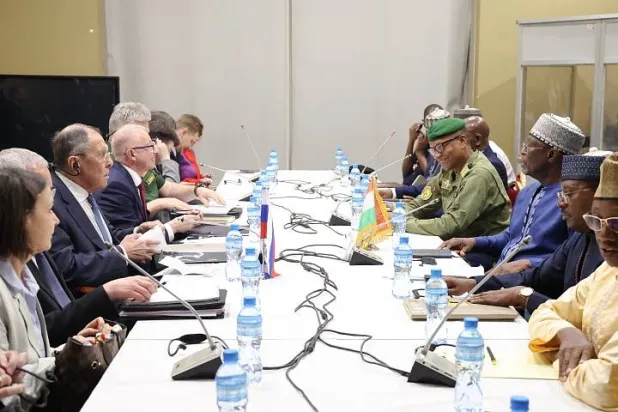
These accusations came in a joint statement issued on Wednesday following the second round of consultations between the foreign ministers of Russia and the Confederation of Sahel States, consultations attended by Sergei Lavrov in the Nigerien capital Niamey, with the foreign ministers of the Sahel states: Mali, Niger, and Burkina Faso, respectively: Abdoulaye Diop, Bakary Yau Sangare, and Karamoko Jean-Marie Traore.
Lavrov during a meeting with General Abdourahamane Tiani, head of Niger (Russian Foreign Ministry)
The joint statement, published by the Russian Foreign Ministry, strongly condemned 'the barbaric and heinous terrorist attacks that occurred in the Confederation of Sahel States, particularly those targeting institutions and cities of the Republic of Mali on April 25, 2026, and the aggression against Air Base 101 and Diori Hamani International Airport in Niamey, Republic of Niger, on January 28 and 29, 2026.'
The statement added that 'the attacks not only targeted sovereign states, but also the collective security of the confederation and regional stability in general,' and praised what it called 'the significant contribution of the armed forces of the Russian Federation in combating terrorism and insecurity in the Sahel region.'
New colonialism
In the context of repeated accusations against the West, the joint statement said that Russia and the Sahel states 'noted the involvement of external international parties in these coordinated barbaric attacks, and in acts of economic and media terrorism within the confederation space.'
The statement referred to what it called 'the condemned collusion between Ukraine and France, and other countries, with terrorist groups active in the Sahel region,' before strongly condemning 'these destructive acts aimed at undermining the sovereignty of the confederation states and stability in the region.'
In his speech during the consultations, the Russian Foreign Minister said that Russia and the Sahel states 'agree on the need to form a multipolar and just world order, and to work together to confront the neo-colonial practices that are still ingrained in our Western colleagues.'
Group photo of the foreign ministers of the Sahel states and the Russian Foreign Minister (Russian Foreign Ministry)
African awakening
Lavrov added that 'the entire world is undergoing geopolitical transformations, and Africa is a prominent and clear example of that,' noting that what Africa is experiencing now is a 'second awakening,' and said that in this awakening, 'the continent aspires not only to political independence and international legal representation, but also to the ability to manage its own natural resources.'
Lavrov emphasized that African countries 'want to ensure that these raw resources are not exported to other countries where the main added value is concentrated, but rather want to achieve this added value within the African continent itself,' stressing that 'Russia is ready to effectively contribute in this regard.'
Lavrov said: 'Our country, our companies, and the relevant economic and financial institutions are fully prepared to effectively accompany our African friends in this approach.' He indicated that Moscow is preparing to host the third Russia-Africa summit next October, whose agenda will focus on economic, trade, and investment issues.
Aerial view of Gao city in central Mali (AFP)
Gateway to the Sahel
Russia clearly relies on the Sahel states as a gateway to enter African markets; Lavrov signed a memorandum of understanding with his counterparts in the Sahel states yesterday establishing regular consultations, accompanied by the first concrete plan for these consultations covering the next two years.
Lavrov said during a press conference following the consultations that he discussed with the Sahel states 'expanding the scope of cooperation in a "3+1" format to include other areas beyond foreign policy, particularly economy and finance, including cooperation between central banks,' while the final statement indicated Russia's support for the 'Confederation Investment and Development Bank' project planned by the Sahel states.
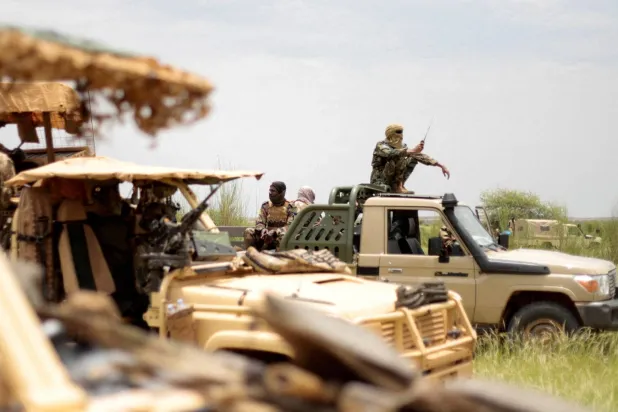
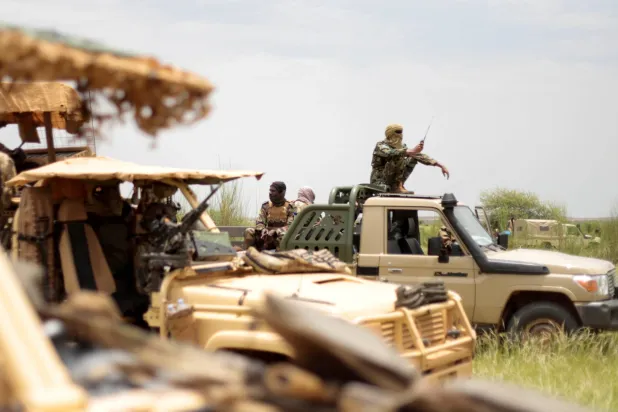
Malian soldiers seen during a patrol near the Niger border (File photo - Reuters)
Lavrov said: 'We also touched on the common interest in establishing parliamentary cooperation, a promising field given the role of parliaments in supporting legislative activity.' He added that the discussion also included 'activating cooperation mechanisms within the United Nations.'
The Russian Foreign Minister said: 'Undoubtedly, counter-terrorism was a priority in our discussions today. In this area as well, mechanisms can be established for continuous monitoring of phenomena that hinder our development, particularly through identifying and dismantling financing networks; terrorism represents an urgent and rapidly impacting problem for both the Confederation of Sahel States and the Russian Federation.'
The final statement welcomed what it called 'the intensification of military and military-technical cooperation between the member states of the confederation and the Russian Federation,' while the Russian side affirmed 'its country's determination and will to continue supporting the enhancement of operational capabilities of the armed forces of the member states and the unified force of the Confederation of Sahel States.'
Malians supporting the coup in Bamako in 2020 (AP)
Reliable partner
For his part, Burkina Faso's Foreign Minister Karamoko Jean-Marie Traore said during a joint press conference with Lavrov that 'Russia has always stood by the Sahel states in their quest for liberation, and in their struggle to build true sovereignty and develop internal self-capabilities that enable them to ultimately break free from forms of domination.'
Karamoko added that 'Russia was among the partners who stood firm and stayed when others left,' in reference to France and the West, and said that the Russians are 'partners who sincerely extended a helping hand, at a time when others were trying to maintain formulas and models that do not allow the Sahel states to overcome their crises.'
He explained that 'huge steps have been taken in security cooperation with Russia,' and said: 'Russia was present alongside our countries in the security field, and continues to accompany us in this area. Today, this cooperation has transcended the bounds of the purely security and defense field to other economic and commercial areas.'
Patrol of Malian army elements in the capital Bamako in August 2020 (AP)
Resumption of battles
Concurrently with the Russia-Sahel consultations in Niamey, battles were raging in the Anfig region of northern Mali between Tuareg rebels allied with Al-Qaeda and the Malian army backed by Russian forces, battles that have been ongoing since last Saturday.
The Malian army said in a statement that it carried out 13 airstrikes on Wednesday, resulting in the destruction of six combat vehicles and one pickup truck, and the neutralization of about 100 terrorists. The Malian army affirmed that it will continue its war on terrorism until victory.
Traffic on a main road in the Malian capital Bamako on Saturday (AFP)
As for the Russian 'Africa Corps,' which is leading the battles in Anfig, it published photos of what it said were terrorist elements killed during the battles, and videos it said prove that the rebels suffered heavy losses, indicating that the rebel leaders bear responsibility for the deaths of hundreds of their fighters when they ordered them to fight.
Original source: Asharq Al-Awsat
Comments (0)
Be the first to comment.