Sami Al-Kaf | On the Price Paid by Citizens in Yemen

An analysis of the deep humanitarian, economic, and institutional toll inflicted on Yemeni citizens by Houthi rule, contrasting it with the efforts of the internationally recognized government to alleviate public suffering.
The presence of the Houthi movement in areas under its control has not been linked to a developmental project that expands life opportunities; rather, it is tied to a long series of practices that included child recruitment, the blowing up of homes and mosques, the confiscation of salaries and humanitarian aid, the disappearance of thousands of people in prisons, and the transformation of state institutions into tools for oppression. Furthermore, it targeted every dissenting voice or independent national figure who held fast to the idea of the republic and the state. When force becomes a substitute for the law, "fear" becomes a substitute for "trust," and the value of human beings diminishes before the demands of the regime's survival.
Some believe that what is happening in Yemen can easily be viewed as an extension of a long war resulting from an armed coup against the state. However, in my view, this characterization alone does not explain the nature of the suffering experienced by millions of Yemenis in areas under Houthi control. When violations transform from sporadic events into permanent practice, they become part of the governance mechanism itself, rather than merely a side effect of the conflict.
At this point, the meaning of authority changes. In my assessment, the state no longer functions as a framework protecting society, but is replaced by the logic of militias. Citizenship is substituted by the criterion of loyalty, and institutions become tools to reproduce control rather than perform their natural functions in protecting rights and preserving human dignity.
Accordingly, as explained above, it can be understood that the Yemeni crisis is not merely a management crisis, but also a crisis in the conception of the "meaning of the state" and its "function." The modern state is measured by its ability to provide security, education, health, sustainable development, and, above all, justice, whereas the authority of armed groups is measured by its ability to subjugate society and perpetuate its influence.
Therefore, the presence of the Houthi movement in areas under its control has not been linked to a developmental project that expands life opportunities, but rather to a long series of practices that included child recruitment, the blowing up of homes and mosques, the confiscation of salaries and humanitarian aid, the hiding of thousands of people in prisons, and the turning of state institutions into tools for oppression, in addition to targeting every dissenting voice or independent national figure who held onto the idea of the republic and the state. When force becomes a substitute for the law, "fear" becomes a substitute for "trust," and the human value retreats before the requirements of the regime's survival.
In contrast, the legitimate Yemeni government, recognized regionally and internationally, has not stopped searching for pathways to alleviate the suffering of citizens, despite the difficulties and complexities on the ground and the depletion of resources. It has dealt with humanitarian, regional, and international initiatives with a high degree of responsibility, presenting more than one initiative to operate Sana'a Airport legally and safely through the national carrier, stemming from the conviction that the right of Yemenis to travel, medical treatment, and education should not remain a hostage to political bickering. The core idea in those initiatives was that humanitarian interests should remain above narrow calculations, and that the citizen—by any available or possible measure—should remain the primary goal of any political or administrative effort.
Perhaps the issue of Yemenia Airways highlights, in my view, a clear example of this contrast in approaching the crisis. Following the Houthi group's seizure of four company aircraft in 2024 and preventing them from taking off from Sana'a Airport, the regionally and internationally recognized Yemeni government chose to avoid escalation, allowing those aircraft to be allocated for operating flights between Sana'a and Amman to preserve the continuity of travel and protect the national carrier as a commercial and sovereign institution serving all Yemenis.
In my estimation, this was not a waiver of rights as much as it was an attempt to prioritize humanitarian considerations and keep a window open for patients, students, and travelers, at a time when the country was in dire need of every outlet to alleviate the burden of war.
However, the Houthi movement's continued rejection of initiatives related to opening Sana'a Airport and operating regular flights revealed that the problem is not about the absence of solutions, but rather the absence of political will to accept them. Doors that could have contributed to easing the suffering of thousands of families were closed, and the disruption of the national carrier continued despite the possibility of reaching practical arrangements that achieve the citizens' interests. When a feasible solution is rejected while public rhetoric continues to raise the slogan of lifting suffering, a gap arises between slogans and practice, and humanity itself becomes material for political conflict instead of being a point of convergence among all parties.
Perhaps this explains the contradiction between the Houthi rhetoric regarding what they call the "siege" and their practical stances toward humanitarian initiatives. If the interest of Yemenis were a priority, it would be logical to support every step that ensures the continuity of civil travel, preserves the state's economic institutions, and eases the burdens on the people. However, the rejection of those initiatives by the Houthi movement showed that weaponizing the population's suffering in mobilization rhetoric remained more prominent than seeking realistic solutions.
Please note with me that an authority which needs the crisis to continue in order to justify its existence finds a threat to its rhetoric in its resolution, whereas the state sees alleviating people's suffering as a condition for gaining its legitimacy and strengthening society's trust in it.
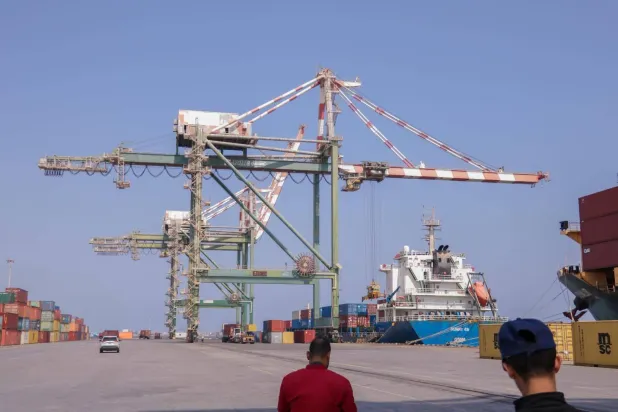
The same logic appears in the targeting of Yemeni oil exports, following Houthi drone attacks that hit the Al-Dhabba oil terminal in Hadhramout and led to the disruption of crude oil exports. This deprived the state of one of its most important financial resources necessary to pay salaries, finance services, and provide the fuel needed to run electricity.
Nevertheless, the regionally and internationally recognized Yemeni government did not move to widen the circle of escalation; rather, it worked in cooperation with Saudi Arabia to provide budget support and secure the petroleum derivatives necessary to maintain basic services. This path reflected an attempt to separate the management of the conflict from citizens' rights, so that Yemenis do not become additional victims in the equations of power and confrontation.
Closely related to this is another dimension of equal importance, represented by the nature of the project within which the Houthi group operates. The issue, from this perspective, is not merely about managing internal affairs, but also involves a political and military alignment with an axis led by Iran, which makes Yemeni territory part of regional conflicts that transcend direct national interests.
When Yemeni geography is used to threaten international navigation or to serve external calculations, the price is paid not only by regional parties, but by the Yemeni citizen, who finds himself deprived of security, stability, and development, while his daily life priorities take a back seat to political gambles that do not reflect his actual needs.
Read more
Houthi threats open a new chapter in the Yemeni crisis
Iranian Mahan Air turns back after being denied entry to Yemeni airspace
Is Yemen approaching a new scenario?
In this context, the announcement by the Chairman of the Presidential Leadership Council, Dr. Rashad Al-Alimi, on the evening of Monday, July 20, 2026, regarding the resumption of oil exports by all means starting from the date of his announcement, acquires a significance that transcends, in my view, the direct economic dimension. It represents an affirmation that national wealth should be employed to serve all Yemenis, through fulfilling state obligations, improving services, and restoring resources that represent the basis of any economic and administrative recovery process.
Original source: Independent Arabia


Comments (0)
Be the first to comment.