Sudan and the 'Muslim Brotherhood' Rule... Bashir and the Dilemma of Foreign Policy (5-6)
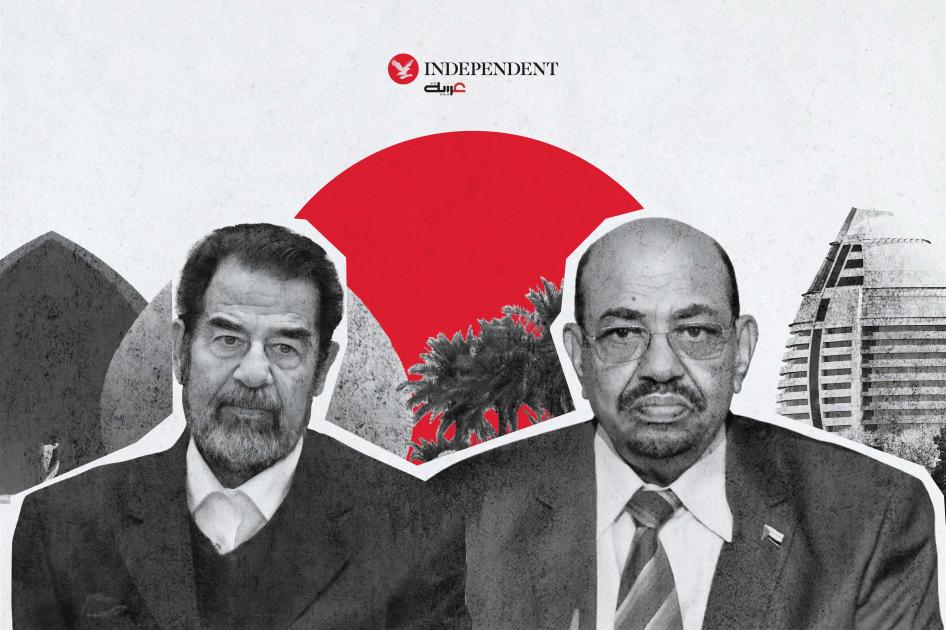
Summary: Recently declassified British documents reveal the reality of Sudanese foreign policy when the Revolutionary Command Council, led by ousted President Omar al-Bashir, came to power in 1989. The documents also explain how Bashir and his comrades attempted to change Sudan's relationship with the Arab and Western worlds at the time, but the Gulf War placed the country before major challenges.
The military authorities in Sudan inherited several internal and external crises in 1989. Internally, there was the issue of the South and the Sudan People's Liberation Army forces, which controlled vast areas and were supported by Western and African parties. Wars drained Sudan's economic, military, and political capabilities and hindered development in this Arab country for decades. The Islamic character and the role of the Muslim Brotherhood in the military coup in Sudan also worried Arab and Western countries. Externally, Sudanese foreign policy was dominated by emotions and ideologies rather than national interests and was somewhat contradictory. On one hand, the Sudanese Muslim Brotherhood pushed Khartoum towards rapprochement with Tehran and allowed Iran to set up military militias similar to the Iranian Revolutionary Guard. On the other hand, nationalist and leftist currents opened the door for Palestinian movements that carried out several violent operations, damaging Sudan's foreign policy.
Liquidation of Foreign Ambassadors
When the Revolutionary Command Council wanted to rectify the situation in 1989 and chose Baghdad over Tehran, and Bashir immediately after taking power went to Baghdad to join the Iraqis in celebrating the recapture of Al-Faw, they were not lucky in improving Sudan's foreign relations, as the Iraqi invasion of Kuwait occurred a few months after Bashir's visit. When the international coalition forces in the Second Gulf War, led by the United States, began preparing to liberate Kuwait, concern prevailed in Western capitals after a secret informant provided the British government with information that Iraq intended to liquidate a number of foreign ambassadors in Khartoum. One of the documents in the file on relations between Sudan and Iraq, within the correspondence of the British Foreign Office that was recently declassified, stated:
"October 30, 1990. A secret informant contacted the Middle East and North Africa Department of the British Foreign Office in London a few days ago to convey reports that if war broke out in the Gulf, the Iraqis intended to liquidate a number of foreign ambassadors in Khartoum, including the British ambassador. They know that our ambassador has 5 SAS men to protect him. Nevertheless, the Iraqis viewed Sudan as a soft underbelly for carrying out terrorist attacks."
Iraq's invasion of Kuwait hindered rapprochement between Baghdad and Khartoum after Bashir came to power (AFP)
"My informant has always amazed me with his incredibly good knowledge of Sudan and its internal politics. He told me that his information came from several separate sources and he considers it reliable. Circumstances that should not be ignored, especially if we take into account recent remarks made by al-Dabi to Carson about the potential threat of a terrorist attack in Sudan. You may feel it appropriate to remind the Foreign Office, and through it the relevant local agencies, of their commitment to ensuring adequate protection for you personally, for your embassy, and for the British community."
"The information has been fully assessed here. At present, nothing is available to us in London to support the information. However, we feel, and I am confident you will feel, that this information should not be ignored in the current circumstances, especially if we take into account recent remarks made by al-Dabi to Carson about the potential threat of a terrorist attack in Sudan."
Targeting Diplomatic Missions
Another British document discusses the process of liquidating the staff of Sudanese diplomatic missions, including the Sudanese embassy in Baghdad, and the Iraqi government's plan to deport Egyptians and Sudanese working in Iraq during the Iran-Iraq war (1980-1988) by setting a specific ceiling for the annual amount of remittances for residents in Iraq. The document stated:
"September 18, 1989. My Sudanese colleague, Mohamed Ahmed al-Mirghani, came to say goodbye to me after two years in Baghdad. He said his dismissal was premature and part of a broader process to replace ambassadors in some embassies with political loyalists. His future was uncertain. He needed to return home and introduce himself to the new regime. I asked him about the situation of Sudanese workers in Iraq. He said that as a result of the recent decree reducing remittances of foreign workers from $800 annually to $300 annually, nearly 70 percent of Arab workers here would leave Iraq. He speculated whether this was not the actual motive. The Iraqis wanted to limit the outflow of hard currency. He claimed that Egyptians are particularly upset now because they are members of the AAC and thus should be treated specially. I asked if any Sudanese were in the explosion near Hilla. He said there were no Sudanese casualties, but he understood there were some injuries among Egyptian experts. He said he heard that the Iraqis were pursuing a policy of reducing the number of foreign workers in their military institutions, and this could explain why there were relatively few foreigners in the incident."
Read more
Where did Omar al-Bashir and his comrades disappear?
Omar al-Bashir before the court on corruption charges
Sudanese judiciary charges Hamdok with offenses punishable by death
Suspicion of Espionage
"The Sudanese embassy here is still under the responsibility of the second secretary, who was our informant on the points above. The former ambassador was transferred in August to Khartoum and seems to have joined the presidential staff there. Ali Adham (a good source of mine) is apparently going through a crisis. About a month ago he told me he was hoping to take a long-awaited vacation in Seychelles once the new ambassador arrived (expected in early December but not yet arrived). However, we were told that Adham has been dismissed from the foreign service due to allegations against him, and he is scheduled to return to Khartoum not for retirement but for trial, on suspicion of spying for Iraq. Apparently, when Adham was young, he had connections with various communist organizations (Chinese). The Iraqis discovered this and successfully blackmailed him into spying for them. Adham has not left Iraq yet, according to the charge, and is instead trying to travel to the United States or the United Kingdom, using the pretext of wanting to pursue further studies, but actually for his personal safety. Although Adham, according to the Sudanese, has already received visa application forms from us, British visa officials who are aware of his file have not received any application from him. So said the US embassy, which we consulted. But they heard that a few months ago he signed a petition attacking the new regime in Khartoum."
Displeasure with the Change of Regime
Original source: Independent Arabia


Comments (0)
Be the first to comment.