Turkey Rejects Description of Its Intervention in Cyprus as 'Invasion'
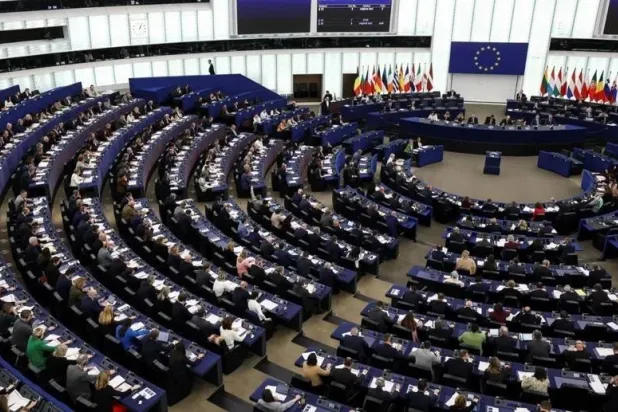
Turkey announced its rejection of a European Parliament resolution on Cyprus that described its 1974 intervention in the northern part of the island as an 'invasion'.
The Turkish Defense Ministry said: 'We strongly reject the false, illogical, and defamatory claims and the European Parliament resolution targeting the Turkish Armed Forces regarding the 1974 Peace Operation, which saved the Turkish Cypriot people from genocide after the systematic attacks, massacres, and forced displacement... they suffered on the island.'
The European Parliament adopted on July 8 a resolution titled 'The Impact of the 1974 Turkish Invasion on Cypriot Women and Children and the Crimes Committed by the Turkish Armed Forces' with 575 votes in favor, 33 against, and 43 abstentions.
'Illogical' resolution
The resolution was based on a report prepared by Greek MEP Eleonora Meleti, a member of the European Parliament's Committee on Women's Rights and Gender Equality, who belongs to the New Democracy party led by Greek Prime Minister Kyriakos Mitsotakis.
Turkish Defense Ministry Spokesperson Zeki Akturk said during a press briefing on Thursday that 'the resolution ignored the massacres, mass graves, and years of inhumane attacks suffered by the Turkish Cypriot people,' considering this 'clear evidence of the European Parliament's illogical nature and its one-sided approach based on Greek Cypriot propaganda.'
'The Green Line' separating the Turkish north and Greek south of Cyprus (AFP)
He added that 'EOKA,' which he described as 'terrorist,' referring to a Greek Cypriot paramilitary organization that fought to end British rule in Cyprus and ultimately unite with Greece, burned and destroyed 103 Turkish villages, and displaced around 30,000 Turkish Cypriots from their homes since 1963 in pursuit of unification with Greece.
Akturk continued that 'it is a tragic irony that those who ignore the massacres committed before the eyes of the whole world, during what is known as Bloody Christmas, are now trying to blame our Turkish Armed Forces.'
He stated that Turkey 'as a guarantor state, within its legitimate rights and powers derived from international agreements, ended the attacks targeting the existence and security of the Turkish Cypriot people through the 1974 Peace Operation in Cyprus, saved the Turkish Cypriot people from genocide, and established peace and security on the island.'
Soldiers from Turkish forces in northern Cyprus (Turkish Defense Ministry)
Akturk considered the presence of Turkish soldiers on the island of Cyprus to this day as 'a guarantee of peace, security, and stability for more than half a century,' stressing that Turkey will continue to ensure the rights, interests, and security of the Turkish Cypriot people in the 'Turkish Republic of Northern Cyprus' (recognized only by Turkey), and that the Turkish Armed Forces are now 'more determined than ever to respond appropriately to any hostile act targeting the security of the Turkish Cypriot people.'
Previous accusations
This resolution is not the first of its kind against Turkey in the European Parliament; the Foreign Ministry has previously rejected similar resolutions adopted by approximately '100 votes out of 730' members in the European Parliament.
Turkish reports revealed the objection of MEP Georgios Georgiou, a member of the AKEL party from (Greek) Cyprus, during the debate on the resolution in the European Parliament's plenary session, asserting that EOKA and its Greek Cypriot paramilitary forces also committed atrocities against Turkish Cypriots.
During the session, as reported by the Turkish press, the Cypriot MP said: 'There has always been an atmosphere in the European Parliament such that if a draft resolution with a single sentence stating that "Turks are barbarians and must be crushed wherever they are" were presented, I am sure it would pass by an overwhelming majority.'
Erdogan during his reception of Council of Europe President Antonio Costa and European Commission President Ursula von der Leyen in Ankara on July 8 (Turkish Presidency)
Turkish writer and political analyst Hasan Gogus attributed the repeated issuance of such resolutions against Turkey to two factors. One: its gradual departure from the image of a state governed by the rule of law and from the 'Copenhagen criteria' qualifying for European Union membership. The other: the changing composition of the European Parliament, and 'consequently its stance towards Turkey, due to the rapid rise of the far right in Europe.'
While conceding that political pressure is not Turkey's strength, he argued that it is also not correct to attribute the decline of its influence within the European Union solely to the activities of Greek Cypriot lobby groups, considering that major players in the European Union, such as Germany, France, and Italy, see it as a convenient pretext to hinder Ankara's bid for EU membership, as well as its participation in some important programs, such as the European Union's 'Defense Industries Program (EDIP).'
Original source: Asharq Al-Awsat

Comments (0)
Be the first to comment.