United Nations: Gum Arabic Trade in Sudan Fuels Civil War
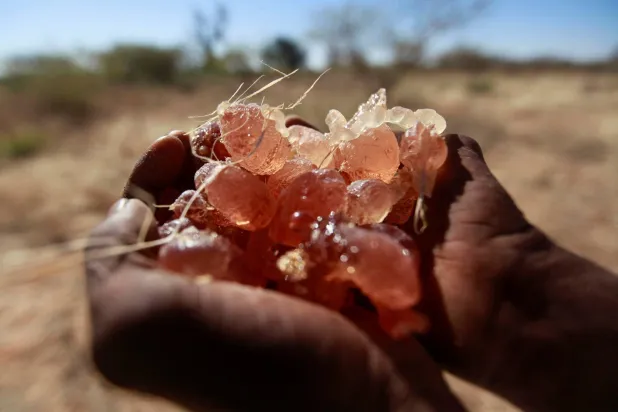
The United Nations High Commissioner for Human Rights on Wednesday called on states, companies, and parties involved in the gum arabic industry in Sudan to comply with international law.
The International Criminal Court will hold a public hearing on July 21 to consider a request from the Office of the Prosecutor to withdraw charges against Sudanese citizen Abdullah Banda Abaker Nourin, one of the accused of committing war crimes in the Darfur region, a move that could end one of the oldest cases before the court.
The court said in a statement posted on its website that Trial Chamber IV will hold the session at 2:30 p.m. The Hague time to hear observations from the prosecution, defense, and participants regarding the request to withdraw charges, with the session to be broadcast on the court's website.
The case relates to the attack on September 29, 2007, on the African Union Mission in Sudan (AMIS) peacekeeping force site in the town of Haskanita, North Darfur, which resulted in the deaths of 12 force members and serious injuries to eight others. Banda voluntarily appeared before the court in June 2010, and Pre-Trial Chamber I confirmed the charges against him on March 7, 2011, and committed him to trial. He later failed to appear, and Trial Chamber IV issued an arrest warrant for him on September 11, 2014. The case remained pending due to his absence, as the court does not conduct trials in absentia.
Prosecution seeks to drop charges
The Office of the Prosecutor announced on Tuesday that it had requested permission to withdraw three charges of war crimes against Abdullah Banda, concluding that the evidence no longer provided 'substantial grounds' to believe in his criminal responsibility for the alleged crimes. The Office said it filed the request to withdraw charges on October 5, 2023, and it remained confidential under the chamber's orders until documents were unsealed and announced this week.
It attributed its decision to the significant deterioration of evidence over time, exhaustion of all investigative leads, inability to reach or lack of cooperation from several witnesses, credibility issues with key witnesses, and the emergence of new evidence in favor of the accused. It added: 'More than a decade after the confirmation of charges and with investigations reaching their final stages, it is unlikely that any further inquiries will change this assessment.'
The Office of the Prosecutor attributed its decision to what it called an 'objective assessment of the evidence' and a commitment not to proceed to trial unless sufficient evidence exists, noting that the withdrawal of charges—if approved by the court—would end Banda's case without preventing the prosecution from refiling charges in the future if new evidence emerges.
Deputy Prosecutor Nazhat Khan said her office is aware of the decision's impact on victims who have waited years for justice, but it is committed to ensuring that no case is sent to trial unless based on sufficient evidence.
Deputy Prosecutor of the International Criminal Court Nazhat Khan (AFP)
She added: 'The request to withdraw charges concerns Banda alone and does not affect other cases related to Darfur crimes or the investigations conducted by the Office of the Prosecutor regarding crimes committed during the current war in Sudan.'
The request to withdraw charges comes as Banda remains active on the military scene in Sudan. After the outbreak of war between the army and the Rapid Support Forces on April 15, 2023, he joined the joint force of armed movements that signed the Juba Agreement, currently allied with the army. Sudan Tribune reported that he arrived in El Fasher in November 2023 at the head of a military force and announced his joining the fight alongside the army, later participating in military operations by the joint force in the Darfur region. According to the newspaper, Banda was seriously injured during a Rapid Support Forces attack on the Malha area in North Darfur in March 2025, was taken to Egypt for treatment, and then returned to Omdurman.
The withdrawal request comes amid complexities faced by one of the ICC's oldest cases on Darfur, while the Office of the Prosecutor continues its investigations into crimes committed in the Darfur region since the outbreak of war between the army and the Rapid Support Forces.
The UN Security Council referred the Darfur case to the International Criminal Court in 2005 under Resolution 1593, making it the first case referred to the court by the Council. Accordingly, the court issued arrest warrants for several Sudanese officials, including former President Omar Hassan Ahmad al-Bashir, against whom two arrest warrants were issued, the first on March 4, 2009, for war crimes and crimes against humanity, and the second on July 12, 2010, for genocide. The court also issued arrest warrants for then-State Minister of Interior Ahmed Muhammad Harun in April 2007, former Defense Minister Abdel Rahim Muhammad Hussein on March 1, 2012, in addition to Abdullah Banda.
Throughout its rule, the government of President Omar al-Bashir refused to recognize the court's jurisdiction or surrender any of the wanted individuals, despite repeated demands from the Security Council and the ICC.
After the fall of al-Bashir's regime on April 11, 2019, the transitional government declared its readiness to cooperate with the court. The Juba Peace Agreement signed in October 2020 stipulated cooperation with the ICC. The Cabinet approved a draft law to join the Rome Statute in August 2021, and officials pledged to surrender the wanted individuals, but those commitments were not implemented until the coup of October 25, 2021.
Ali Kushayb during the sentencing hearing where he was convicted of war crimes in Darfur, December 9 (AFP)
The fate of executing arrest warrants for those wanted by the ICC remains pending, and authorities conceal their whereabouts, though al-Bashir is known to reside somewhere in the north of the country.
Ali Muhammad Ali Abd-al-Rahman, known as 'Ali Kushayb,' is the first and only defendant in the Darfur case to appear before the ICC. He surrendered to the court in June 2020, and Trial Chamber I convicted him on October 6, 2025, of war crimes and crimes against humanity in Darfur, sentencing him on December 9, 2025, to 20 years in prison.
Kushayb's conviction is the first conviction issued by the court in Darfur cases since the case was referred to it over twenty years ago. The sentence remains subject to appeal. As for Bahr Idriss Abu Garda, who served as Minister of Health after signing a peace agreement with al-Bashir's government, he voluntarily appeared before the court in 2009 in the same case related to the Haskanita attack. Pre-Trial Chamber I declined to confirm charges against him, ending the proceedings without referral to trial.
Original source: Asharq Al-Awsat


Comments (0)
Be the first to comment.