Why did the Iranian plane insist on landing in Yemen?

After hours of escalation that began in the skies of Yemen, with an Iranian plane attempting to land at Sanaa airport without the approval of the internationally recognized government, and ending with its arrival at Hodeidah airport under Houthi control, questions are mounting about the dimensions of the Iranian move, the reasons for insisting on entering Yemeni airspace, and the course of confrontation this incident may open.
The crisis escalated with the Yemeni government's announcement of its rejection of what it described as an attempt by the Houthis and Iran to impose a fait accompli by violating Yemeni airspace, vowing to prevent the plane heading to Sanaa from landing. Government forces targeted the runway of Sanaa airport to prevent the plane from landing, before it headed to Hodeidah airport and landed there, while the Yemeni Civil Aviation Authority announced the closure of all the country's airports to air traffic until further notice.
In this context, political analyst Mubarak Al Aati believes that the recent escalation in Yemen is behind the Houthi group, incited by Tehran, in an Iranian attempt to expand the arenas of conflict in the region, noting that the Yemeni government's move to prevent the Iranian plane from landing reflected a firm stance in defending the country's sovereignty.
Read more
The full story of the Iranian plane that violated Yemen's airspace
Iranian plane triggers confrontation in Yemen's skies and the Coalition to Support Legitimacy intercepts Houthi missiles
Yemen envoy insists on prisoner swap deal despite differences among factions
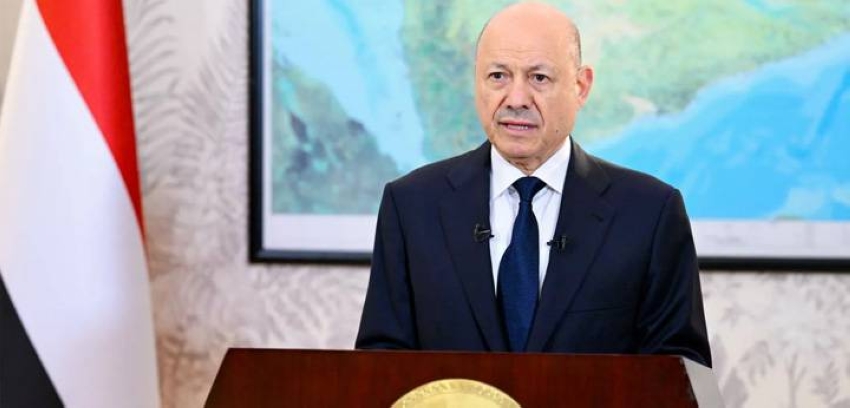
Al Aati said, in an audio file with 'Independent Arabia', that 'the government of President Rashad al-Alimi was at the level of responsibility' after it took measures to prevent the Iranian plane from landing in Sanaa, stressing that this step showed the ability of the internationally recognized government to protect Yemeni airspace and impose its sovereignty.
The speaker added that the government moved to prove the presence of state institutions and their ability, in coordination with regional and international powers, to prevent Yemen from slipping and turning into a new arena for conflict. He believed that the government 'cut off the way for the Tehran regime and the Houthis' during their attempt to violate Yemen's sovereignty, warning that the escalation may head towards Saudi Arabia or the region’s countries, and possibly extend to an attempt to close the Bab el-Mandeb Strait, which may require a new international move to ensure freedom of navigation.
Original source: Independent Arabia




Comments (0)
Be the first to comment.