Wildfire Smoke Covers US Cities Ahead of World Cup Final, Trump Blames Canada
Summary: Andrew Giuliani, executive director of the White House World Cup Task Force, said in a press briefing that tournament organizers are 'monitoring the situation closely.' Experts at the National Weather Service warned that smoke could become denser through the night and into Saturday morning.
Thick plumes of wildfire smoke, drifting south from Canada and northern Minnesota, triggered new air quality warnings across the United States on Friday, raising concerns about the World Cup final scheduled for Sunday near New York.
US President Donald Trump launched an attack on Canada, where authorities reported more than 200 fires still out of control on Friday, calling the pollution 'completely unacceptable.'
Trump wrote on his Truth Social platform, 'The United States is under an unjustified invasion of dirty, polluted, and unhealthy air, whose quality is dangerous and completely unacceptable,' adding, 'I will call the Prime Minister today to find out what they are going to do about it.'
Detroit has become the most polluted city in the world due to the smoke, according to the tracking site IQAir. Washington and Chicago are not far from the same pollution level, and officials urged residents not to leave indoor spaces unless necessary.
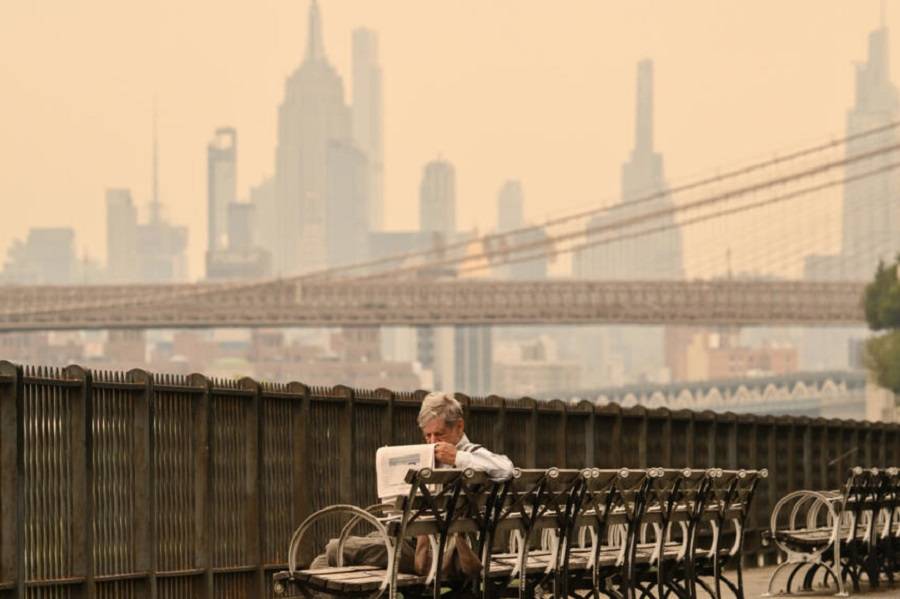
In New York and neighboring New Jersey, where the final will be held Sunday at an open-air stadium, conditions have become 'unhealthy,' after smoky haze made the Manhattan skyline barely visible on Thursday.
The National Weather Service warned that smoke could become denser through the night and into Saturday morning.
Andrew Giuliani, executive director of the White House World Cup Task Force, said in a press briefing that tournament organizers are 'monitoring the situation closely.' Experts at the National Weather Service warned that smoke could become denser through the night and into Saturday morning.
Peter Mullinax, an expert at the National Weather Service, told AFP, 'What we will start to see is the return of northwesterly winds over the Great Lakes region, which will carry some of that smoke and push it toward the Northeast.' However, he clarified that forecasts do not indicate that air quality in the northeastern United States on Sunday will be as bad as what the region experienced during the week. He added that during the match between Spain and Argentina, 'we are not expecting to see the intense smoke density we are seeing now,' even if hazy conditions persist.
He continued, 'I don't think this has the same level of impact that playing a match right now would have.'
Mark Parrington, an expert at the Copernicus Atmosphere Monitoring Service, noted that rainfall over the weekend could also help reduce the smoke. He said, 'We just have to see if those fires continue at the same scale.'
'More toxic'
In cities across the Midwest and Northeast, people wore masks outdoors to filter the polluted and hazardous air, and libraries and train stations were distributing them for free in New York.
Chris Carlsten, who studies the health effects of wildfire smoke at the University of British Columbia, said that fine particulate matter from wildfires particularly affects the lungs, while pollution from cars tends more to affect the heart. He added that smoke plumes can carry residues of wood and plants, as well as paint, plastic, or metals.
Read more
World Cup final puts Spanish league on throne of football
Argentina beats England, faces Spain in World Cup final
Spain reaches World Cup final at the expense of France
Why we may see the best World Cup semifinal in history?
As the smoke travels, it undergoes what is known as 'photochemical aging,' a series of reactions that Carlsten says 'appear, based on what we know in chemistry, to make the aerosol more toxic.'
The impact is stronger in the upper Midwest, closer to the fire sites, with parts of Michigan, Minnesota, and Wisconsin recording air quality in the 'hazardous' range.
Role of climate change
Experts stressed the link between recurring wildfire smoke episodes and climate change.
Paul Mathewson, director of science programs at Clean Wisconsin, one of the states that has seen a sharp rise in smoky days in recent years, said, 'The increasing prevalence of smoke in the air highlights the importance of a rapid transition to clean energy, rather than building more polluting fossil fuel infrastructure that further exacerbates climate change.'
Mark Parrington emphasized that climate change is priming conditions for a longer fire season, accompanied by higher surface air temperatures and lower soil moisture.
He explained, 'When ignition occurs, we see large-scale and sustained combustion, so that these fires can remain burning for weeks on end throughout the summer.'
Fire activity escalated in Canada on Friday, with more than 200 fires out of control, particularly in Ontario province, according to authorities. The fires in Ontario have caused no casualties, and many remote area residents have been evacuated.
Meanwhile, 16 fires remain active in the Superior National Forest, located on the border between Minnesota and Canada.
The US Forest Service said forecasts of unsettled weather and shifting winds, with the potential for strong and damaging winds in scattered areas and thunderstorms, will challenge firefighting efforts.
Original source: Independent Arabia






Comments (0)
Be the first to comment.