With drones and white paint... Europe tries to protect infrastructure from heat
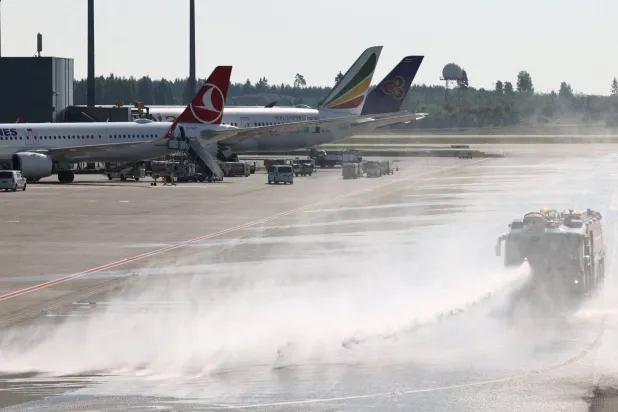
European countries are turning to a variety of solutions to face record heatwaves.
As pressure mounts on Europe's rail and electricity networks and some roads crack under record heatwaves, European countries are turning to a variety of solutions to address aging infrastructure, ranging from drones inspecting rails and AI-powered sensors to a surprisingly simple tool... white paint.
At Oslo Airport in Norway on Wednesday, with temperatures expected to reach 30°C, about 10 degrees above the seasonal norm, workers sprayed the runway with water to cool it, according to Reuters.
This marks a notable shift in a country more accustomed to dealing with cold, and highlights the challenges Europe faces in adapting to rising temperatures that fuel wildfires, cause thousands of deaths, and put infrastructure under increasing strain.
Jorn Arvid Remark, an engineer at state-owned Avinor, which operates Norwegian airports, said: 'In Norway, asphalt must withstand both extreme cold and relatively high temperatures,' adding that the airport is testing a new type of heat-resistant asphalt.
Fire crews spray about 9,000 liters of water on key parts of the runway, which can be damaged in high temperatures as it softens under the weight of aircraft.
Europe's roads and railways, many built decades ago, are struggling to adapt to these conditions. Reuters Climate Monitor data showed that temperatures in Western Europe on Wednesday were about 5.5°C above the mid-July norm.
Chris Dodwell, co-director of the sustainability center at asset management firm Impax, said: 'Our infrastructure is in no way prepared for the extreme weather events we expect to see,' adding that heatwaves, once rare, are now occurring regularly.
A 2025 report by major central banks estimated that severe weather events, including heatwaves, droughts, and floods, could reduce euro zone GDP by up to 4.7% by 2030.
Rising temperatures mean more storms and floods
Europe's railway networks have been among the most affected by these changes.
An EU report in April revealed that over 70% of railway managers have observed increasing disruptions from extreme weather. Between 2015 and 2024, total weather-related downtime amounted to between one and three years of rail services across the continent.
Heat can cause rails to expand, and disrupt transformers, signals, and power systems. But extreme weather conditions caused by rising temperatures can be even more destructive.
Oliviero Baccelli, a professor at Bocconi University in Milan, said: 'The most serious problem for railway networks is not the heat itself, but the thunderstorms, strong winds, and landslides that often follow heatwaves.' He added: 'Italy has already seen major disruptions to its rail network, especially on mountain routes in the Alps, due to climate-related events.'
Northern European countries, including Britain, face particular challenges because much of their rail infrastructure was designed to withstand a narrower temperature range compared to southern European networks.
John Lawrence, head of the railway technical network at the Institution of Engineering and Technology, said that many railway components and systems 'still rely on designs dating back decades.'
He added that adapting entire networks to withstand heat will cost substantial sums, although rail operators are exploring more stable designs for sleepers and technologies such as AI and drones to 'accelerate track inspection and monitoring.'
Britain's Network Rail has pledged to invest £2.6 billion ($3.5 billion) between 2024 and 2029 to help its network cope with the increasing frequency of extreme weather.
However, not all solutions are expensive; some transport network operators use traditional methods to mitigate heat by reflecting sunlight. Stockholm's transport authority spent about 100,000 Swedish kronor ($10,300) on painting parts of metro rails white during May and June to reduce the risk of buckling.
Heatwaves 'more intense, frequent, and longer-lasting'
Martin Wilson, engineering director at French rail equipment maker Alstom, said Europe could learn from transport systems designed to operate at temperatures above 50°C, such as the Riyadh Metro and Dubai Tram.
He said: 'Heatwaves today are more severe, more frequent, and longer-lasting... Rising temperatures are an increasing challenge for railway systems across Europe.'
The pressure is not limited to railways; roads face similar challenges. Engineers say motorways in northern Europe were primarily designed to withstand damage from freeze-thaw cycles, while southern European countries like Spain use asphalt mixes more suitable for summer heat. But finding the right balance is becoming harder as countries must cope with both colder winters and hotter summers.
Jose Pablo Saez Villar, from the Spanish Association of Civil Engineers, referring to road engineers in northern Europe, said: 'They may have to adjust their approach.'
Paris transport authority has set up a heatwave emergency unit and is working on a climate adaptation plan by the end of the year.
In Norway, officials say warmer and wetter weather is changing how new infrastructure is designed.
Grete Vikan, responsible for community development and climate at the Norwegian Public Roads Administration, said: 'Roads will be built with more robust specifications... so they can withstand the challenges we already face, as well as expected climate change impacts.'
Original source: Asharq Al-Awsat



Comments (0)
Be the first to comment.