Damascus.. First Syrian-American Forum Launches to Discuss Oil Investments and Reconstruction
Following Washington's initiation of procedures to remove Syria from the list of state sponsors of terrorism..
ISTANBUL/ Laith al-Junaidi/ Anadolu
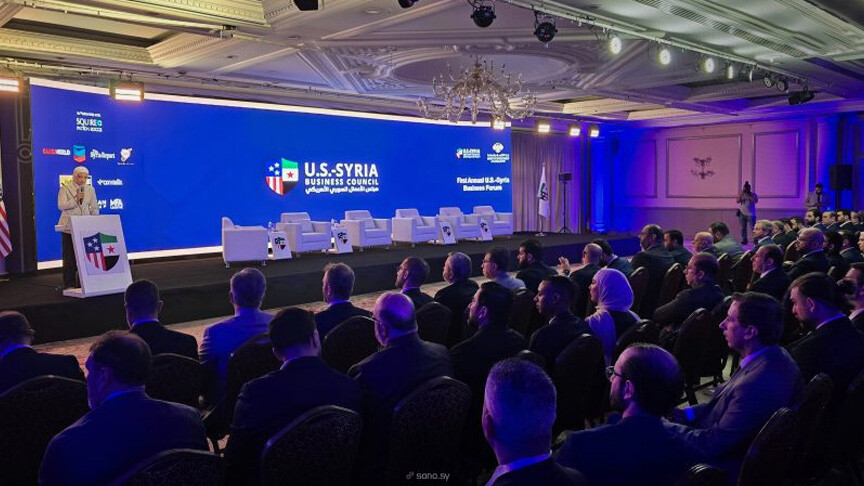
The first Syrian-American business forum kicked off in the Syrian capital Damascus on Monday, with the participation of representatives from ministries and economic and commercial entities from both countries, to discuss investment opportunities in oil and gas and reconstruction.
The Syrian Ministry of Economy and Industry is organizing the forum in cooperation with the Syrian-American Business Council, following the Trump administration's initiation of procedures to revoke Syria's designation as a state sponsor of terrorism.
On July 8, Trump notified Congress of his administration's intention to revoke the designation, starting a 45-day review period before the decision takes effect.
The head of the Syrian-American Business Council, Issam Ghrewati, said the forum represents "a declaration of confidence and a milestone in renewing the economic partnership between Syria and the United States, and lays the foundation for a new phase of economic cooperation between the two countries."
He added that the forum allows Americans and Syrians to meet in Damascus to discuss investment, innovation, and economic development, considering that the initiation of procedures to revoke Syria's designation as a state sponsor of terrorism opens the door for a new phase of openness and cooperation.
For his part, Syrian Minister of Economy and Industry Nidal al-Shaar said: "Today we open a new chapter in economic relations between Syria and America, based on cooperation, partnership, and building a shared economic future."
He added that the recent US decisions not only represent a change in policies but also remove barriers that hindered trade, investment, and financial participation for years, paving the way for a new economic relationship between the two countries.
In the energy sector, the CEO of the Syrian Petroleum Company, Youssef Qablawi, said his country is moving to expand cooperation with international companies and attract investments to the oil and gas sectors.
He explained that the company has signed memorandums of understanding with international companies, most of which have turned into investment contracts, pointing to plans to expand investments, especially off the Syrian coast.
On the American side, Timothy Linderking, former senior advisor at the Bureau of Near Eastern Affairs at the US State Department and current director at Squire Patton Boggs, said Syria now has promising opportunities.
He affirmed that the presence of US companies aims to "support building bridges of cooperation between the public and private sectors."
In a related context, US Deputy Assistant Secretary of State Jacob McGee emphasized in a pre-recorded video speech that Syria "has moved from a phase of economic isolation to a new phase of openness."
He revealed joint moves to integrate the country into the international financial system, saying: "We are working with the Syrian government to facilitate Syria's integration into the global financial system, and to provide banking solutions and a clear regulatory environment that support investment movement."
He stated that US companies have already begun "exploring investment opportunities in Syria, amid growing interest in signing agreements and building partnerships in various sectors."
He explained that these steps coincide with the emergence of the first signs of economic recovery, represented by "the growth of tourism activity and the return of increasing numbers of refugees."
Despite the lifting of most sanctions on Syria after the overthrow of Bashar al-Assad's regime, the country remains on the US list of state sponsors of terrorism since 1979, which American and Syrian experts and officials consider one of the most prominent remaining challenges to the Syrian economy's recovery.
The United States placed Syria on the list of state sponsors of terrorism during the era of the late President Hafez al-Assad (1971-2000), on the grounds that it provided repeated support to groups that Washington classifies as 'terrorist'.
Original source: Anadolu Agency


Comments (0)
Be the first to comment.