How can artificial intelligence become more sustainable?
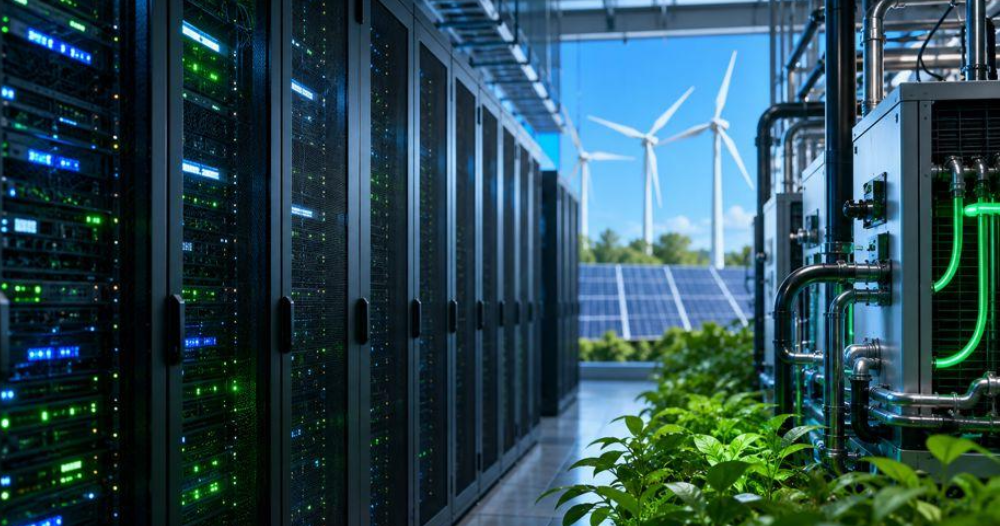
How can artificial intelligence become more sustainable?
In the global AI race, the competition is no longer just about developing smarter models or launching more sophisticated applications—it has shifted to a more pressing question: who will pay the bill for this progress?
Behind every conversation with a smart robot, or every image generation or data analysis process, giant data centers operate that consume enormous amounts of electricity and water, placing increasing strain on energy grids and the environment.
And as investment in these centers accelerates to meet growing demand for AI technologies, a fundamental challenge emerges: how to strike a balance between innovation and sustainability, so that the digital revolution does not become an environmental burden that threatens global goals to reduce carbon emissions.
Sustainability of AI
Data centers have become a central focus in the global debate on AI sustainability, as many view them as the most visible face of energy and natural resource consumption.
However, this perception does not reflect the full picture. The problem is not the existence of these centers per se, but rather the way they are designed, built, and operated, in addition to how the AI models that rely on them are developed.
Experts point out that the benefits provided by data centers extend to internet users around the world, enabling easy and fast access to cloud computing services and AI applications.
Yet their environmental impacts remain primarily local, because the electricity and water consumption and the resulting emissions are concentrated in the regions hosting these facilities.
Currently, the largest share of data centers is located in a limited number of areas, such as the US state of Virginia, Ireland, Texas, and Singapore, placing significant pressure on electricity grids and water resources in those regions.
The need for energy
With the rapid expansion of new data centers, the need for energy is growing at a pace akin to adding an entire city with tens of thousands of homes in a short period. This drives some developers to resort to quick solutions based on building private fossil-fuel power plants to meet the needs of new centers.
Although these solutions provide the required energy in the short term, they increase carbon emissions and exacerbate pollution, while power grid operators find themselves forced to invest in expanding infrastructure in record time. Often, local communities bear part of this cost through higher electricity prices or increased pressure on basic services.
Specialists believe that the solution is not to continue building data centers in the same traditional regions, but rather to redistribute them geographically and choose new locations with renewable energy sources and infrastructure capable of accommodating growing demand. Thoughtful local planning can ease the burden on electricity grids, reduce natural resource depletion, and limit community objections associated with establishing these projects.
Renewable energy
Renewable energy emerges as one of the most important elements in the transition to more sustainable data centers. In the US state of Nevada, Google is developing a geothermal energy project aimed at powering its data centers with clean electricity around the clock—a model that reflects the potential to rely on stable energy sources not tied to weather fluctuations, unlike solar or wind power.
Meanwhile, governments play a pivotal role in accelerating this transition through regulatory frameworks. Ireland has imposed a requirement on new data centers to source 80% of their power from renewable energy, encouraging companies to invest in low-emission solutions rather than relying on traditional fuels.
Experts emphasize that combining government policies with voluntary commitments from tech companies represents the most effective path to reducing the environmental footprint of this fast-growing sector.
Design and construction phases
Sustainability is not limited to the operational phase of data centers; it begins at the design and construction stages. Choosing low-emission building materials, such as treated wood or low-carbon concrete, can significantly reduce construction-related emissions. Additionally, repurposing old factories and industrial buildings instead of building new facilities reduces land and resource consumption.
These buildings offer an additional advantage: they are already connected to electricity and water grids and have industrial use permits, which shortens licensing procedures and reduces the need to build new infrastructure or clear green spaces for modern facilities.
Another promising idea is the repurposing of the immense heat generated by servers during operation. Instead of dissipating this heat into the air, it can be used to heat homes or industrial facilities—a practice already adopted by some countries.
In West London, about 17 megawatts of waste heat from data centers are used to heat up to 10,000 homes and commercial premises, while Norway uses the heat from these centers to warm trout farms, turning a source of waste into a beneficial economic and environmental resource.
AI models
However, achieving true sustainability depends not only on improving data center efficiency but also on how AI models themselves are developed.
In recent years, companies have tended to build larger and more complex models, leading to a significant increase in computing and energy needs.
Researchers argue that this approach is not the only option: smaller, more efficient models can be developed that achieve similar results in many practical applications. Among the key techniques used to achieve this is "model distillation," which trains a small model to leverage the capabilities of a large model, along with "reduced numerical precision," which lowers the amount of required computations without significantly affecting result quality.
Recent studies indicate that selecting the right model for each task—rather than using the largest available model in all cases—can reduce energy consumption by up to 33 times. This represents a major shift in the operational efficiency of AI applications, especially with the expected expansion of their use within organizations and everyday tasks.
Enhancing transparency
Experts stress that enhancing transparency is a critical factor in driving this transformation. Currently, users and companies lack clear information about the amount of energy consumed by each request sent to AI systems or the resulting carbon emissions, making environmentally conscious decision-making extremely difficult.
Researchers suggest that AI platforms should display real-time data on energy consumption and emissions for each operation, just as some household appliances show electricity consumption rates.
Original source: Argaam




Comments (0)
Be the first to comment.